2 months ago
103
2 months ago
103
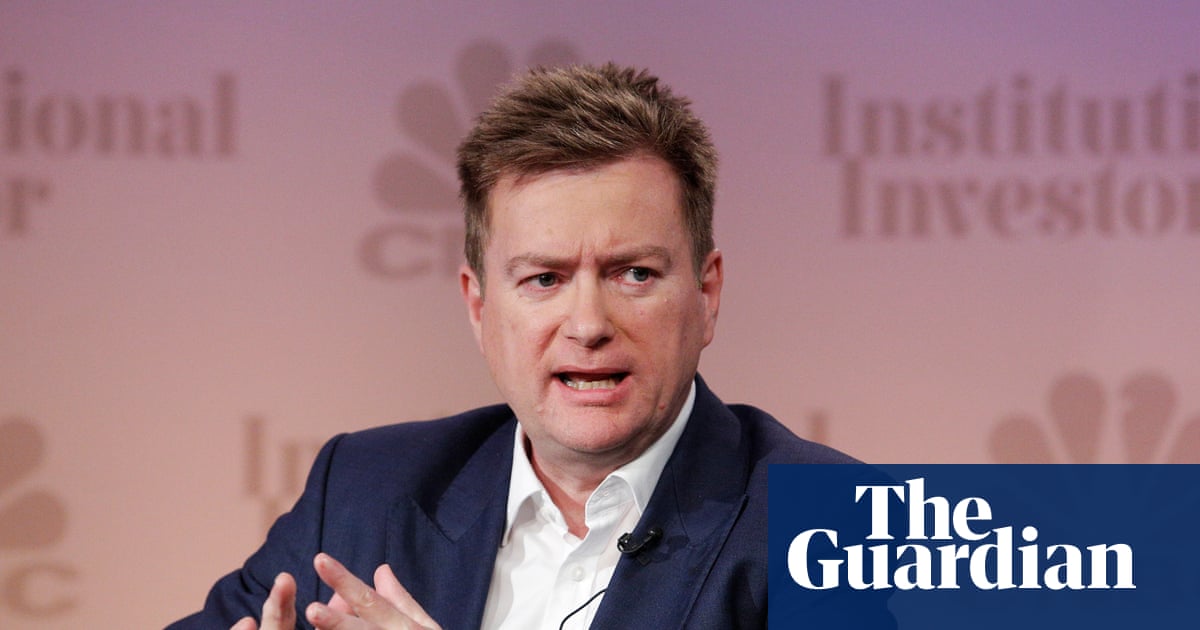
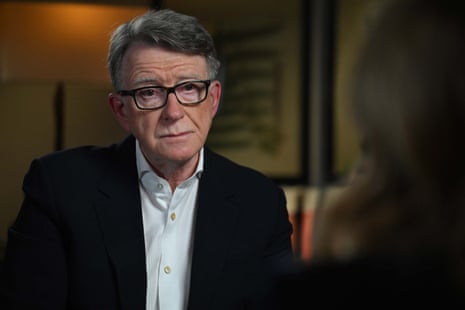
Mandelson says he liked Trump's 'graciousness' and 'directness'
Laura Kuenssberg asks Peter Mandelson if he liked Donald Trump when he was the UK ambassador.
Mandelson says he did like Trump, listing of numerous reasons why, but said he did not like all of his “language”.
I like him, yes, I liked his humour, his graciousness…
I liked his directness. You knew exactly what he was thinking and where you stood and what he wanted. And how he was proposing to engage, with you. Did I like in all his language? No, I didn’t, did I? Did he make me gasp?
Sometimes, in some of the things he said, of course. But at the end of the day, President Trump is an extraordinary risk taker.
And for me, in the world today, given all its conflicts and its dangers and what and how I would define leadership of a country, I attach a lot of importance.
Key events Show key events only Please turn on JavaScript to use this feature
Mandelson declines to apologise for friendship with Epstein: 'I was not culpable'
Asked whether he wanted to apologise for his association with Epstein, Mandelson said: “I want to apologise to those women for a system that refused to hear their voices and did not give them the protection they were entitled to expect.”
Pressed by Laura Kuenssberg on whether he would apologise for his friendship with Epstein after his conviction, Mandelson said:
If I had known, if I was in any way complicit or culpable, of course I would apologise... but I was not culpable, I was not knowledgeable for what he was doing, and I regret, and will regret to my dying day, the fact that powerless women were not given the protection they were entitled to expect.
Asked if he deserved to be sacked, Mandelson said: “I understand why I was sacked.”
Mandelson says continuing friendship with Jeffrey Epstein was 'terrible mistake'
Peter Mandelson was then questioned about his relationship with Jeffrey Epstein, and asked about why he continued to be friends with him after his conviction.
Mandelson replied:
It was a most terrible mistake on my part.
I believed the story he told in 2008 in his first indictment in Florida. I accepted his story and I wish I hadn’t.
I gave my support to somebody because I believed what he was telling me and it was misplaced loyalty.
Mandelson was sacked in September over leaked emails in which he expressed his support for Jeffrey Epstein and urged him to “fight for early release” in 2008 while the disgraced financier was facing charges of soliciting sex from minors. The tranche of emails revealed the pair had maintained contact until 2010.
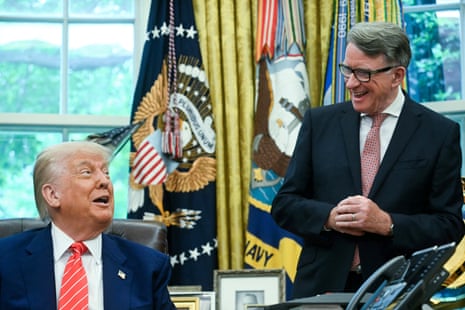
Mandelson says he liked Trump's 'graciousness' and 'directness'
Laura Kuenssberg asks Peter Mandelson if he liked Donald Trump when he was the UK ambassador.
Mandelson says he did like Trump, listing of numerous reasons why, but said he did not like all of his “language”.
I like him, yes, I liked his humour, his graciousness…
I liked his directness. You knew exactly what he was thinking and where you stood and what he wanted. And how he was proposing to engage, with you. Did I like in all his language? No, I didn’t, did I? Did he make me gasp?
Sometimes, in some of the things he said, of course. But at the end of the day, President Trump is an extraordinary risk taker.
And for me, in the world today, given all its conflicts and its dangers and what and how I would define leadership of a country, I attach a lot of importance.
The US won't take Greenland by military force, Mandelson says
Peter Mandelson has given his first broadcast interview since being sacked as Britain’s ambassador to Washington last year after disclosures were made about the extent of his friendship with Jeffrey Epstein. He has been asked by the BBC about Donald Trump’s threats to Greenland – specifically the ones in which he said the US will take the largely autonomous Arctic territory “the easy way” or “the hard way”, citing Washington’s need for it for national security.
Mandelson said he believes the US is not going to occupy Greenland or launch a military invasion, saying Trump is not a “fool”. He said:
What’s going to happen is there’s going to be, another discussion, a lot of consultation and a lot of negotiation.
At the end of the day, we are all going to have to wake up to the reality that the Arctic needs securing against China and Russia.
And if you ask me who is going to lead in that effort to secure we all know, don’t we, that it’s going to be the United States.
Kemi Badenoch has said her party would introduce age limits to curb social media use among under-16s (see opening post for more details).
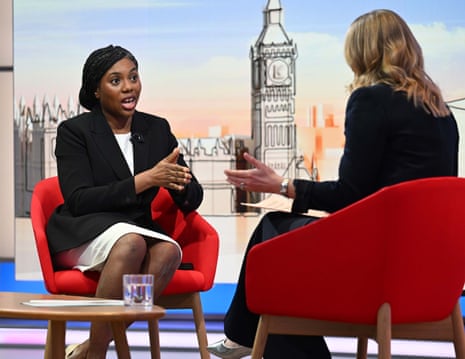
She told the BBC’s Sunday with Laura Kuenssberg programme:
What we are seeing is a lot of children spending so many hours a day on platforms that are profiting from their anxiety, from their distraction, and they are actually designed to be addictive.
So what we want to see is common sense, protection for children and freedom for adults.
We want to give parents some understanding that the government understands what they’re going through. So we want to bring in age limits.
The internet is a wild west, social media in particular. We don’t think children should be on there, and we want the industry to see the direction of travel so that we can start working with them now in order to get the proper solutions in place.
Demonstrators have continued to take to the streets of Iran, defying an escalating crackdown by authorities against the growing protest movement.
Earlier this week, the prime minister, Keir Starmer, condemned the killing of protesters in the country and urged Tehran to “exercise restraint”
Donald Trump has repeatedly threatened to intervene in recent days, warning Iranian leaders against using force against demonstrators. On Saturday, Trump said the US stands “ready to help”.
The flow of information from Iran has been hampered after the country’s leaders last week shut down access to the internet and international telephone calls in response to the protests.
A US-based rights group, HRANA, said the death toll had increases to 116, mostly protesters but including 37 members of the security forces.
When asked about intervention by the BBC this morning, Badenoch said she would not have an issue with it, but any action – speaking hypothetically – would need a broad coalition of countries to ensure a stable Iran was created.
Greenland is a 'second order issue' versus what is happening 'right now', Badenoch says
Kemi Badenoch says what she is worried about most pressingly is the existence of Nato and keeping the US “on side”. She said talking about deploying troops to settle a dispute between the alliance’s members is premature.
The Conservative party leader said Greenland is “a second order issue versus what is happening right now”, seeming to refer to the protests in Iran (she said she does not have an issue with “removing a regime” that is trying to “harm” the UK)
Badenoch said:
Of course, we need to make sure that we secure Nato countries, and we stand with Greenland. We stand with Denmark. But right now, talking about troops as if we are going to war with the US. I don’t want your viewers to be confused about what it is that the priority is. The priority right now is the British national interest. What are we doing to make our country safer? Making sure the nation is strong.
When pressed about what she meant by Greenland being a “second order” issue, Badenoch said the talk about the US invading Greenland is hypothetical, adding that she does not want to escalate the situation.
Badenoch says she was 'completely shocked' by Trump's comments on Greenland
Badenoch is asked about reports that the UK might respond to the US threat of taking over Greenland by promising some of its own troops to the largely autonomous Arctic territory. The Conservative party leader is asked if she would support such a decision.
Badenoch says she was “completely shocked” by Donald Trump’s comments on Greenland, but refuses to be drawn on any details, saying she does not deal in hypotheticals.
The Trump administration has said repeatedly that the US needs to gain control of Greenland, a mineral-rich, largely self-governing part of Denmark with foreign and security policy run from Copenhagen. The White House has said using the US military is “always an option”.
Badenoch said it is right to support Nato countries but questioned what exactly the threat in question was. She said:
What I’m not going to do is give a blank check. What is the reason why we are sending troops to Greenland? Is that for defence? Is that to make sure that we are being more serious? Nato spending has been well below what it should be across the countries. So it’s all about the specifics.
What I’m not going to do is have an operational conversation when I don’t have the level of security briefings and detail which the prime minister has. What I am doing is setting out a broader strategy about what kind of country we need to be.
The world is changing the rules based order is quite clearly breaking down. How are we strengthening ourselves? What I’m not going to do is pretend to be a military general and, give operational details about where exactly we would send troops. That is not my job.
Conservative party leader Kemi Badenoch is speaking to Laura Kuenssberg now on the BBC in what is the second of the new year interviews with party leaders (Keir Starmer was first up last week).
The Conservative party has been leaking members and elected officials to Reform UK, which polling suggests has a broad voter coalition that stretches from struggling workers and frustrated graduates to wealthy retirees.
Tory leader Kemi Badenoch has been praised by commentators for her recent PMQ performances but her appeal to voters still appears to be limited.
However, Badenoch would have been happy with the latest YouGov poll putting her party ahead of Labour for the first time since the 2024 general election. The poll had the Tories on 19% and Labour on 17% – both behind Reform UK, which had 26%.
Ban social media for under-16s, top teaching union urges UK government
Geraldine McKelvie
Geraldine McKelvie is a senior correspondent at the Guardian
One of the UK’s biggest teaching unions has called on the government to ban social media for under-16s over concerns about mental health and concentration.
The Teachers’ Union (NASUWT) wants legislation to be tightened so big tech firms would face penalties for allowing children to access their platforms.
The online safety debate was thrust back into the spotlight this month when it emerged Elon Musk’s Grok AI tool was digitally removing the clothing of women and children.
A pioneering social media ban for under-16s came into force in Australia last month, but its effectiveness has yet to be established.
NASUWT said there was increasing evidence that unregulated access to social media was detrimental to children, affecting behaviour in school and harming mental health. It also said children were being harmed by exposure to violent and sexually explicit content.
The union’s general secretary, Matt Wrack, said:
Teachers are dealing every day with the fallout of a social media landscape not originally designed and not suitable for children. Social media companies have shown time and again that they will not act responsibly unless they are forced to do so.
If we are serious about safeguarding children, protecting their mental health and combating the behaviour crisis in our schools, then a statutory ban for under-16s must happen urgently.
You can read the full story here:
Conservatives would ban under-16s from social media if in power
Good morning and welcome to our live coverage of UK politics. The Conservatives have announced they would ban under-16s from accessing social media platforms if they were in government, amid growing concerns about young people’s mental health, ability to concentrate and their easy access to harmful content online.
The Conservative party leader, Kemi Badenoch, also said phones would be banned in schools if the Tories came into power, arguing the move would help protect children’s mental health and education.
The party, which is heavily trailing in the polls, wants social media companies, including the hugely popular TikTok, and Snapchat, to use age verification checks to prevent under-16s from using their sites.
It comes as the NASUWT teachers’ union calls on the government to ban social media for under-16s to improve concentration at school and stem damage to mental health.
Australia’s world-first social media ban for children under the age of 16 came into effect last month. Under-16s there cannot use major social media platforms, including TikTok, Facebook, Instagram, YouTube and Snapchat, and have had their existing profiles deactivated and can’t set up new accounts.
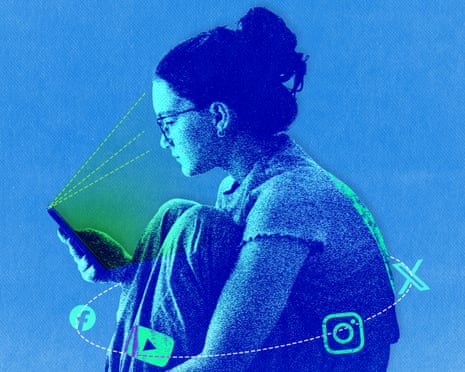
Several other countries are considering social media bans for under-15s after Australia’s ban including Denmark, whose government hopes to introduce a ban in 2026, Norway, and France, who reportedly intends to ban social media platforms for children from the start of the 2026 academic year.
The UK Labour party has not entirely opposed the idea, saying “nothing is off the table” but has cautioned that any ban must be “based on robust evidence”.
Kemi Badenoch will likely be grilled on the details of the proposed under-16s social media ban when she appears on the BBC’s Laura Kuenssberg Sunday Politics programme shortly. We will bring you what is said then so stick with us.