3 months ago
130
3 months ago
130
The Peter Mandelson security vetting scandal is the biggest crisis for the diplomatic service in decades, a former Foreign Office chief has said.
Sir Simon McDonald, who was the permanent under-secretary of the government department until 2020, has spoken out in defence of Sir Oliver Robbins, saying the civil servant was “thrown under a bus” by the prime minister, Keir Starmer, when he was dismissed from his role on Thursday.
Robbins was sacked hours after the Guardian revealed that Peter Mandelson failed his security vetting in January 2025, during the process to appoint him as ambassador the US.
Robbins is said to have known about Mandelson’s failure to pass the UK Security Vetting (UKSV) assessment, but that he did not forward that information on to ministers. Starmer claims he was not made aware of the outcome of the vetting process until this week.
Robbins is reportedly angry at what he considers to be unfair treatment by the prime minister and is said to believe that he was following due process. McDonald agreed with this assessment and answered “yes” when asked by the BBC’s Today programme if Robbins was “thrown under a bus”.
He said: “Yes, this story broke on Thursday morning in a piece in the Guardian, within the news cycle Olly Robbins had been required to resign.”
McDonald said this shows that “No 10 required a scalp and wanted it quickly,” adding: “I cannot see that there was any process, any fairness, any giving him the chance to set out his case and that feels, to me, wrong.”
“I think this is the biggest crisis in the diplomatic service since I joined it in 1982,” he added.
Robbins is expected to give his side of the story early next week, with the Commons foreign affairs select committee inviting him to give evidence on Tuesday. Ministers are concerned he will use his public appearance before MPs to hit back at No 10’s version of events, which could be damaging for Starmer.
McDonald suggested the government had misrepresented what happened during the vetting process in order to shift blame and that the decision to appoint Mandelson despite concerns raised by the civil service was made by the prime minister.
He said: “The whole posting was controversial. By the time Olly Robbins became permanent secretary in the Foreign Office, the posting had been announced, it was clear that the prime minister wanted his man to go to Washington, and the system was making that happen.”
The Guardian understands from multiple sources the conclusion of the vetting process amounted to a failure, rather than a lower category approval “with risk management”, and was marked as such on an official document.
On Friday the Cabinet Office released a template page from the summary document produced by UKSV after Mandelson’s vetting. The document would be used by a vetting officer to summarise their findings.
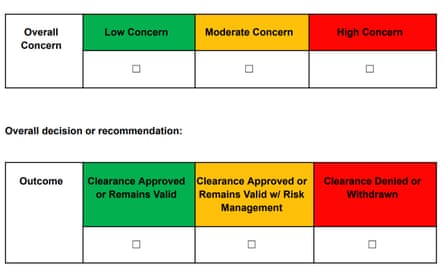
It lists three rankings for possible “overall concern”: low, medium and high. In the next box, there is a space for a vetting officer to list the outcome of the assessment with their “overall decision or recommendation”. Again, there are three options: clearance approved, clearance approved “with risk management” or clearance denied.
According to multiple sources, the UKSV vetting process in Mandelson’s case concluded there was a “high” overall concern and concluded “clearance denied”. It was this recommendation that was overruled by the Foreign Office, which employed a rarely used authority to grant him clearance anyway.
Of the process, McDonald said: “If it [the vetting process] did amount to failure then that fact, that ultimate conclusion would have to be conveyed to the political level, but the fact that it was not indicates to me that the fact was rather more complicated than No 10 would wish to present.”
The prime minister said earlier this week he was “furious” about what had happened, while Downing Street squarely blamed the Foreign Office, with Starmer’s official spokesperson saying No 10 had “repeatedly” sought the facts of the case without being told.
Asked if this amounted to a “cover-up”, they did not reject this, saying: “Well, the prime minister was not informed and he’s made clear that it is staggering that he was not informed.”
The Guardian revealed on Friday that Starmer was also kept in the dark about information relating to Mandelson’s security vetting failure by two other top civil servants. The cabinet secretary, Antonia Romeo, and Catherine Little, the Cabinet Office’s permanent secretary, became aware of the situation last month but did not immediately pass on that information to the prime minister.