3 months ago
147
3 months ago
147
Trumps says Iran war is 'close to over'
The Sky News interview is one of several Donald Trump has given in the past 24 hours, in which he has indicated the war with Iran may be nearing an end.
When asked by Sky whether a deal could happen before King Charles visits the US at the end of the month, Trump said: “It’s possible. Very possible. They’re beaten up pretty bad.”
In an interview with Fox News, which is scheduled to air later this morning, the US president said the Iran war was “close to over, yeah, I mean I view it as very close to over”. In a short preview of the interview posted on social media last night, Trump said: “If I pulled up stakes right now, it would take them [Iran] 20 years to rebuild that country. And we’re not finished.
“We’ll see what happens. I think they want to make a deal very badly.”
The clip came hours after he told the New York Post that another round of peace talks “could be happening over the next two days” in Pakistan.
Trump has previously suggested that the war was ending. In his address to the nation on 1 April, Trump said the war was “nearing completion” and could end in “two or three weeks”.
Key events Show key events only Please turn on JavaScript to use this feature
Iran president says Tehran is 'seeking dialogue, not war'
The Iranian president, Masoud Pezeshkian, said his country is not seeking war but dialogue, as he warned any attempt by the US to impose its will or force Tehran to surrender “is doomed to failure”.
In comments carried by the official Islamic Republic News Agency (IRNA), he said:
Iran is not seeking war or instability and has always emphasised dialogue and constructive engagement with various countries. However, any attempt to impose one’s will or force the country to surrender is doomed to failure, and the Iranian nation will never accept such an approach.
China said it welcomes “all efforts conducive to a ceasefire and the cessation of hostilities” following reports that a second round of negotiations could take place in Pakistan.
Speaking at a press briefing today, the Chinese foreign ministry spokesperson, Guo Jiakun, praised Pakistan for its “role in facilitating a temporary ceasefire between the US and Iran and playing a fair and balanced mediating role”.
Russia’s foreign minister, Sergei Lavrov, said Iran has an “inalienable right” to enrich uranium for civilian purposes.
Whether Iran, in its negotiations with the US, chooses to “pause or insist on reserving this right”, Russia will “support any approach based on the principle of the universality of the right to enrichment”, Lavrov said at a press conference after an official visit to China, according to the Russian state-owned Tass news agency.

The Israeli military has issued another order forcing people to flee their homes south of the Zahrani river in southern Lebanon.
“The airstrikes are ongoing as the Israel Defense Forces operate with significant force in the area,” said Avichay Adraee, the Israeli military’s Arabic language spokesperson.
The UN said Israel has issued warnings and displacement orders covering approximately 14% of Lebanon, including the whole region south of the Zahrani river, most of Beirut’s southern suburbs and parts of the Bekaa region. They affect more than 100 towns and villages and have caused the displacement of more than a million people.
The Israeli military has continued its strikes on southern Lebanon, while Hezbollah said it launched rockets at several areas in northern Israel.
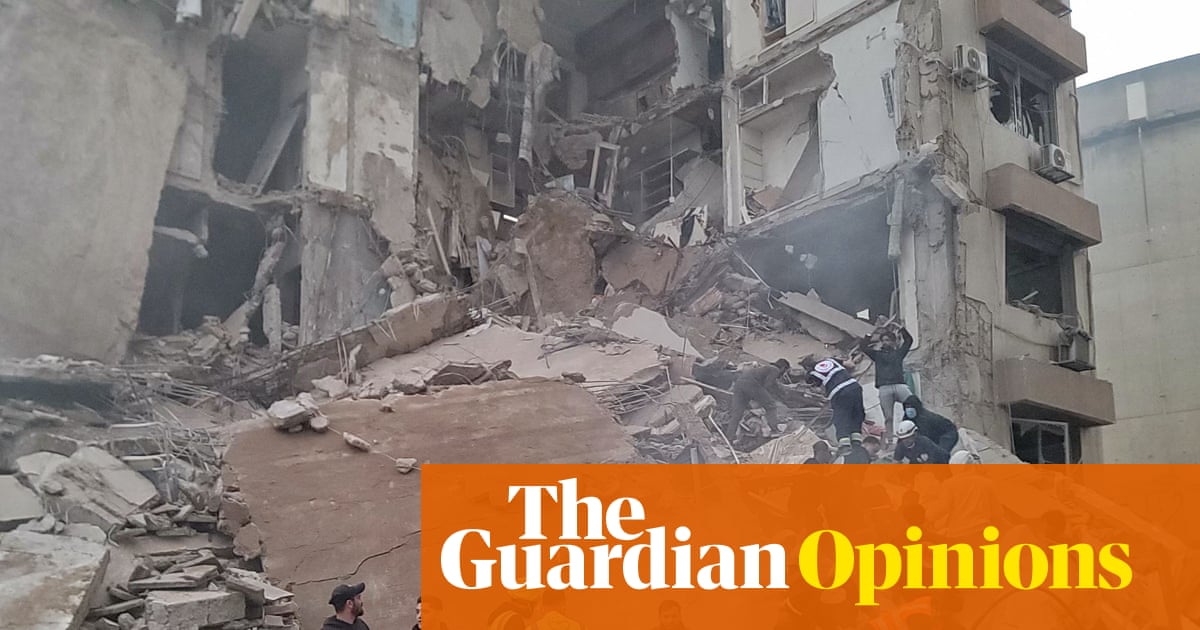
Lebanon’s official National News Agency reported five people were killed in an Israeli airstrike that hit the southern Lebanese town of Ansariyah, while civil defence teams and paramedics recovered four bodies after an Israeli raid in the Qadmus area.
The news agency also reported two people were killed in drone strikes on two vehicles on the Tyre-Beirut coastal highway, near the towns of Saadiyat and Jiyeh south of the Lebanese capital. The strikes were reportedly the closest to Beirut in a week, after a series of Israel attacks on the Lebanese capital on 8 April killed more than 350 people.
There was no immediate comment from the Israeli military.

Meanwhile, the Iran-backed Hezbollah group said it targeted several areas in northern Israel with rocket barrages this morning, including Metula, Kfar Giladi and Kiryat Shmona, according to reports by the Hezbollah-owned al-Manar TV.
The attacks come hours after Lebanon and Israel’s ambassadors to the US held their first direct talks in decades in Washington. They agreed to hold further direct negotiations, although Hezbollah has strongly rejected the talks.
Trumps says Iran war is 'close to over'
The Sky News interview is one of several Donald Trump has given in the past 24 hours, in which he has indicated the war with Iran may be nearing an end.
When asked by Sky whether a deal could happen before King Charles visits the US at the end of the month, Trump said: “It’s possible. Very possible. They’re beaten up pretty bad.”
In an interview with Fox News, which is scheduled to air later this morning, the US president said the Iran war was “close to over, yeah, I mean I view it as very close to over”. In a short preview of the interview posted on social media last night, Trump said: “If I pulled up stakes right now, it would take them [Iran] 20 years to rebuild that country. And we’re not finished.
“We’ll see what happens. I think they want to make a deal very badly.”
The clip came hours after he told the New York Post that another round of peace talks “could be happening over the next two days” in Pakistan.
Trump has previously suggested that the war was ending. In his address to the nation on 1 April, Trump said the war was “nearing completion” and could end in “two or three weeks”.
Trump warns UK trade deal could 'always be changed'
Donald Trump said he had given the UK a “good trade deal” and warned that the deal could “always be changed”.
When asked by Sky News for his thoughts on the special relationship, Trump replied: “With who?”
After Sky clarified it meant with the UK, the US president replied: “It’s the relationship where: when we asked them for help, they were not there. When we needed them, they were not there. When we didn’t need them, they were not there. And they still aren’t there.”
He added: “It’s been better, but it’s sad. And we gave them a good trade deal, better than I had to, which can always be changed.”
Trump says strained US-UK relationship will not overshadow royal visit
Donald Trump said the “special relationship” between the US and UK was in a poor state but that it will not have impact on King Charle’s upcoming state visit to America.
In an interview with Sky News, the US president once again criticised Keir Starmer over his policies, particularly on energy and immigration, and reiterated his disappointment that the UK and other Nato allies had not joined his war against Iran when the US “needed them”.
Despite fraught relations between the UK and US, King Charles will go ahead with a four-day trip to America later this month, Buckingham Palace confirmed.
Speaking hours after Buckingham Palace released details of the king’s US itinerary, Trump described Charles as a “great gentleman”.
“I’ve known him for a long time. He’s wonderful, wonderful person,” he said.
Trump insisted his strained relationship with Starmer would “not at all” overshadow the royal visit.
On the UK prime minister, Trump said Starmer had made a “tragic mistake in closing the North Sea oil”, as well as “a tragic mistake on immigration”.
The head of the International Atomic Energy Agency (IAEA) said any US-Iran agreement to end the war must include “very detailed” measures to verify Tehran’s nuclear activities.
“Iran has a very ambitious, wide nuclear programme so all of that will require the presence of IAEA inspectors,” said director general Rafael Grossi.
“Otherwise, you will not have an agreement. You will have an illusion of an agreement.”
He added that any agreement on nuclear technology “requires very detailed verification mechanisms”.
Iran has not allowed the IAEA access to its nuclear facilities bombed by Israel and the US during a 12-day war in June, according to a confidential IAEA report circulated to member states and seen by the Associated Press.
The report stressed that it “cannot verify whether Iran has suspended all enrichment-related activities” or the “size of Iran’s uranium stockpile at the affected nuclear facilities”.
Iran has long maintained that its nuclear programme is for peaceful purposes and has demanded recognition of its sovereign right to enrich uranium.
Trump continues feud with Pope Leo in Truth Social post
Donald Trump has doubled down on his criticism of Pope Leo over the war in Iran, despite earlier attacks drawing swift criticism from Catholics and the international community.
In a Truth Social post, he said:
Will someone please tell Pope Leo that Iran has killed at least 42,000 innocent, completely unarmed, protesters in the last two months, and that for Iran to have a Nuclear Bomb is absolutely unacceptable. Thank you for your attention to this matter. AMERICA IS BACK!!!
He also took aim at Nato in a separate post, writing: “NATO wasn’t there for us, and they won’t be there for us in the future!”
Trump said he would not apologise for earlier attacks on Pope Leo, whom he called weak on crime and “terrible for foreign policy” in a lengthy social media post on Sunday. He did, however, delete a post of an AI image depicting himself as a Jesus-like figure.
Giorgia Meloni, Italy’s prime minister, described Trump’s criticism of the pope as “unacceptable”.
South Korea has secured supplies of more than 270m barrels of crude oil via routes unaffected by the US blockade of the strait of Hormuz, a senior official has said.
“I hereby report to the nation that visits to four countries have secured the import of 273m barrels of crude oil by the end of this year,” Kang Hoon-sik, chief of staff to the president, said.
The amount is sufficient for more than three months of South Korea’s oil needs, Kang said after he returned from a trip to Kazakhstan, Oman, Saudi Arabia and Qatar.
Pakistani prime minister Shehbaz Sharif will depart for an official visit to Saudi Arabia on Wednesday, his office said, as Islamabad continues feverish rounds of diplomacy aimed at facilitating US-Iran peace talks.
Prime minister Muhammad Shehbaz Sharif will depart from Islamabad for Jeddah today on an official visit to Saudi Arabia, accompanied by a high-level delegation.”
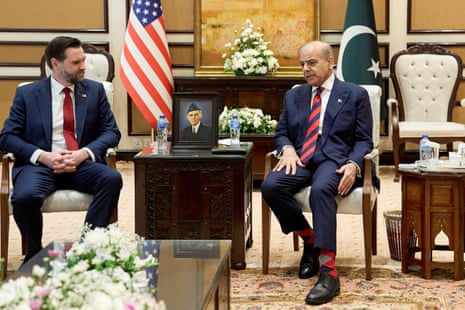
Saudi Arabia is one of Washington’s regional allies to have come under attack from Iran since the outbreak of the war in February. Islamabad’s finance ministry announced on Wednesday that Saudi Arabia would provide Pakistan with $3bn to help bolster the country’s foreign reserves.
Sharif will also travel to Qatar and Turkey.
In Turkey, Sharif is expected to participate in the fifth Antalya Diplomacy Forum and hold meetings with Turkish president Recep Tayyip Erdoğan and other world leaders.
Are non-Iranian vessels transiting through the strait of Hormuz?
America’s blockade of Iranian ports is designed to choke off Iran’s oil revenues and force the regime back to the negotiating table – but it could have the added effect of removing almost two millions barrels of oil a day from the world market, further tightening global supply.
Data shows that Iran exported an average of 1.84m barrels per day in March, despite the ongoing war. But exports from Gulf countries that rely on the strait of Hormuz to get their oil to market have been severely curtailed by Iran’s defacto blockade of the strait since early March.
The US military appears to be seeking to establish secure passage for non-Iranian ships in order to restart the flow of oil through the strait – and White House officials have briefed some US media that more than 20 vessels not linked to Iran have transited through the waterway since the blockade began.
But experts and analysts who track shipping movements have questioned the accuracy of those claims.
Maritime data company Kpler said “traffic through the Strait of Hormuz remains well below typical levels” and noted just six vessels crossed through the strait on Monday, when the blockade began.
Salvatore Mercogliano, a maritime historian and an associate professor at Campbell University in North Carolina, said “the Trump Administration talks a lot about ships coming through the Strait but there is no indication yet.”
Kpler has said confidence among shipowners remains weak, with uncertainty weighing on “transit decisions.”
For now, the operating environment remains high risk, limiting any meaningful recovery in flows.”
Experts have said that despite the presence of the US navy, many shipping companies will be wary of entering or leaving the strait out of fear of attacks from Iran. German shipping giant Hapag-Lloyd has said it will not resume transiting the strait for now as the situation remains tense.
At a Turning Points USA event in Georgia on Tuesday, US vice-president JD Vance faced heckles from an audience member – who appeared to be criticising the Trump administration for its stance on Gaza.
JD Vance has said Iran will “thrive” if it commits to not having a nuclear weapon. Speaking at a Turning Point USA event in Georgia, the US vice-president said Donald Trump “doesn’t want to make, like, a small deal. He wants to make the grand bargain.”
We’re going to make it economically prosperous, and we’re going to invite the Iranian people into the world economy in a way they haven’t been in my entire life.”
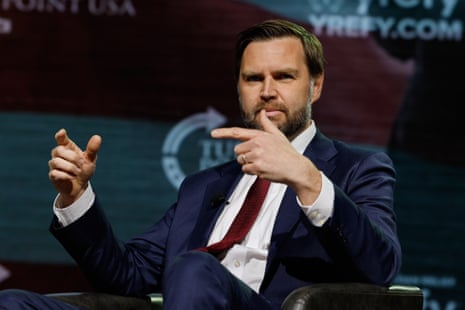
Vance – who took part in weekend negotiations with Iran in Pakistan - said there was a lot of mistrust between Washington and Tehran that cannot be resolved overnight, but that Iranian negotiators wanted to make a deal and that he felt “very good about where we are.”
Talks to end the Iran war could resume in Pakistan over the next two days, Trump said on Tuesday, after the collapse of weekend negotiations prompted Washington to impose a blockade on Iranian ports. The fragile two-week ceasefire between the US and Iran still has a week to run.
Trump: 'I think you’re going to be watching an amazing two days ahead'
Donald Trump has made further hints that talks with Iran could resume in Pakistan, telling an ABC reporter that he did not think it would be necessary to extend the two-week ceasefire that ends on 21 April.
“I think you’re going to be watching an amazing two days ahead,” Trump told reporter Jonathan Karl.
It could end either way, but I think a deal is preferable because then they can rebuild …They really do have a different regime now. No matter what, we took out the radicals.”
The signs of diplomatic engagement helped calm oil markets, pressing benchmark prices down for a second day on Wednesday. Asian stocks rose while the safe-haven dollar stabilised after falling for a seventh straight session overnight.
Summary
Welcome to the Guardian’s continuing coverage of the crisis in the Middle East.
The US military has said American forces have completely halted economic trade going in and out of Iran by sea through a blockade.
After talks between the US and Iran in Pakistan ended without a breakthrough, Donald Trump declared a naval blockade on ships using Iranian ports in the Gulf in an effort to increase pressure on the country’s economy, and as a counter to Iran’s near-total closure of the strait of Hormuz to ships using other Gulf ports.
The blockade has created further uncertainty for shippers, oil companies and war risk insurers.
On Wednesday morning, US central command (Centcom) said US forces had “achieved maritime superiority in the Middle East”.
An estimated 90% of Iran’s economy is fueled by international trade by sea. In less than 36 hours since the blockade was implemented, U.S. forces have completely halted economic trade going into and out of Iran by sea.”
-
Donald Trump has said that talks with Iran could resume in Pakistan over the next two days, according to an interview with the New York Post. “Something could be happening over the next two days, and we’re more inclined to go there,” Trump was quoted as saying.
-
US secretary of state Marco Rubio said Israel-Lebanon talks in Washington on Tuesday were a “historic opportunity”. He said that while every complexity would not be resolved immediately, he hoped the parties would begin to move forward.
-
Lebanon’s president expressed hope that direct talks would lead to an end to his country’s “suffering” after war erupted again between Israel and Hezbollah last month. “I hope that the meeting in Washington... will mark the beginning of the end of the suffering of the Lebanese people in general, and those in the south in particular,” president Joseph Aoun said in a statement, adding that “stability will not return to the south if Israel continues to occupy its lands”.
-
Lebanon’s top envoy to the US said the high-level diplomatic engagement between her country and Israel was “constructive,” but urged an end to the ongoing conflict between Israel and Iran-backed Hezbollah militants that has displaced thousands of Lebanese. After participating in Tuesday’s talks with Rubio and Israel’s ambassador to the US, Nada Hamadeh Moawad said she had “underscored the need to preserve our territorial integrity and state sovereignty”.
-
The US will not renew a 30-day waiver of sanctions on Iranian oil at sea that expires this week officials told Reuters, as the US imposes a blockade on shipments from Iranian ports.
-
UK prime minister Keir Starmer and French president Emmanuel Macron will co-host a summit in Paris on Friday focused on efforts to reopen the strait of Hormuz, Downing Street said. A spokesperson said: “The summit will advance work towards a coordinated, independent, multinational plan to safeguard international shipping once the conflict ends.”
-
Trump criticised Italian prime minister Giorgia Meloni, a political ally, in an interview published on Tuesday for her unwillingness to help in the Iran war. “I’m shocked at her. I thought she had courage, but I was wrong,” he told Italian daily Corriere della Sera.
-
Foreign ministers from Saudi Arabia, Pakistan and Egypt will meet Turkey’s top diplomat this week for talks on regional matters, a ministry source told AFP on Tuesday. “This is the third meeting of the four countries to discuss regional affairs, not specifically Hormuz,” said the source, who wished to remain anonymous.
-
Hezbollah said it targeted 13 northern Israeli towns with rockets shortly after the start of Lebanese-Israeli talks in Washington. In a statement, the group said it targeted Kiryat Shmona, Metula and 11 other towns “with simultaneous rocket salvos” at 6.15pm.
-
US treasury secretary Scott Bessent has said the underlying US economy remains strong and that growth could still exceed 3% or 3.5% this year despite the impact of the US-Israel war on Iran. Earlier on Tuesday, the International Monetary Fund (IMF) cut its growth forecasts for 2026 based on the impact of the war and said any further escalation in the conflict could trigger a global recession. Bessent however cast cuts in global growth forecasts and higher inflation projections by the IMF and World Bank as an overreaction.