3 months ago
111
3 months ago
111
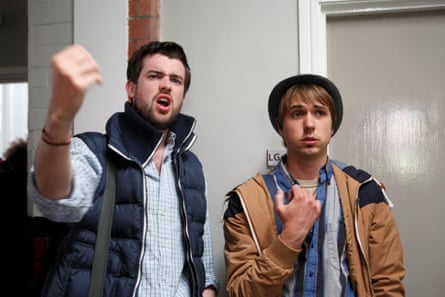
The day I meet Jack Whitehall in central London, it has just been announced that he will be hosting Saturday Night Live (SNL) this Saturday. He is also about to get married and his stag do, which was two days before our interview, has been meticulously documented by the tabloids. It feels like a lot, so his immaculate appearance – even his beard looks polished; you wouldn’t believe this man had ever been fall-over drunk – is baffling. He is 37, but doesn’t look markedly different from the baby-faced man of 23 who appeared on our screens in Jesse Armstrong’s and Sam Bain’s stinging student satire Fresh Meat. That series sealed his place as the country’s posh mascot on panel shows including Would I Lie to You?, Mock the Week, Never Mind the Buzzcocks and 8 Out of 10 Cats.
His last comedy tour ended in 2024 and the wait for his next, at the start of 2027, is his longest hiatus yet. “After every tour, I hate the sound of my own voice,” he says. From 2017 to 2024, “I did tours back to back. I’d run out of life experience. I’d talked about every fucking thing that had ever happened to me, I’d done every possible iteration of joke about my dad. In the interim three or four years, I’ve got engaged, I’m planning a wedding, I’ll have had some time in married life, I’ve had a daughter, I’m now the father of a toddler. It felt as if I had stuff to talk about again.”
It must be hard to write jokes from real life, I say, when your life is so unusually, well, Instagrammable. “The one advantage I have is that I’ve never been relatable. I was never doing everyman comedy. I always had a slightly ridiculous life that needed to be approached through a certain lens and undermined in a certain way. I think that has probably served me quite well.” But, he says: “Now, you have to undermine your class privilege, your innate gender privilege, your race privilege and your fame privilege. That’s a lot of privileges. That’s probably the first 20 minutes.”
The choice of Whitehall to host SNL is a bit of a puzzle, politically. It’s a satirical show and the era when posh people could run everything, including satire, is long gone – torched, like so many things, by Boris Johnson.
When I put this to Whitehall, it is the only time in the interview that he is evasive. He answers every other question straight, or swerves as effortlessly as a swallow. “Well, it won’t be my satirical voice. They have an amazing group of writers, the best and sharpest minds in British comedy.” But they went to him for a reason? “Maybe they think I’ll make a good Prince Harry?” (I mean, yes, obviously.)
“I don’t do a lot of politics, because I don’t think people are interested in the political viewpoint of a public schoolboy. I’d never feel comfortable doing polemic. I think people are exhausted by it. They’ve had 20 years of a Tory government, they do not want a Tory comedian … not that I’m a Tory. I’m definitely not. But the perception of me is that I have a Tory …” He trails off. “Bloodline?” I suggest. “Background,” he says, firmly.
In his onstage self, Whitehall is mortified by class. In his early career, he had tried to “create a new persona that was no part of me at all”. He went to the University of Manchester, but dropped out; he had attempted to fit in by “pretending I wasn’t an unbearable toff”. “My act is embarrassed by my background – that’s been the voice of my comedy. Because it cringes me out.”
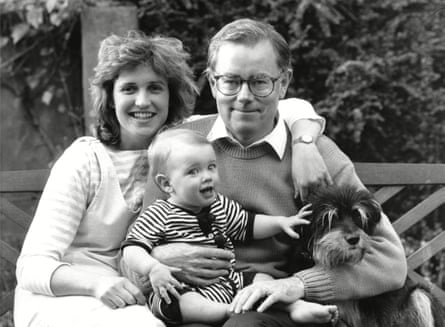
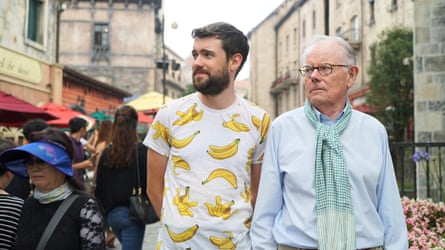
When he started standup – he was nominated for best newcomer at the Edinburgh festival fringe in 2009 – he had already appeared on Big Brother’s Big Mouth and 8 Out of 10 Cats. “Nepo baby” wasn’t a phrase then, but he was certainly connected. His mother is an actor who goes by the stage name Hilary Gish, while his father, Michael Whitehall, is a TV producer. Whitehall’s father has featured throughout his career, in the stories Whitehall tells about him (Whitehall Sr rigged his son’s postal vote for the 2010 general election, the first in which he was eligible to vote, to make sure he would vote Conservative) and in numerous father-son double acts, including the five seasons of the documentary Travels With My Father.
To return to the stag do, it began at the Devonshire, a sceney London pub that reportedly sells 20,000 pints of Guinness a week. Whitehall wore an inflatable crown and guests included James Corden and Jamie Redknapp, but most of the other guys were friends from school (Marlborough College and the fractionally less posh Dragon school). Someone fell over and Corden apparently did some shouting, which I know because it was practically livestreamed in the tabloids. Whitehall suspects there were journalists and photographers in the pub. “I didn’t notice them, because I was quite drunk by that point. They must have had a video camera. The worry is that you have a traitor within the mix [of the friendship group]. We could have done a Traitors game to work out who it was.”
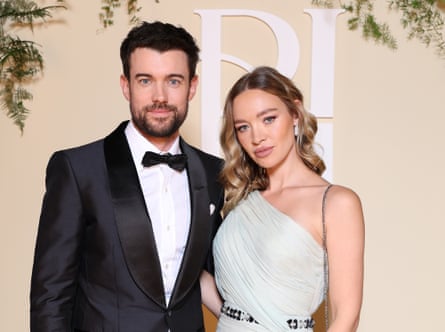
His marriage, likewise, would make a good reality TV format: Snog, Marry, Avoid: The Covid Edition. He and Roxy Horner, a model, had been on three dates in 2020. She lived in Australia, he in London. “I said: ‘Come back to England and we can hang out.’ She flew over and pretty soon after that we went into lockdown. We were suddenly in a sort of house share, with my brother and his partner. It was quite a surreal way to start a relationship. It helped that the government said she couldn’t leave my house. It was a good way to guarantee quality time together.” They emerged, blinking, into 2021, “all the way into this relationship without doing anything normal, meeting the parents, meeting all my friends.” They had their first child, a daughter, in 2023.
When he discovered he was going to have a baby, he was in the middle of writing Settle Down, his tour that ran from 2023 to 2024. He pondered the merits of writing about a baby, who wouldn’t have right of reply for years. “I would, I thought, arrive at some conclusion for the next tour, having thought it through at every ethical level. But I already had a joke in that routine about how Roxy had briefly dated Leonardo DiCaprio. So I ended it with an ultrasound scan on the stage with his face superimposed on it. And I did think: this feels … she hasn’t even been born yet and she’s already a punchline.”
As amazing as it sounds, Horner was fine with that material. When a joke is close to the bone, he will check it with its main characters. “One thing I’ve learned is that it’s definitely worth making sure that the material works before having the awkward conversation, because otherwise it’s a complete waste,” he says.
His other project is the dramedy The ’Burbs, a remake and serialisation of the 1989 Dana Olsen classic starring Tom Hanks and Carrie Fisher. Whitehall and Keke Palmer play newlyweds Rob and Samira Fisher who, although he is English, have moved back with their baby to his childhood home in suburban America and are beset on every side by fishy happenings. There is a dead body in clingfilm in a walk-in freezer and a Victorian house the paintwork of which is the least distressed thing about it. A teenage girl disappeared in Rob’s youth. She was, it turns out, his best friend. Why wasn’t he truthful about their relationship? Why was she never found? Why do all the neighbourhood committee members have the same joyless smile? It’s a caper, a bit like Scooby-Doo.
“We actually called ourselves Scooby and the Gang on set,” he says. “It reminded me of Desperate Housewives as well – it’s quite fun and quite frothy, there are darker things afoot, but it’s not True Detective. This is definitely not in any of the briefing materials that I’ve been given by NBC Universal, but it’s kind of soapy. There’s enough mystery to keep you intrigued, but you don’t feel emotionally exhausted.” I didn’t know actors got briefed on how to describe things. “It’s mainly spoiler notes. But they don’t need to worry about me, because I can’t remember anything that happened.”
Palmer sets the tone and brings the meat in their couple dynamic: Whitehall is a personable, hyper-British nice young man, while Palmer has a mind like a mantrap and boundless vim. He was flown over to Atlanta for 24 hours to do a screen test with her, “which is like going on a date with five people watching to assess whether you have the chemistry to proceed beyond that room”.
The murder mystery is told with so much warmth and affection that you wonder whether or not you mind who did it. The emotional heft is partly in the story it tells about new parenthood. Granted, even that has been given the Hollywood treatment, but Whitehall says: “Lots of the stuff about coming to terms with being new parents and adjusting to the change in your life and only one of you being able to go back to work, that whole sequence about the couple just trying to have a night out … All these scenarios and scenes had played out quite recently in our real lives. Keke had a son about the same age as my daughter.”
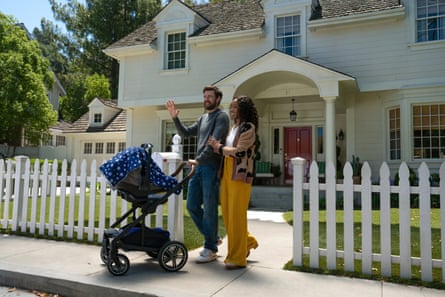
remake. Photograph: NBC Universal/Elizabeth Morris/Peacock
The couple fall in and out of trust through the metaphor of suspected psychopathy. The way resentments turn into catastrophes and the way communication is rebuilt are deftly told. “If I’d read the scripts a year before, I would definitely have thought: this makes a very salient point that I could maybe apply to my real life, but all my mistakes had already been made. Maybe for child two.”
There is overt racism towards Palmer’s character and microaggressions from the cardboard-smile people, with Whitehall’s Englishman-in-suburbia counterweight making the point that “in a very different way, he was an outsider in that community. He can empathise, but never fully understand how she feels, as an outsider. Celeste [Hughey], the showrunner, was really keen not to shy away from it, but at the same time didn’t want it to feel heavy-handed.”
Whitehall arrived in Los Angeles to film The ’Burbs just as it was “lurching from one crisis to another. I was there just at the end of the fires and left just before the ICE raids. It was a weird place to arrive and a weird place to leave; people were very distressed. A lot of people are dissociating because they can’t continue to be that angry and that sad. They’ve almost checked out.”
He sounds less carefree than the Whitehall we are used to – and different from a regular actor talking about a studio dramedy. He is much less guarded and I guess much less worried about the briefing notes. Even to such a gilded life, standup has brought its steel, the knowledge that the sky is not going to fall in if you say what is in your head. Whitehall loves acting, he says, but “standup makes me a better actor, a better improviser, a better host, a better writer. It keeps me sharp.”