2 months ago
126
2 months ago
126
Martin Dohrn likes bees. Big bees, small bees, angry bees, randy bees, bees with voluminous ruffs and calves like tiny Henry VIIIs – rare is the bee that Dohrn doesn’t deem worthy of … what, exactly? Appreciation? Or something more profound?
“It’s hard to explain,” says the veteran wildlife photographer, peering at us through his red-framed glasses while perched at his gadget-strewn kitchen table. “But I really feel for bees. They’re really … I mean, I could say they’re my friends.”
And why not? If My Garden of a Thousand Bees has a theme (other than “bees”), it’s that companionship can thrive in the least likely places. The least likely place in this instance being a small patch of urban Bristol, where the spring and summer of 2020 found Dohrn directing his expertly modified bumble-cams at the 60+ species of bee that frequented his back garden. We meet the wool carder bee, with its bald back and ferocious aerial combat skills; the ashy mining bee, with its exhausted waddle and washed-out pelt, like a bumblebee that’s spent the last four decades grumbling about the ex-missus on a bench outside Ladbrokes; and the red-tailed mason bee, which builds its nest in an empty snail shell before topping it with a hipsterish dried-grass wigwam. I imagine a lightly pyjama’ed Kevin McCloud, watching at home, permitting himself a nod of admiration.
They’re all here, bumbling through the hazy Bristol sunshine while Dohrn, face scrunched up as he watches through his state-of-the-art magnifying lens, says things like “wow”, “yes” and “oh man, will you look at that!”.
Bees live in “a completely different dimension”, he says. Et voilà, a “time-stretching” approach to film-making that results in gasp-inducing detail and a soundtrack pitched somewhere between a bustling heliport and a distant conversation between drunken lawnmowers.
There is something pleasantly bee-like about Dohrn’s award-winning film, too. A leisurely thing, it drifts woozily around the photographer’s garden, picking up facts here and there and storing them like pollen in little pouches on the backs of its thighs. Not too many facts, mind. This is no place for statistics or percentages. The photographer’s narrative bag is an altogether looser affair, with as many shrugs and ellipses as there are firm specifics on, say, the climate crisis: “All over the world, bees are declining” is all we get on the doom-boffin front. Consequently, Dohrn – an affable, wistful sort who wears a range of crumpled action-shorts and calls us “mate” – often appears as awestruck and bewildered by his hairy quarry as we do.
Enter an industrious leafcutter bee called Nicky. Dohrn is smitten. He leans towards her nest, nose filling the screen like a nostrilly Jupiter. They bond. “I could tell she was looking at me. Does she know these are my eyes?” he asks, pointing at his eyes. “Scientists have shown that honeybees can recognise individual people, so why wouldn’t she?”
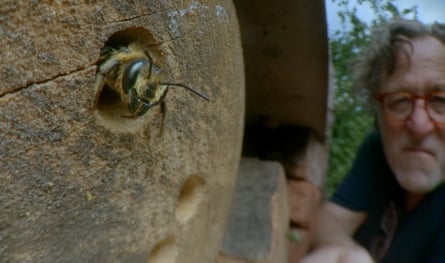
Oh, the unbearable lightness of bee-ing! While we ponder the imponderables, the film-maker shows us around Bee City, the remarkable “multicultural” metropolis he has assembled out of wildflowers and bits of wood in response to his garden’s shortage of be(e)fitting accommodation. Here are the starter homes and perfumed A-roads, along which teenage bees wrestle while the hairy-footed flower bee waddles past obliviously with her shopping. There is the tower block occupied by teeny scissor bees and the capsule hotel from which rows of male mason bees peer, like businessmen assessing the weather.
Here, essentially, is life in microcosm; the subtext, as with all modern wildlife documentaries, being, “Let’s not cock it up entirely, eh?”
Anyway, here comes Nicky again. Poor Nicky. After building four nests in quick succession, the knackered single mum throws in the towel and, in the dying days of summer, simply flies off into the heavens.
“I had no idea I was going to get so involved,” says Dohrn, peering disconsolately into the deserted apartment that was once his friend’s home. He sighs. His lockdown project has, he says, “changed my view of bees”. A wistful smile. “It’s changed my view of the world.”