2 months ago
101
2 months ago
101
Now more than 40 years old, Nan Goldin’s The Ballad of Sexual Dependency records a lost world, but one that feels as present as it did when I first saw these images. A compilation of photographs taken by the artist between 1973 and 1986, the Ballad has been presented as an ever-changing slide show, with various accompanying soundtracks and voiceovers, since the 1980s.
It has also been presented on video, as a film and a book. I’ve been familiar with these images for much of my adult life, watching Robin smoking, with Kenny in the background in the purple room. The smoke still hangs there beneath the mirrorball and Robin’s profile is still astonishing. I have seen Suzanne in tears and, in another shot, looking at her face in the mirror in a tiled bathroom dizzy with slanting reflections.
I have seen these picnics and beach days and the road in the hot light and the man sitting on the edge of the bed, lost in his thoughts. Goldin observes him as she squeezes the shutter (you can’t see this, but you know it is happening). The camera is on a tripod on the far side of the room, and Nan and Brian had been photographing themselves having sex, just as she’d taken pictures of her other friends doing the same. There’s some twitchy sullen feeling in the air you can’t identify. A year later, Brian ended up beating her very badly, consumed by jealousy after reading her diary.
Goldin has called the Ballad the diary she lets people read. Her Nikon camera was always to hand, so much so that people forgot about it (except when they didn’t). In this show, Goldin displays it in the form of 126 framed photographic prints, stacked four high and covering three black walls. They fill the space. The slide show originally presented up to 800 images over 45 minutes in a darkened room, accompanied by a changing soundtrack that often included Maria Callas, Petula Clark, Dionne Warwick and Dean Martin. Goldin thinks of the slideshow as a movie made with stills.
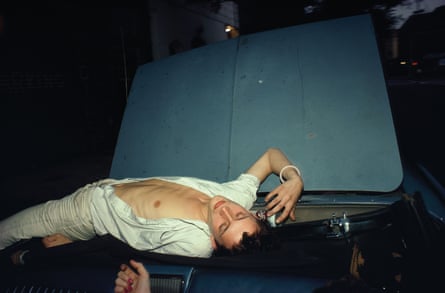
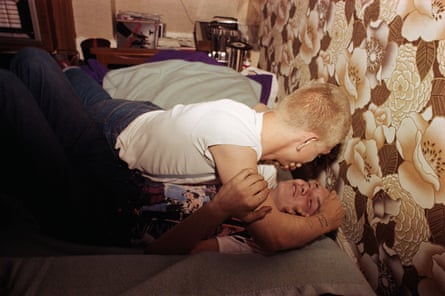
Here you get lost among the prints in a different way. Their effect is cumulative and electrifying. There’s no let-up in these full-on arrays, which send the eye skittering between images, pinballing between captured moments and emotions. We go backwards and forwards in time, catching glimpses of the artist’s parents, and an old Mexican couple who seem happy enough but are a week away from their second divorce. Skinheads hanging out in a room with frightening wallpaper; Bobby masturbating; macho guys and sorrowful guys and a guy dressed as Napoleon on New Year’s Eve; someone called French Chris lying on the bonnet of a convertible, posing, his shirt open wide, like a beautiful corpse.
Among the flashbacks, we encounter an empty bed in a New York brothel, wedding photos, and a cluster of photographs featuring Goldin’s black eye and bruised face, an ectopic pregnancy scar, a heart-shaped bruise. We lurch from these to tender intimacies, people dancing or having sex and lost in the moment, people alone and people coupling and uncoupling. Her titles tantalise with their brevity, just as the pictures always leave you asking: “What’s the story?” This, in part, is what still makes the Ballad so compelling and rewarding. Each photograph, it strikes me, leaves you on a kind of brink.
These are pictures of innocence and experience. We begin with the Duke and Duchess of Windsor, as gruesome in the Coney Island Wax Museum as they undoubtedly were in life, and we end with a pair of skeletons screwing in a doorway, wrapped in a tender graffiti embrace. These first and last images bracket the people who move in and out of Goldin’s orbit, who shared beds and parties and holidays, tenderness and sex and silences and games of Monopoly.
What strikes me now is not how louche and edgy life was for Goldin and her adoptive family of friends, but how normal their lives now seem. They don’t look lost or marginalised at all. We are now used to people posting smartphone images and videos as a kind of constantly updated and often highly self-conscious and calculated mirage of their lives. Back in the 1970s and 80s, Goldin just had a camera, and photographed on the fly. To begin with, she presented her slide shows in nightclubs and bars. Her audience were her peers.
Goldin’s camera sees more than the photographer does. The apparent casualness of her approach is deceptive. The emotional texture and atmosphere of her images proves that not everyone who can hold a phone can take photographs worth looking at. When she was dancing, when she was having sex, when and wherever she was, Goldin homed in.