2 months ago
81
2 months ago
81
The only thing that kept Dr Ahmed Muhanna going during his 22 months inside Israeli prisons and detention centres was dreaming of his return to his family and to Gaza. When he was finally released after 665 days as a prisoner, he arrived home to find every place he had returned to in his memories had been obliterated.
While in prison, he and the other inmates were “completely cut off from the outside world”, he says. When he was released he was driven over the border and through Gaza to his hospital, the al-Awda. The scale of the destruction he saw “made my skin crawl … my chest tightened and my tears began to flow”.
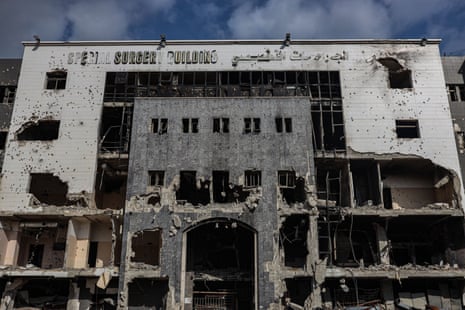
When Muhanna, one of Gaza’s most senior anaesthesiologists and emergency care consultants, was detained by Israeli forces in December 2023, the al-Awda hospital was under siege.
Now, barely three months after his release, despite the ceasefire officially still in place, he says he and his colleagues are facing another onslaught as the devastated healthcare system battles to cope with a wave of disease and preventable deaths.
Muhanna says he returned to a hospital hollowed out of staff, medical equipment and medicine. While in detention, 75 of his colleagues at al-Awda were killed, he says. Since 7 October 2023, 1,200 Palestinian healthcare workers have been killed and 384 detained by Israel’s military, according to the NGO Healthcare Workers Watch.
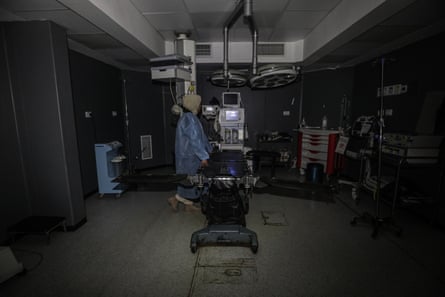
“I feel such pain and sorrow at what we are facing,” Muhanna says.
Despite the ceasefire, 77% of the population, including 100,000 children, still face “high levels of acute food insecurity”, according to the World Health Organization (WHO). Muhanna and his staff continue to treat severely malnourished children who develop complex medical issues as a result.
International human rights organisations, including a UN commission, have concluded that Israel has committed genocide in Gaza, often citing Israel’s blocking of humanitarian aid and systematic destruction of the healthcare system.
“The deliberate military targeting of the healthcare system has been successful not only in destroying the infrastructure but also now depriving the people of medical care and increasing the mortality rates,” Muhanna says.
According to the UN Human Rights Office (OHCHR) 94% of Gaza’s hospitals have been damaged or destroyed, leaving patients, including newborn babies, without essential care. The report confirms that despite the ceasefire, Israel has prevented the entry of medical supplies and nutrients “indispensable to the survival of civilians”. Muhanna says this leads to preventable deaths.
Now, the situation is deteriorating further, after Israel announced it will revoke the licences of 37 international non-governmental organisations (INGOs) working in Gaza and the occupied West Bank, saying they failed to meet requirements under new registration rules. These include medical aid organisations such as Médicins Sans Frontières (MSF).
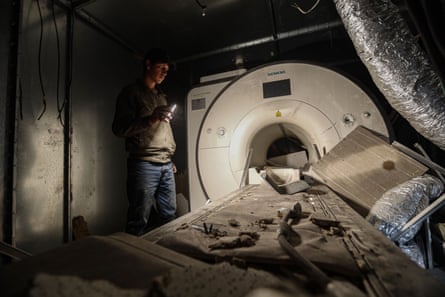
“Today, there is not a single, functional MRI machine in Gaza. There is only one CT scanner,” says Muhanna, making it difficult for doctors, who rely on these critical machines, to make informed decisions in life-threatening cases.
He says cancer patients suffer as tumours spread, while available treatments are blocked, and there has been a rise in kidney failures due to the lack of dialysis machines.
“I am a doctor but I am helpless and unable to do anything to help people,” says Muhanna. At the same time, he says this motivates him to keep working.
Having begun work immediately after he was released, Muhanna has not been able to rest or begin to process the trauma of what he experienced in Israeli detention facilities. He says he was tortured, humiliated, and denied food and medical treatment. A UN report recently concluded that Israel has “de facto state policy” of organised torture.
At first he was taken to the notorious Sde Teiman detention centre, where for 24 days he remained blindfolded and with his hands tied the entire time. During his transfer to a detention facility in al-Naqab, Muhanna was beaten by the Israeli forces so badly that one of his ribs broke. He says he asked for painkillers but wasn’t given any. “There were no medical services whatsoever.”
He says he saw two men die due to lack of medical treatment – deaths he believes were entirely preventable, including that of a 37-year-old man who had signs of gastrointestinal obstruction.
“I went to the prison guards and told them he had to be taken to the clinic urgently and may require urgent surgical intervention,” he recalls. Muhanna says the guards did nothing. “He was in pain all night … his abdomen became swollen and he began vomiting faeces because of the intestinal blockage.”
Muhanna says he was “always hungry” as they were given minimal food. At one point, he was put with 40 detainees in a small tent enclosed by a fence, where they had no access to the bathroom from 4pm till 5am daily. “It was nothing short of a tragedy.”
Muhanna was never charged.
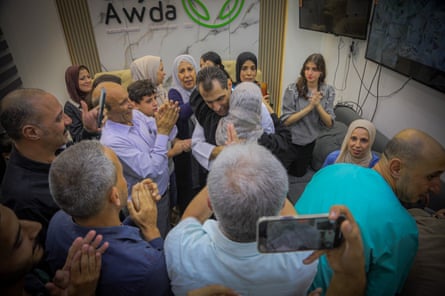
When he was released, he was taken back to Gaza. “The first person I looked for was my mother,” he says. “I hugged her tightly. I had worried about her so much … We stayed in that embrace for five minutes before anyone could bring themselves to pull us apart.”
Seeing his wife and children again “felt like life had come back to me”, he says. “It was an indescribable moment of happiness.” His middle daughter Salma, just a little girl when he was detained, was now almost as tall as he was.
As he recovers from the trauma of his experiences in detention and deals with the overwhelming medical crisis Gaza is facing, he says he feels little hope for the future.
“There is no future for my children here. I want them to be safe, to have a future, to study at good universities and to work in good jobs,” he says. “When I am not at the hospital, I try to think of somewhere I can take them, to go out together but there is nowhere to go. No green spaces. Gaza used to have life; restaurants, beaches. Now there is nothing left.”