3 months ago
80
3 months ago
80
The number of plays attributed to the 16th-century playwright Thomas Kyd has more than doubled in a major new edition.
The forthcoming second volume of The Collected Works of Thomas Kyd makes a substantial case for his sole or part-authorship of plays previously attributed to William Shakespeare or Christopher Marlowe.
Kyd’s traditionally accepted dramas are the revenge play The Spanish Tragedy, the love tragedy Soliman and Perseda, and the classical tragedy Cornelia.
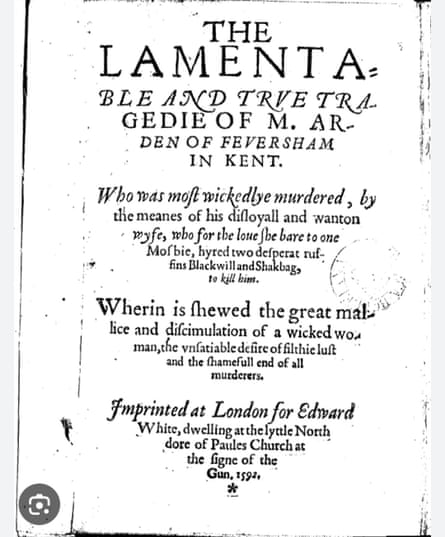
His canon now includes works such as the domestic tragedy Arden of Faversham, which is attributed solely to Kyd and “not at all” to Shakespeare, as others have previously assumed.
In the first critical edition of Kyd’s collected works since 1901, he is presented as a “tragically neglected major playwright”. Its nine scholars argue that the restored oeuvre situates Kyd as a leading Elizabethan dramatist, unjustly overshadowed by his great contemporaries, as well as “broadening our understanding of a golden period of literature and theatre”.
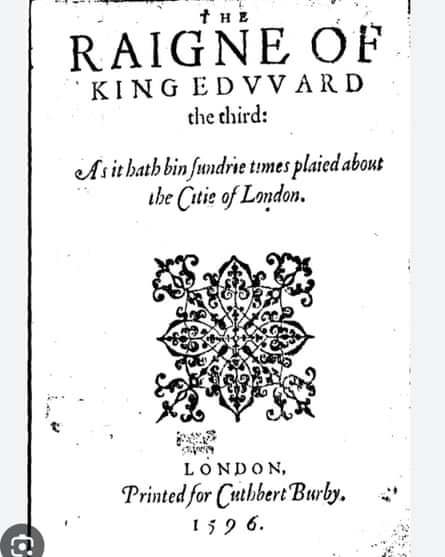
Dr Darren Freebury-Jones, a former academic at the Shakespeare Birthplace Trust in Stratford-upon-Avon, is the publication’s associate editor. He told the Guardian: “Kyd’s canon has now been expanded from three plays to eight. In the cases of Arden of Faversham, Fair Em, the Miller’s Daughter of Manchester and parts of Henry VI Part 1 and Edward III, this is the first time they have been presented in a critical, collected play edition as Kyd’s, despite a long history of these plays being associated with him.”
Evidence presented in the new volume includes computational analysis of linguistic minutiae, as well as similarities in plotting and characterisation. It attributes Henry VI Part 1 to Kyd, Thomas Nashe and Shakespeare, but not to Marlowe as was previously assumed.
Freebury-Jones, whose books include Shakespeare’s Borrowed Feathers, a study of early modern authors who inspired Shakespeare, said: “Kyd is quite different from Shakespeare in several respects, particularly in terms of rhyme. He has this curious habit of breaking up his rhyme schemes. So, you’re reading his text, you’re thinking, ‘no, this is not rhyming’. And then a couple of lines later, you have a rhyming word.
“It’s quite different to Shakespeare. Arden of Faversham sits firmly within Kyd’s vocabulary that is quite distinct from Shakespeare’s.”
He added that Arden of Faversham closely corresponds to other Kyd texts in terms of stage directions, for example. “Stage directions beginning ‘Then they’ are unique to Kyd in commercial drama of the period. There are also numerous distinct internal repetitions, such as the exact image of ‘heart’s grief’ and the phrase, ‘fine device’, which feature in Kyd’s plays, but not in the much larger attested corpora of dramatists such as Shakespeare.
“We can broaden our appreciation, as well as understanding of Shakespeare, by comparing his plays to those that were being performed at the same time.”
Prof Sir Brian Vickers of the University of London, the general editor of the Kyd edition, said: “Apart from Shakespeare, Marlowe has enjoyed the most publicity of all the Elizabethan dramatists, although the number of plays that he actually wrote is very small. This is partly the accident of being notorious, because he died in a terrible fight in a tavern in Deptford with a dagger thrust in his eye, which gives you a certain kudos.
“Whereas Kyd – who once shared a room with Marlowe – was a serious writer, who just went about his business as one of the hard-working, conscientious writers who never became notorious. He deserves to have his plays staged today.”
-
The Collected Works of Thomas Kyd: Volume 2 will be published in April