2 months ago
69
2 months ago
69
On the morning of the World Baseball Classic final between the United States and Venezuela, the headline of the New York Times daily briefing read, “America, alone,” in reference to the unwillingness of the country’s traditional allies to join the war with Iran. The revived rhetoric of America First, once a restoration of the isolationist, often Nazi-sympathetic sentiments of the 1930s, has coalesced into current policy, status, attitude: America by itself, making its own rules, intent on largely playing alone by them.
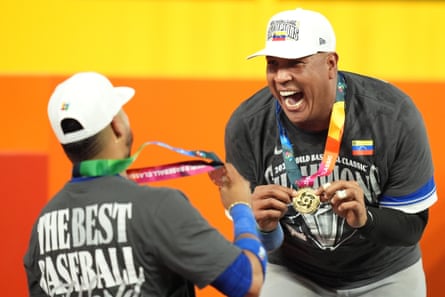
Venezuela won the final, thrillingly, 3-2 over Team USA, but not before the hosts extended that isolationism with a sourness that produced a comically vapid extension of American bravado, and nearly undermined a tournament that in its 20th year is at last becoming one of baseball’s great successes.
The WBC was a two-week block party. Canada, fresh off the Toronto Blue Jays’ American League pennant, reached the quarter-finals for the first time. Venezuela played with heart and national pride (the players even had a drum in the dugout, each base hit a party), the Dominicans with the verve characteristic of the Serie del Caribe, and in a surprising semi-final run, the Italians adopted the underdog spirit of a soccer nation intent on proving they can swing the lumber, too – all while sipping espresso in the dugout.
What was the American cultural export during this global baseball fiesta? War.
Team USA alternated between boredom (“It’s not the Olympics,” the Phillies’ Bryce Harper groused early in the tournament) and playing the role of chickenhawk toy soldiers.
The chickenhawk side won out.
Last October, Cal Raleigh and Randy Arozarena were teammates as the Seattle Mariners nearly reached the World Series. But when the US played Mexico last week, Raleigh went tough guy, refusing to shake hands with his Mariners teammate. Underneath his jersey, Raleigh wore a T-shirt that read “Front Toward Enemy”.
The shtick continued. Before the game against Canada, Team USA manager Mark DeRosa invited Robert O’Neill, a member of Seal Team 6 – the fighting unit that killed Osama bin Laden – to address the team. Then, after Pittsburgh Pirates star Paul Skenes dominated the Dominican Republic in the semi-final, DeRosa told the Associated Press, “You never want it to get lost why you’re doing this, whatever that why is. And a lot of people, like Paul Skenes said to me when he signed up for this, ‘I want to do this for every serviceman and woman who protects our freedom,’ and that’s why we wear ‘USA’ across our chest.”
In the final, when Harper’s dramatic two-run homer in the bottom of the eighth tied the game at 2-2, his celebration of choice rounding third was a military salute to the Team USA bench and a stare into the television camera, pointing at the American flag shoulder patch on his jersey. Suddenly, it was the 9/11 era all over again.
Except that it wasn’t. The gestures were hollow, performative. The Americans peacocked, on guard in a constant state of war. America alone, standing guard when everyone else was having fun. At the WBC, Team USA seemed not part of a baseball celebration but doing their part for a nonexistent war effort. Only the camo was missing.
It was a childlike pander to the current moment. Donald Trump 2.0 taking on the world – especially many of the countries that have been decades-old allies – has brought with it an uncomfortable truth for many US athletes: America can no longer consider itself as the unquestioned good guy. Trump’s regime has speculated about clearing Gaza, and annexing Canada and Greenland. Two months ago, he removed the Maduro regime in Venezuela – and now US forces have struck boats in the Caribbean and Iran.
On Monday as a power grid failure plunged Cuba into darkness, Trump spoke not of humanitarian aid, but blithely of empire. Of takeover. “I could do anything I want with it, you want to know the truth,” he told White House reporters. “They’re a very weakened nation right now.” On Tuesday night, moments after Venezuela’s win, Trump took to Truth Social and wrote, “STATEHOOD!!! President DJT”.
America’s inherent goodness has always been a specious proposition, but in the days when the US existed in opposition to the Soviet Union, the country’s athletes did not question the seemingly uncomplicated binary. America stood for freedom and democracy in the world, and the players were the good soldiers in representing, in the columnist Thomas Friedman’s words, “the idea of America”.
Now, though, athletes may find themselves playing an important role in furthering Trump’s vision. In January, the US state department announced a “sports diplomacy” initiative with the NFL, where, according to its press release, the government planned to “leverage current and former NFL players and coaches as cultural ambassadors” to “support US foreign policy goals by promoting American Excellence and leadership in sports”. Tensions between the US and Canada were already stoked by Trump’s references to the country as the “51st state”, adding animosity – and symbolism – to the recent clashes in hockey: the American men and women defeated Canada in the gold medal games at last month’s Winter Olympics, and Trump was quick to invite both teams to the White House to celebrate (the women declined).
This, perhaps, is nothing new. Whether they know it or not, athletes have been used as tools to sell America politically for decades – most often as shields against international criticism of its racial problems – but with the nation adopting a more adversarial tone with the rest of the world, only the most incurious of players can continue to coast, unwilling to rethink America’s standing. And nor can they act inconvenienced by questions of geopolitics, for during this WBC it was Team USA who introduced the cosplay, acting like Green Berets when the rest of the world was playing the drums and drinking espresso.
The Trump administration has not hidden its appetites, and many of the players are riding along. The ones who continue to blindly tout America First – DeRosa and much of his crew, for example – will be exposed, either by acknowledging their collaboration with a nation that is taking a dark turn, or through the inevitable hypocrisies that come with being a willful marionette, unequipped to defend the bravado before running for cover. That’s what the US men’s hockey team did when they failed to defend their female counterparts from Trump’s insults. Instead, they headed to the White House, where cold Big Macs (580 calories, 43% the recommended daily amount of fat, 46% of sodium) awaited the conquering heroes.
It is a new space. So many players have been afforded the luxury of hiding behind the cliches for so long, young men getting paid to hit a ball with a stick, unasked to reconsider the lines they toe, question their dinner-table politics, or the significance of the clothes on their backs – the T-shirts with the stars and stripes, guns and camo, constant reminders of who is the biggest, the strongest, the best, who is always right. During a fortnight that beautifully celebrated the national pastime, one memorable image will be of Venezuela in the sunburst of joy. Another will be that of America alone, the hosts masquerading as toy soldiers, at home and painfully out of place.