2 months ago
87
2 months ago
87
I grew up loving Prince’s music and remember thinking: “I’m gonna work for that guy one day.” Through high school and college I photographed local bands. I’d say I worked for a newspaper but I didn’t tell them it was the high-school newspaper, so they’d give me passes to U2 or Boy George. Once, when I went to photograph Lionel Richie, Sheila E was supporting, who I knew had a Prince connection. I ended up talking to her guitar-player and told him I was a photographer and artist. He asked me to draw something, so I did a quick portrait of him on a napkin and he said we should stay in touch.
Around the Sign o’ the Times album he called to say he was joining Prince’s band, and said: “I’m gonna take you with me.” He showed Prince some of my artwork, which he apparently liked. I was asked to paint a stage for him – that was the first job I did, and one day he asked: “Have you ever taken photos?” I was in the right place at the right time. I got a digital camera and became in-house art director at Paisley Park, taking photos from 1988 until 1996.
I had a different experience with Prince to most. When I first met him, nobody told me, “Don’t look him in the eyes” or anything like that. I was 25 and tried to be my normal self, but professional, which suited the way we worked. He’d say: “I’ve got an idea, grab your camera.” Sometimes he’d ask me to delete a photo – it might have blurred, or the light hadn’t been good – but he was very lucky to be so photogenic. There were shots where he came in with no makeup, and he had a different look, but he still looked great. I’d say 98% of the time he looked incredible.
This shot was for Notorious magazine, one of the few times that somebody from outside hired me. It was for their end-of-year cover and their art director wanted his stomach to read “1999”. Prince was not having that. He wanted to do something new. It was during the period he was talking about his freedom from record labels, and he suggested the word “Free”. We set up at Paisley Park before 8am, which was unusually early. The art director saw the purple backdrop and one movie light and went: “Is this how you wanna shoot?” I told him it was how we worked. He said: “If I could suggest something, would it be OK?” He came back with a shower curtain and hung it in front to give diffusion.
When it came to the slogan Prince told the guy mixing the gold paint: “Steve will do it.” I was like: “What?” The next thing I knew I was writing “Free” on Prince’s stomach with my fingers. It was cold, so he started laughing like a kid; I was thinking “I hope the paint doesn’t run because I’ve got to clean my fingers off and start shooting.” Prince’s arms are outstretched because he knew that would draw more attention to the word.
I was slightly taller so always had a great angle to shoot him from. He’d drop his chin a bit and look up with those eyes. He used to ask: “Why do people think I’ve had a nose job?” I told him that was because when he was younger people would shoot him straight to the nose whereas the way I did it made him look more angular, so people thought he’d had work done. The model in the shot is Desray Junca, who’d been in the video for The Greatest Romance Ever Sold. He wanted a foil for the shoot: someone to give him options. The gold on her fingers makes it look as if she’s been doing the painting. Nobody wanted to see me sitting there like that.
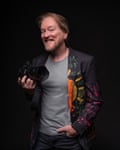
Steve Parke’s CV
Born: Arizona, 1963
High point: Being given the opportunity by Prince, who was masterful in his own creativity and artistry.
Top tip: Trust your eye, because what you see leads to your style and your perception.