3 months ago
127
3 months ago
127
Maurice Ostro, founder patron of the Faiths Forum for London, has been engaged in interfaith work for decades. For much of that time, he said, he was teased by good-natured people who insisted there was little need for it in the UK.
“People used to laugh at me for doing this work,” he said, but now, amid record-breaking incidents of antisemitism and anti-Muslim hatred, the jokes have stopped.
Ostro was speaking before an interfaith walk in Regent’s Park that brought together about 50 people – including faith leaders and other members of the community – to celebrate St George’s Day.
The group gathered at St John’s Wood Church in Regent’s Park on a sunny Thursday afternoon, where they were welcomed by the Rev Anders Bergquist, before walking to a nearby synagogue. The event ended at London Central Mosque, tracing a route that reflected the city’s religious diversity.
“You are all very welcome,” said Bergquist, pointing to two St George’s flags flying above the church. He reminded the group that St George is also the flag of the Church of England, which has pushed back at the surge in Christian nationalism in recent months.
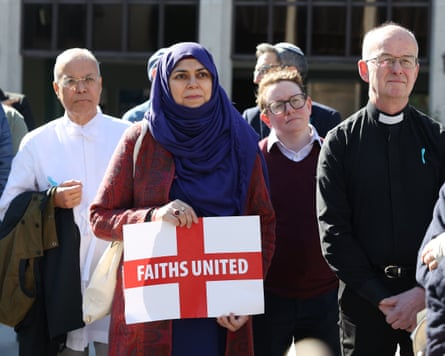
Attenders set off waving St George’s flags and holding St George placards with the slogan “Faiths United” and “England United” as they began the walk. The group first stopped at The Liberal Jewish Synagogue, before continuing on to London Central mosque.
At the mosque, Imam Sheikh Khalefa Ezzat spoke about the “value of unity, peace, and courage”. “Our duty is to bring peace and bring people together … not to divide them,” he said.
It was one of nearly a dozen events taking place across the country over the week. These included Muslim and Jewish women coming together to make Doves of Peace in London on Tuesday; 100 local people of all backgrounds in Birmingham walking to a Muslim centre targeted in a racist graffiti attack on Wednesday; and a St George’s Day parade in Gravesend, Kent, where schools and community groups sang the national anthem.
For Ostro, interfaith work is not just about having tea and samosas. He is the child of a sole survivor of the Holocaust in his family. “They were all wiped out because of this needless hatred. But one person, my father, was saved by Christians,” he said. “I’m alive, my children are alive, my grandchildren are alive only because people stood next to each other and helped one another when they saw things were going wrong.”
The choice to celebrate St George’s Day is an intentional one. “It shouldn’t be used as a day to divide people further. We should be celebrating and coming around the flag, and not shying away from that,” said Julie Siddiqi, founder of Together We Thrive and co-chair of British Muslim Network.
Sunder Katwala, director of British Future, said research showed there is a broad public consensus on who can be English, which is not defined by ethnicity. The research suggested white English people were often most confident about that, while the idea could feel more contested among minorities, some of whom may still experience anxiety about whether they truly belong.
Katwala argued that interfaith events like this are an answer to that anxiety. “I live in Dartford, and there’s been a St George’s Day parade for years. It’s organised around cohesion charities with schoolchildren. It’s very multi-ethnic, very diverse. It allows people to be proud of being English while showing that everyone is invited,” Katwala said. “When people see that, they feel reassured.”
Though Siddiqi said she understood why people feel vulnerable and question whether they belong at such events, she called on more minority communities to take part.
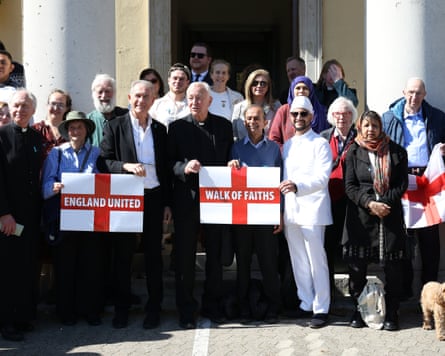
“It’s very easy right now, as a Muslim, as a woman who wears a headscarf, to feel backed into a corner; to feel negative, to fall into a victim mentality. I’m not doing that. I refuse,” she said. “We have to come out even more, flying our flag, literally, as I will be today.”
Phil Rosenberg, director of the Board of Deputies of British Jews, said that while concerns of rising hate crimes must be taken with the utmost seriousness, he worried about a risk of having a distorted view of the country.
“That’s partly related to social media and the way algorithms promote hate and extreme rhetoric over and above what moderate, mainstream people think and feel – and that’s kind of by design. It’s also weaponised by hostile foreign states – Russia, China, Iran – who take arguments, whether Brexit, trans issues, or the Israel-Palestine conflict, and polarise them even more, putting bots onto the most extreme ends and turning neighbours into enemies,” he said.
One of the joys of participating in the walk, he added, was getting off the internet. “We’re seeing real people in all their complexity, and in most cases, the fact that most people are good people who want to get on with each other,” he said. “We’re rediscovering that there isn’t an ‘us versus them’ in the way it can feel online.”
For Ostro, a few years ago, not much would have been made about hosting an interfaith celebration on St George’s Day. “This is a relatively recent phenomenon, where those who wish to divide us have thought: ‘This is clever – the flag of St George, let’s make this, rather than what he actually was, which is somebody who resonated in a positive way with Jews, Muslims and Christians, let’s make him a divisive figure’,” he said.
While in Birmingham for one of the interfaith events this week, Ostro was inspired by a hijab-wearing Muslim volunteer, who pointed out English flags on lampposts. For her, he said, they did not signal belonging, but exclusion.
“And that’s something we can’t stand quietly by,” he said. “The flag of St George is a national symbol. It’s not a nationalist symbol or a racist symbol, and it mustn’t be allowed to go that way, because that would start a very dangerous downward spiral.”