2 months ago
88
2 months ago
88
British pet owners who want to take their furry friends elsewhere in Europe have been warned not to try to dodge expensive health certificates by using a pet passport issued abroad.
Before Brexit, taking a cat, dog or ferret to the EU was relatively simple: the Pet Travel Scheme meant an animal needed a microchip, vaccination against rabies, a pet passport and, for dogs, there were also requirements concerning tapeworm treatment.
But since 2021 the process has become more cumbersome – and expensive – with the pet passport component replaced by the animal health certificate (AHC).
This document must be issued within the 10 days before entry to the EU and is valid for four months for onward travel within the EU and re-entry to Great Britain. A slightly simpler process involving a pet travel document is in place for travel from Great Britain to Northern Ireland. Pet passports can still be issued to owners resident in Northern Ireland.
However, social media sites including Reddit and Facebook are replete with pet owners reporting that they have bypassed the need for an AHC by obtaining a pet passport from a vet within the EU, with this approach often taken by people in the motorhome and “van life” community.
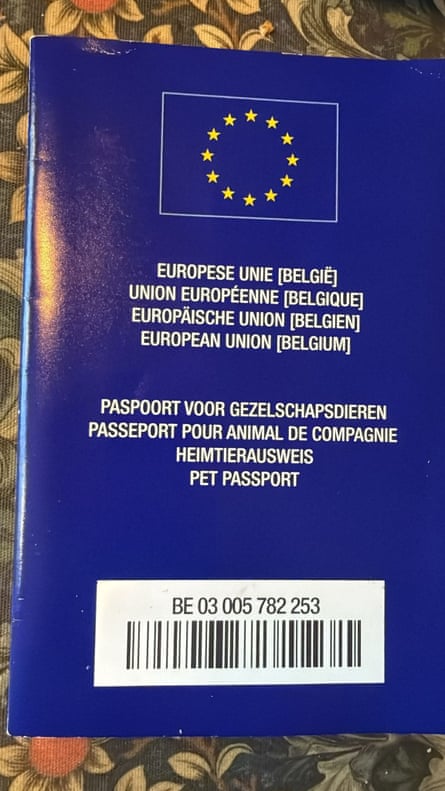
Dr David Nicholl, a consultant neurologist in Hagley, Worcestershire, has an EU pet passport for his jack russell, Lily, noting it was much cheaper than an AHC.
“[There is] loads of hassle and [it is] very expensive with the existing system,” he said.
Nicholl says he arranged an EU pet passport for Lily in Belgium and has had no difficulties in using it, adding that the document does not show the address of the owner.
However, some experts have warned the approach could backfire.
Dr Elizabeth Mullineaux, the senior vice-president of the British Veterinary Association, says EU guidance states that the European pet passport – for dogs, cats and ferrets – is only issued to pet owners who are resident in the EU.
“Any British residents trying to use this as a cheap or easy alternative should be aware of the risks of getting caught out when pets are being moved between the EU and Great Britain,” she says.
While a pet passport is valid for the life of the animal, provided its rabies vaccination is in date, the European Commission confirms that EU pet passports are only valid for pet animals residing habitually with their owner in an EU member state.
It also stresses that an EU pet passport issued to a pet owner resident in Great Britain – regardless of the nationality of the pet owner – is no longer a valid document for travelling with pets from Great Britain to the EU.
“This applies to passports issued in a member state or Northern Ireland or in Great Britain before the end of the transition period and to passports issued in a member state or Northern Ireland after the end of the transition period,” a commission spokesperson said.
Instead, the commission says an AHC issued by an official veterinarian in Great Britain is required for each entry of a pet residing in Great Britain and travelling to the EU.
“Enforcement of this legislation is with member state competent authorities. The use of invalid documents may lead to refusal of entry of the animal at the EU borders,” the spokesperson added.
The requirement for an AHC is, however, costly, with prices varying widely around the country.
The Guardian has found some vets charging more than £250 for a single animal, with discounts for additional pets. However, AHCs are often far cheaper at veterinary practices near the ports and Channel tunnel, with some in Folkestone in Kent offering AHCs for £99 for one pet and £124 for two. If the pet is a returning customer and their details have not changed, the fees can be as low as £69 for one pet and £94 for two.
The BVA says AHCs are more onerous, complex and time-consuming for vets than pet passports were, meaning the documents are more costly for pet owners.
“Where costs differ from practice to practice or from one region to the next, it simply reflects that no two businesses are the same, with variations in staffing costs and fee structures, as well as the cost of renting the building, and therefore it’s difficult to accurately compare like for like,” Mullineaux says.
However, the Department for Environment, Food and Rural Affairs says the Competition and Markets Authority is carrying out the final stages of its inquiry into veterinary services for household pets, which includes reviewing possibly anti-competitive pricing.
Chris Theobald, a senior policy, public affairs and campaigns manager at the charity Guide Dogs, said further changes are afoot.
“Following calls from organisations including Guide Dogs, the UK and EU have agreed that the UK will rejoin the pet passport scheme, but a date for this has not been confirmed,” he says.