4 hours ago
11
4 hours ago
11
Lynette Yiadom-Boakye is a painter with the imagination of a great novelist. Her contribution to the Barbican’s exhibition about Panafrica in art and culture deserves to win the Booker prize. She paints fictional people not portraits – a young woman reading avidly, a man standing alone in Pierrot-like fancy clothes, another wearing a cool green coat. You wonder if they are siblings, their scattered trajectories taking them through contemporary life as if this were a book by Zadie Smith or Jonathan Franzen.
For this brand new group of paintings she has a white-walled room to herself. While her young moderns are captured in their ironies along the side walls, at the ends of the room, in uneasy relation to them, hang sombre pictures of African elders, idealised ancestors. Together they form an utterly absorbing, unfinished, epic story of the diaspora experience. Can the young contemporaries connect with those noble figures and find their way back to Africa? Do they even want to? As the poet Aimé Césaire asked: “Who am I? Who are we? What are we in this white world?”
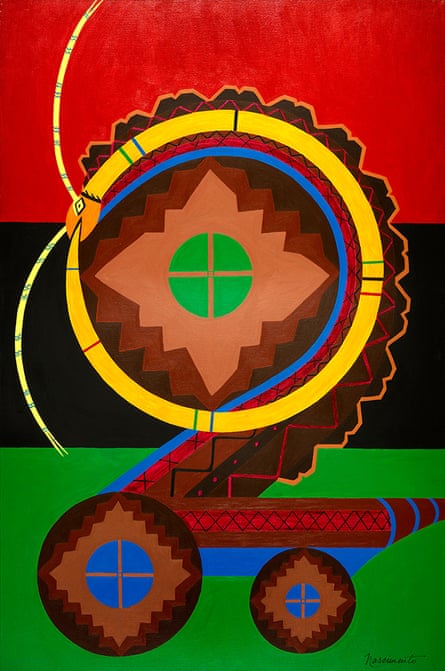
Césaire was one of the founders of Négritude, the French cultural movement that kicked against colonial assimilation in the early 20th century by asserting Blackness and validating the legacy and traditions of Africa. It provides the artistic launchpad of this epic show alongside the political idea of Panafricanism which also first appeared in the early 1900s. From these beginnings the curators conjure what they describe as “Panafrica, the promised land … a realm of philosophical inquiry whose contours – mobile, discontinuous, and always provisional – have been mapped here largely through a process of echo-location.”
There must be something to this because, presumably in conversation with these curators, Yiadom-Boakye has been inspired to create such a haunting body of art. Other artists, too, show images that arrest and move. El Anatsui’s 1995 work The Ancestors Converged Again is an assembly of spooky, magical figures carved roughly from found hunks of wood: it genuinely looks as if he has found these beings rather than invented them, releasing their ghosts from the scavenged timber.
El Anatsui is reinventing and reviving here Africa’s ancient traditions of carved wooden sculpture. The Négritude artist (as classified here) Agnaldo Manuel dos Santos did something similar in the 1950s in his sculpture of a half-human, half-pangolin creature that is another compelling piece.
But the exhibition does not sing. It spits out theory instead. Every section is framed as an essay, with artworks chosen to illustrate an argument: one bay is based around the ideas of sociologist Stuart Hall, which the works don’t seem to illustrate anyway. This is a show that wants to conjure up a utopian place, Panafrica, and make it real, which would be a powerful piece of political enchantment. To do that it needed to be put together with artistic flair. Instead the curators approach their poetic fiction with leaden prosaicness. Rather than carrying you away to Panafrica on wings of imagination they keep stopping to recalibrate their academic echo-location machine.
As a result the huge mix of art, from mid 20th-century sculptor Ronald Moody to a Marlene Dumas painting via a poster for Do the Right Thing, becomes an incoherent, often tedious stew. And there’s worse. This exhibition is so in thrall to theoretical musings around Panafrica it loses sight of … Africa. While this utopian dream of an imaginary continent was being constructed across the 20th and 21st centuries what was happening, you wonder, in Africa and to people worldwide of African descent?
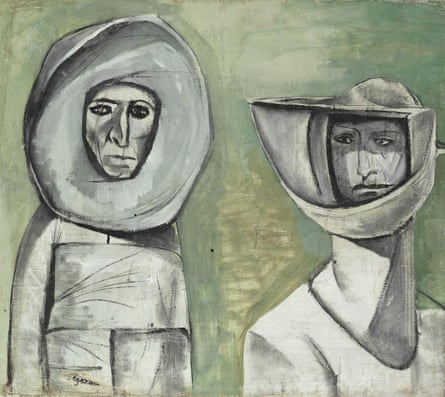
The catalogue even asks explicitly: “But what if Africa were not a place or a figure but a state of mind or a set of practices?” Think about it – that’s millions of people reduced to an abstraction. The more it wafts off into such theoretical whimsy, the less this show excites or engrosses.
You find yourself drawn to the artists who pull away from big ideas, back to life. Claudette Johnson stands out because her portraits home in on herself and others with total clarity: a self-portrait catches her in an almost athletic pose, charged and electric, holding in her anger: it’s beautifully real. Another gripping work is Liz Johnson Artur’s video of decades of Black London life, a montage of protests, markets, music and humour that’s raw and mesmerising. She captures you through honest visual reporting.
Moments like that keep vanishing in a chaotic jumble of 1950s modernist paintings, glass cases of documents and artistic connections that only exist in the curators’ heads. Panafrica is not a bad idea for an exhibition, so how did this show miss and turn what should have been clear and impassioned into a dry discourse?
By reading too much, I suppose.