2 hours ago
4
2 hours ago
4
'Russia's frontline is moving west,' Moldova's president warns
Moldovan president Maia Sandu warned that “Russia’s frontline is moving further west” after a Russian strike on the Moldovan-Ukrainian border overnight, a day after a drone incursion into Moldovan airspace.
“We condemn these attacks and this brutal war. Our thoughts are with the victims and with Ukraine. Moldova will keep strengthening its air surveillance and defences with our European partners – and I urge more air defence support for Ukraine,” she said.
The overnight attack forced the closure of the border checkpoint, around 500 kilometres (310 miles) south of Kyiv, Ukraine’s State Border Guard Service said.
Key events
Norway to bid farewell to King Harald at ceremonial funeral in Oslo
Meanwhile, large crowds are gathering in Oslo for the funeral of late King Harald V, which is expected to attract some of other leading royals from Europe and beyond, including Britain’s Prince William, Japan’s Crown Prince Akishino, Spain’s King Felipe, and Denmark’s King Frederik. Ukraine’s Volodymyr Zelenskyy is also in Oslo.
A procession on foot from the royal palace to Oslo Cathedral is expected to start in about half an hour, with a church ceremony at midday UK time (1pm local time).
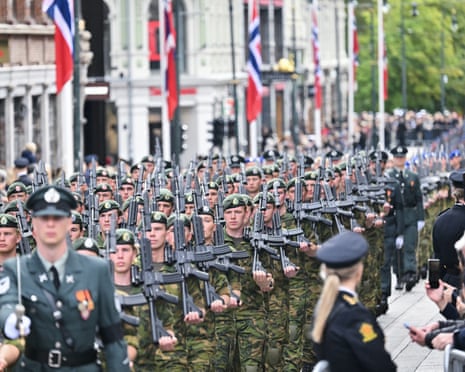
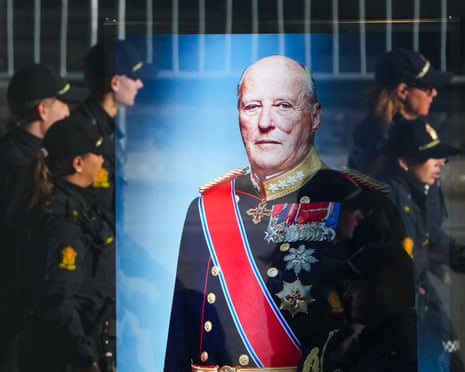
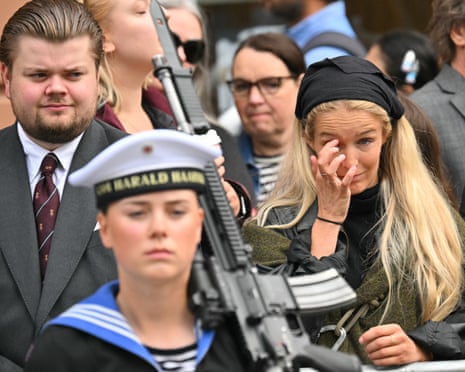
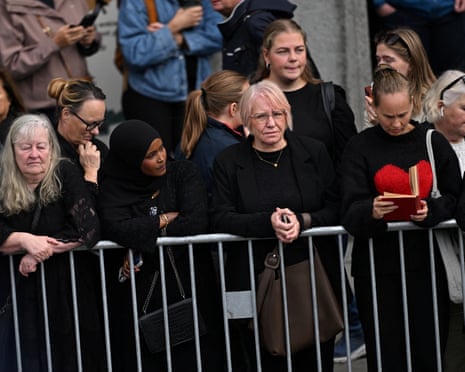
Despite its recent troubles, the monarchy remains broadly popular: 72% of Norwegians support it, while 20% favour a republic or another form of government, a Norstat poll for broadcaster NRK published on 1 September found, the first poll taken since Harald’s death, as reported by Reuters.
French far-right leader Bardella faces domestic criticism over migrant deal with Reform UK
Rowena Mason and Angelique Chrisafis in Paris
Reform UK has insisted its deal with France’s far-right National Rally to return migrants back across the channel was fully approved by the party and signed off by its president, Jordan Bardella, amid a furious backlash in France.
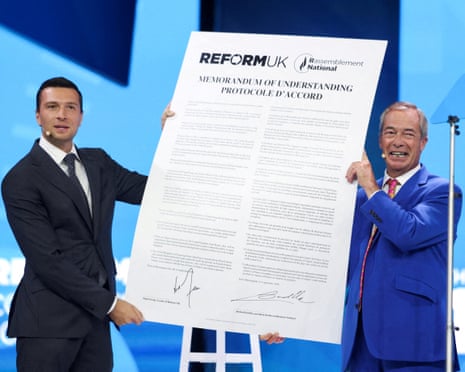
The agreement unveiled on Friday between Nigel Farage and Bardella, who is the 30-year-old protege of presidential candidate Marine Le Pen, appeared to directly contradict Le Pen’s long-held policy of refusing to accept the return of those who arrive in the UK in small boats from France.
Le Pen was pressed for her position by journalists from France TV, the state broadcaster, on Monday. Le Pen declined to comment, saying she would talk about the issue soon, but at a time of her choosing.
In 2021, Le Pen said she wanted a rewriting of border agreements for the UK to specifically send people arriving on boats back to their countries of origin, instead of returning them to France.
Since the agreement, Bardella has come under fire from political parties in France for signing the deal, with Benjamin Haddad, the Europe minister, criticising Bardella for “submission” that was “against our interests and sovereignty”.
Some French media have questioned whether Bardella was duped by Reform, querying whether the French translation accurately conveyed the meaning by Farage that the National Rally (RN) was prepared to accept any migrants back who travel by small boat.
'Russia's frontline is moving west,' Moldova's president warns
Moldovan president Maia Sandu warned that “Russia’s frontline is moving further west” after a Russian strike on the Moldovan-Ukrainian border overnight, a day after a drone incursion into Moldovan airspace.
“We condemn these attacks and this brutal war. Our thoughts are with the victims and with Ukraine. Moldova will keep strengthening its air surveillance and defences with our European partners – and I urge more air defence support for Ukraine,” she said.
The overnight attack forced the closure of the border checkpoint, around 500 kilometres (310 miles) south of Kyiv, Ukraine’s State Border Guard Service said.
Europeans want a united Europe but question whether it can get there, study finds

Jon Henley
Europeans overwhelmingly want a strong, united and independent Europe but question whether it can get there, according to a study that suggests a continent-wide crisis of confidence is creating fertile ground for far-right narratives of decline.
The report, based on 5,800 interviews in France, Germany, Italy, the Netherlands, Poland and the UK and analysis of the way Europe is discussed in the politics and media of 15 countries, paints a picture of an ambitious but disillusioned public.
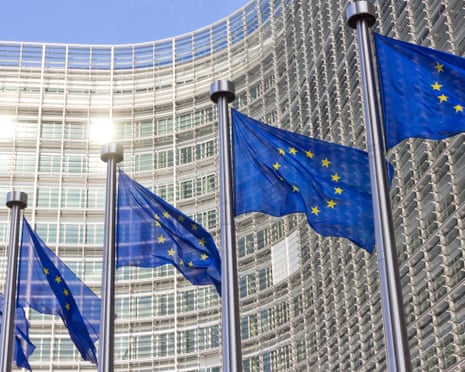
It found that 68% of respondents spoke about Europe in terms of a “general deterioration or loss of normality”, compared with just 12% who said they viewed the present moment as a time of “European awakening and renewal”.
Many recognised the major challenges facing Europe, including war (43%), economic pressures (33%) and the need for greater international autonomy (29%). But 74% said Europe was not dealing well with them, and 56% believed its future was “in danger”.
The problem is not lack of ambition: an overwhelming 73% of respondents harbour a strong European vision of unity and political integration (35%), peace and security (28%) or prosperity (19%), while only 13% hope for “less Europe” or EU dissolution.
For many, said the study’s author, Paweł Zerka, a senior fellow at the European Council on Foreign Relations (ECFR) thinktank, the problem was “not that they’ve stopped wanting a stronger Europe, but that they no longer believe it’s achievable”.
The result, Zerka added, was an “imagination gap. People can picture the kind of Europe they want, but struggle to imagine a credible path from where it is today to where they want it to be. These are matters of policy, not just communication.”
Major material damage from Leipzig drone attack prevented 'only by pure chance,' Merz says
In his comments, Merz also responded to the attempted drone attack at Leipzig airport last month, saying it had been prepared in Russia over an extended period and that a disaster was only narrowly averted.
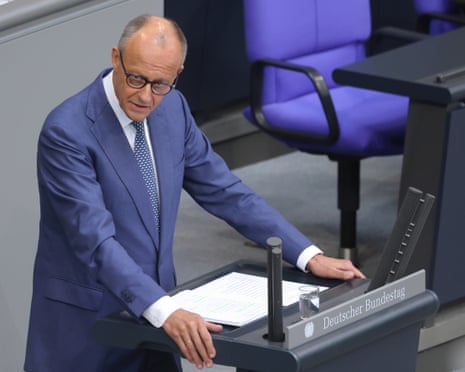
“This attack was planned in Russia for months and was specifically targeted at Germany, and only by pure chance was major material damage and harm to people prevented,” Merz told the parliament.
Russia has rejected any involvement in the drone incident at Leipzig airport.
Chancellor Merz, AfD's Weidel clash over German policy on Ukraine, migration, economy
Over in Germany, AfD’s Alice Weidel said in the Bundestag the result of the Saxony-Anhalt election over the weekend showed “the people finally want a change in policy,” saying the ruling coalition should be “over.”
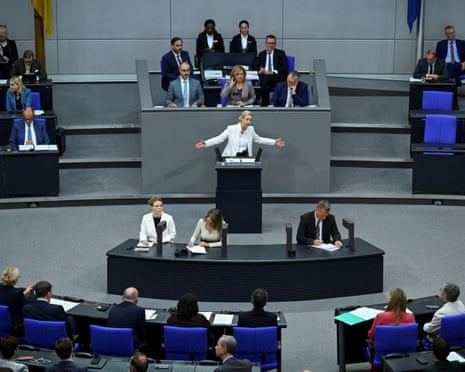
She also harshly criticised the government’s track record on migration, “war propaganda” against Russia, and on energy, calling for resumption of deliveries through the Nord Stream pipeline.
“You failed to understand the message the voters in Saxony-Anhalt sent you last Sunday. But that hardly matters, because your time is up anyway,” she told chancellor Merz.
Responding to her comments, Merz said Weidel “is and will remain a destructive force,” as he pledged Germany “will continue to support” Ukraine, “because it is defending our freedom too.
“You are openly demonstrating the downright grotesque reversal of who is the victim and who is the perpetrator,” he said in a speech, which was repeatedly interrupted by AfD.
Merz also strongly criticised Weidel’s “remigration” proposals, saying they amounted to an attempted “ethnic cleansing based on origin and skin colour,” which would leave Germany “no longer able to function” as one in six skilled workers are of immigrant background.
“Not a single nursing home will remain open, and not a single hospital in Germany will remain open, not a single restaurant will be able to operate in Germany. That would be the result of your immigration policy,” he said, while stressing that his government will push to tighten its policy against irregular migration.
Morning opening: 'Too little response' to Russian strikes on Ukraine, Zelenskyy says

Jakub Krupa
At least two people died were injured in Russian attacks on Ukraine overnight, with Volodymyr Zelenskyy saying “there has been too little response from the international community to these strikes.”
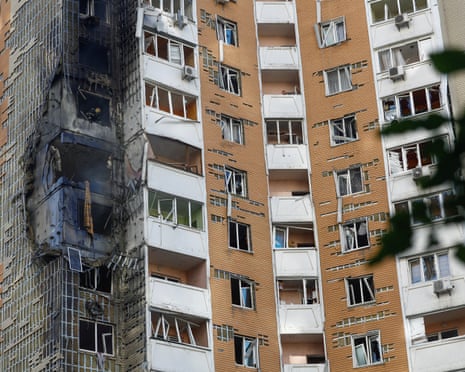
Two people were killed, three injured and 16 evacuated after a strike on the Starokozache border crossing with Moldova. Four people were injured after a Russian drone struck an apartment building in Kyiv. More strikes were reported in Dnipro, Mykolaiv, Kharkiv, Zaporizhzhia and Zhytomyr.
“A response is needed – Moscow must not go into the winter believing that it can get away with missile and drone terror without consequences. The aggression must be stopped here and now, before it spreads any further,” Zelenskyy said.
He called for “effective” sanctions against Russia and support for Ukraine, saying “the partners who can help know exactly what is needed every day.”
The Russian defence ministry said that its forces had struck a Ukrainian cargo vessel carrying military equipment in the Black Sea en route to the port of Odesa, as well as a warehouse in Kyiv, belonging to a company manufacturing drones, Russian news agencies reported.
I will keep an eye on this.
Elsewhere, Germany’s embattled chancellor Friedrich Merz is facing AfD’s leader Alice Weidel in a general debate in the Bundestag this morning after a bruising result in the Saxony-Anhalt state election on the weekend. I will monitor it for key lines.
Over in Oslo, Norway will bid farewell to King Harald V with a funeral paying tribute to the 35-year reign of the monarch, with many international guests expected to attend.
Lots to cover.
It’s Wednesday, 9 September 2026, it’s Jakub Krupa here, and this is Europe Live.
Good morning.