2 months ago
101
2 months ago
101
It is a long time since Egypt had a night this good. There have been two World Cup qualifications since their golden age of three successive Cups of Nations came to an end in 2010, and they’ve got to the finals of two Cups of Nations since, but this had a different feel to the knockout phases in 2017 or 2021 (played in 2022). This wasn’t grinding through, doing just enough (across the knockouts in 2017 and 2021, Egypt won one game without needing extra time or penalties; a grim 1-0 against Morocco in the 2017 quarter-final). It was taking on one of the giants of African football and beating them well. A 3-2 victory over Côte d’Ivoire was probably Egypt’s best single performance since they beat the same opposition 4-1 in the semi-finals of Ghana 2008.
That game in Kumasi was always going to cast its shadow over this quarter-final. Saturday’s coaches were on opposite sides when Egypt beat Côte d’Ivoire on penalties in the 2006 final in Cairo – Hossam Hassan as a 39-year-old squad captain and unused sub and Émerse Faé in the centre of midfield – but it was the semi-final two years later this game most resembled. The 4-1 hurt Côte d’Ivoire far more than the final had, the image of a bewildered Kolo Touré running away from Amr Zaki as he scored Egypt’s third a symbol of the Pharaohs’ superiority that night. Within four minutes on Saturday, Odilon Kossounou had got in a similar mess, legs tangled as Omar Marmoush sped by him to put Egypt ahead.
And because all national teams, to some extent, play amid memory and tradition, the consequence of Saturday’s win is a semi-final on Wednesday that will evoke more recent history: Egypt against Senegal, Mohamed Salah against his former Liverpool teammate Sadio Mané, just as it was in the final in Yaoundé in February 2022, when Mané scored the winning penalty before Salah had even got to take his, and just as it was a month later in the World Cup qualifying playoff when Salah, having learned the dangers of being listed to take the fifth penalty, took the first, missed and Mané again scored the decisive kick.
But this was a hugely significant performance beyond the echoes of history. Egypt had struggled to this point. They had been stodgy. Hassan seemed not to know quite how to get the best out of Marmoush. He seemingly lost faith in the 4-3-3, with Marmoush on the left and Salah on the right, that had helped Egypt to qualify for the World Cup. In the final group game, when he played a much-changed team, and the in the last 16, when Egypt needed extra time to beat an ordinary Benin, Hassan switched to a back three. Was that him going back to basics, to the shape Egypt used when winning those three back-to-back titles under Hassan Shehata?
He changed again for Côte d’Ivoire. To widespread surprise, Egypt lined up with a 4-3-1-2, the formation that has brought Nigeria such success in this tournament, with Emam Ashour behind Salah and Marmoush. And it worked. Egypt had less than 30% possession – which seemed only partly a function of taking such an early lead – but they were a constant menace on the break, which was what brought their third goal, an incisive counter finished off by Salah from Ashour’s cleverly shaped pass. Had it not been for their vulnerability to Côte d’Ivoire’s set plays, Egypt’s victory would have been far more comfortable.
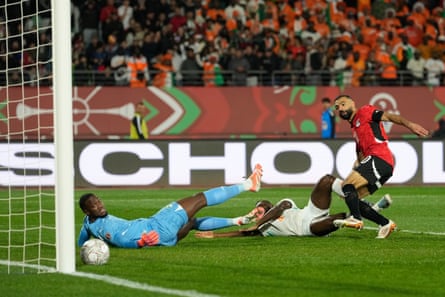
But what was perhaps most impressive was the way they pressed – sparingly, but extremely effectively. Although the first goal couldn’t but conjure images of Zaki and Touré, more significant was how the ball got to Marmoush. Hamdy Fathy, restored to his preferred central midfield role, dispossessed Franck Kessié on halfway and Ashour slipped in Marmoush. The second was headed in by Rami Rabia from a Salah corner, but the corner itself was the result of Marmoush closing down the Côte d’Ivoire right-back Guéla Doué.
Egypt’s golden age ended amid the country’s political crisis as Hosni Mubarak was toppled in 2011, and Mohamed Morsi, a former leader of the Muslim Brotherhood, was elected before being deposed in a coup led by Gen Abdel Fattah el-Sisi, who then won elections in 2014.
Football’s role in the turmoil was made clear by the tragedy at Port Said in February 2012, when 74 people, most of them Al Ahly fans, were killed during rioting as police refused to open gates to allow them to escape – a reprisal by the authorities, Al Ahly ultras said, for the role they had played in the protests that forced out Mubarak. Egypt followed their hat-trick of titles by failing to qualify for the three Cups of Nations that followed.
It would be too much on the back of one game to say that Egyptian football is back to where it was 20 years ago. But under a veteran of Shehata’s side, they at last played with an energy and a wit that recalled the golden age. Again Côte d’Ivoire were on the receiving end. Now for Senegal and putting right more recent football history.