3 hours ago
8
3 hours ago
8
Saudi Arabia has shut down a critical oil pipeline, accusing militants in Iraq of launching drone attacks on the export route being used to bypass the lockdown of the strait of Hormuz.
The world’s largest crude oil exporter has increased its use of the 745-mile (1,200km) pipeline running across the Arabian peninsula, which links Abqaiq, near the Gulf, to the port of Yanbu, on the Red Sea, since the US-Israeli war against Iran began.
The Saudi foreign ministry condemned “the targeting of the East-West pipeline in the Riyadh and Medina regions by several drones coming from Iraq, which caused human injuries and damage”.
An energy ministry official told the SPA news agency earlier that the pipeline was “stopped as a precaution”.
Baghdad is under mounting pressure to prevent militant groups, including those backed by Saudi Arabia’s regional rival Iran, from launching attacks on Gulf countries from Iraqi soil.
The US president, Donald Trump, said he believed Tehran was responsible for the aerial attack. “I think they are, probably they are,” Trump told reporters in Dublin during a visit to Ireland.
On Saturday, Iraq’s government confirmed the attacks were launched from its territory and ordered an investigation. It condemned “the attacks targeting our brethren in the Kingdom of Saudi Arabia”, and the office of the Iraqi prime minister, Ali al-Zaidi, said the commander in charge of the southern province of Maysan had been dismissed.
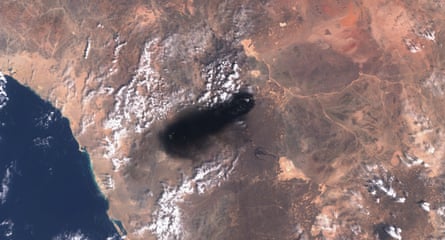
Satellite images from Copernicus Sentinel Data taken on Thursday showed black smoke billowing near Medina, along the general route of the East-West pipeline.
According to the International Energy Agency, Saudi oil exports through the Red Sea port at the pipeline’s end have more than doubled since the war began.
The news comes as Yemen’s Houthi forces have captured the strategic island of Perim in the Bab al-Mandab strait, expanding their control of the narrow waterway, one of the world’s vital shipping routes linking Europe and Asia.
Oil prices climbed past $100 (£74) a barrel this week, while average US diesel prices topped $6 for the first time on Friday – a potential headache for Trump before midterm elections in November.
A failed attempt by the US and Israel to overthrow the Iranian regime this year has destabilised the Gulf, and Iran and its proxies have now tightened their grip over two crucial shipping routes – the strait of Hormuz and the Red Sea.
Trump said on Saturday that everything would “work out just fine” when asked whether he could help move traffic through the strait of Hormuz in light of fresh concerns about Saudi Arabia.
“Everything will work out just fine,” Trump said, speaking in Dublin after meeting the Irish president, Catherine Connolly.
But Iran’s president, Masoud Pezeshkian, speaking on the sidelines of a developing nations Brics summit in India, said the Middle East did not need the US to be a “regional policeman”.
Saudi Arabia has previously accused Tehran-backed Iraqi militias of targeting its oil infrastructure. It said the kingdom “reserves the right to take all necessary measures to protect its sovereignty, its security, its facilities” and its people.
Bahrain, Jordan and Qatar also condemned the attack on the Saudi pipeline, while the Gulf Cooperation Council denounced “a dangerous escalation and an unacceptable threat to the security of the Kingdom”.
Yemen’s Iran-backed Houthi rebels announced a maritime blockade in July against Saudi Arabia – which supports the Yemeni government – attacking its oil tankers in the Red Sea.
After taking control of the Yemeni Red Sea coast on Friday, the Houthis said navigation through the Bab al-Mandab strait was “safe” for all but Saudi Arabia.