2 months ago
143
2 months ago
143
The former Labour minister Sir Patrick Duffy, who has died aged 105, was one of his party’s foremost experts on defence and disarmament during the cold war and its immediate aftermath. It was his misfortune that 19 years of his quarter of a century as a Labour MP were spent on the opposition benches, although he had the gratification of 13 years as a member of the Nato parliamentary assembly, of which he served as president for two years from 1988.
Duffy first stood for parliament in Tiverton, Devon, in 1950, and was successfully elected as an MP on his fourth attempt at a byelection in the Colne Valley, West Yorkshire, in 1963.
He was an economist by training and entered the House of Commons in midlife, after an eventful career during the second world war in the Royal Navy and subsequently as an academic in Britain and the US. His experience made him an Atlanticist and a fervent European for most of his life, although in 2016 he supported Brexit on the grounds that the eurozone had made the EU no longer practical.
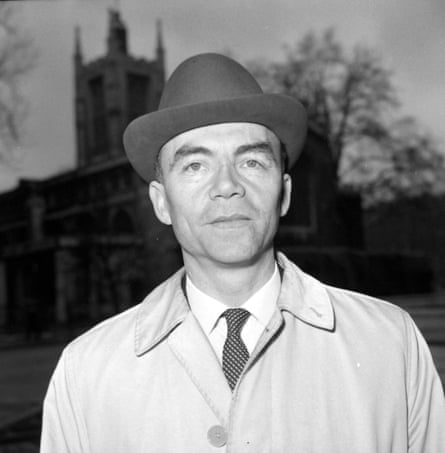
He was always prepared to stand up for his convictions, even if these were at variance with those of his party. This was notably the case when Labour was committed to a unilateral defence policy in the early 1980s, coinciding with his Nato assembly role to which he was appointed after the 1979 general election defeat, which had cost him his job as the navy minister. The post gave him a suitably dignified status and his term as president earned him a customary knighthood in 1991, albeit awarded on the recommendation of the then Conservative prime minister, John Major – the Labour leader, Neil Kinnock, having refused to nominate any candidates for a knighthood.
Duffy was proud of this elevation, given the humble circumstances in which he was raised. He was born in Wigan, the eldest of four children of Irish parents, James and Margaret Duffy, who came from the same village of Raith, near Aghamore in County Mayo. James worked as a miner and in 1925 moved his family to Rossington, on the outskirts of Doncaster, as the pit was developed there. Patrick attended Rossington primary and secondary schools, was an altar boy at his local Roman Catholic church and was taught Latin by his priest, inculcating a love of reading.
He was badly injured during six years’ war service from 1939, partly with the Fleet Air Arm, and a disability pension funded his studies at the London School of Economics from 1946, where he was awarded a BSc (Econ) and a PhD. He also studied at Columbia University, New York. During the war he had developed a growing sense of his Irish identity, which would inform both the rest of his life and also his politics. He had grown up in a household that read the Labour movement newspaper the Daily Herald, and as a student he joined the Labour party.
From 1950, when he first stood for parliament, until his election in Colne Valley, Duffy was a lecturer at the University of Leeds. In the general elections of 1951 and 1955 he stood again in the safe Conservative seat of Tiverton, and was rewarded with the Labour candidacy for the high-profile Yorkshire byelection contest he won in 1963. He held the seat – by just 187 votes – in the general election the following year, but was the only sitting Labour MP to lose in the election of 1966. He returned to lecturing at Leeds and at Drew University, Madison, New Jersey, before being found a comfortable Labour berth in Sheffield Attercliffe, where he was MP from 1970 until standing down in 1992.
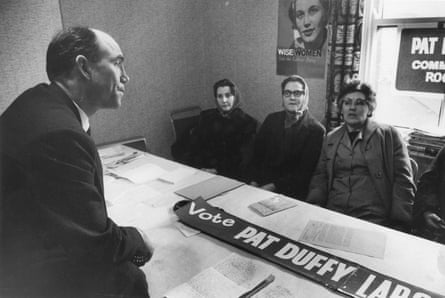
At Westminster he was parliamentary private secretary to Roy Mason as defence secretary (1974-76), before being appointed as junior minister with responsibility for the Royal Navy. He was opposition defence spokesman from 1979 until Michael Foot became Labour leader in 1980 and again briefly in 1983.
Duffy was critical of many leftwing party policies, provoking a challenge to his incumbency as an MP from local activists during Labour’s internal problems of the 80s. He survived one attempt to deselect him by five votes. As a devout Catholic he was strongly opposed to abortion and embryo research. He also voted against Sunday trading and televising the House of Commons.
He was forthright on Irish issues, criticising the “colossal and criminal incompetence” of Conservative policy in Northern Ireland at the time of the death by hunger strike of the IRA’s Bobby Sands, an elected MP, in 1981. He was also critical of the imprisonment of the “Birmingham Six”, before their release from wrongful imprisonment for an IRA bomb attack in Birmingham in 1974, and of the SAS killings of three members of the Provisional IRA in Gibraltar in 1988. He voted against the Anglo-Irish agreement because it gave legitimacy to the partition of Ireland.
After leaving Westminster, Duffy resumed academic work in the US and at the universities of Hull and Lancaster. He made a series of annual pilgrimages on foot to the Walsingham shrine, to Croagh Patrick in County Mayo, and to Santiago de Compostela in Spain. In 2013 he published an autobiography, Growing Up Irish in Britain and British in Ireland, and two years ago a second volume, From Wigan to Westminster.
He is survived by his sister Patricia.