2 months ago
113
2 months ago
113
All history is to some extent narrative. You cannot tell a story without in some way editing it, reducing it, compressing it. Which means that anybody telling a story about a historical event, particularly one from the relatively recent past, risks outraging those who have studied it or who remember it. Often those complaints are pedantic, trivial, but sometimes they are not. It’s one thing to elide two minor characters or to tweak the timeline to simplify a story, quite another to imply misleading motivations.
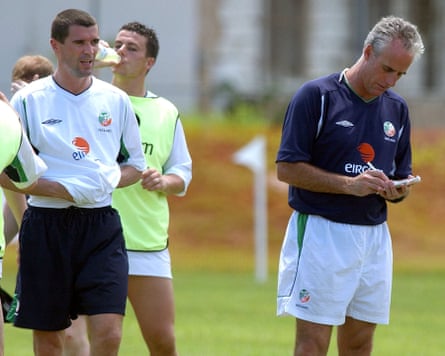
Saipan, Glenn Leyburn’s and Lisa Barros D’Sa’s film about the cataclysmic row between Roy Keane and Mick McCarthy shortly before the 2002 World Cup, came out in Ireland on Boxing Day and will be released in the UK on 23 January. It is obsessed by detail: the tracksuits, the sweatshirts, the kits are all right. It’s startling when the film cuts between reproductions of interviews and press conferences and actual footage to realise just how accurately these scenes have been recreated. Which raises two questions. What is the point? And how can such care have been taken over the look of the film when there are such grotesque inventions and inaccuracies in the plotting and motivation?
Fra Filippo Lippi was a 15-century Florentine painter noted for the realism of his depictions of religious scenes. Go to the Uffizi and compare, for instance, his Madonna with Child and Two Angels with the work around it and you can see why he had such an impact. There is a delicacy and a precision, a spontaneity and humanity, that set him apart from his contemporaries (and his son). It’s that realism Robert Browning picks up on in his dramatic monologue in which he imagines Lippi arguing with a critic who objects: “Nature is complete:/Suppose you reproduce her – (which you can’t)/There’s no advantage! you must beat her, then.” Browning’s Lippi replies: “We’re made so that we love/First when we see them painted, things we have passed/Perhaps a hundred times nor cared to see,” and concludes: “Art was given for that.”
And perhaps in painting, or sculpture or even literature, that is true. Part of the joy of great art is that it highlights the beauty of the everyday. But there is also pleasure to be taken from the technical skill required in mimetic reproduction. Lippi’s work is lighter, less formulaic, more alive than that of his contemporaries. Which is where photography presented a challenge to painting.
John William Inchbold’s mid-19th-century depictions of woodland scenes are startling in their detail and the subtlety of the lighting but, inevitably, they’re less realistic than a snap a child could take on their phone. And that in part explains the move, later in the century, with the Impressionists and their successors, towards something less realistic, something that tries to capture an inner spirit, an energy, or the movement of light.
Film is perhaps now facing a similar challenge. Just as realist painters delighted in reflecting back the world, so it makes sense for filmmakers to depict great historical scenes: here is Julius Caesar being stabbed in the forum, here is Alexander Nevsky leading his troops across the frozen Lake Chudskoe. Here is Winston Churchill delivering a rousing address to the Commons. But that seems a little less necessary when the event being depicted was filmed at the time.
And it seems a particularly odd exercise when the event being depicted was specifically staged for the cameras. What do we gain by seeing Steve Coogan doing an impression of McCarthy in a post-match press conference when the press conference was filmed and the footage exists? The only logic is to maintain continuity for the scenes for which we don’t have footage, of which the most important in Saipan is, of course, the climactic “stick it up your bollocks” tirade in the hotel restaurant. But that scene is itself problematic.
Accounts of exactly what was said vary but everybody who was there agrees that Keane did not attack McCarthy for being insufficiently Irish, as he does in the film. The two players who went to Keane afterwards in sympathy, Gary Breen and David Connolly, were born in England (as were nine others in that squad). To set this up as some sort of Anglo-Irish dispute is untrue, misleading and, frankly, lazy.
Coogan’s portrayal of McCarthy is generally fine, even if there is an alarming moment when it seems as if Jimmy Savile is celebrating an Ireland goal. Éanna Hardwicke is excellent as Keane. But when this was filmed, Coogan was 16 years older than McCarthy was in Saipan. He is also three inches shorter than Hardwicke, whereas McCarthy is three inches taller than Keane. That changes the dynamic significantly. Rather than a man of 30 shouting at a physically imposing man one generation older, the scene in the restaurant becomes a young, hyper-fit, extremely intense athlete berating a shorter man nearly 30 years his senior. And whatever the merits of his argument, that just looks like bullying.
Perhaps that’s primarily an aesthetic concern, the quibble of a journalist who has spent significant time in the presence of McCarthy and Keane. But it’s fundamental, because it calls into question the whole point of the exercise. Why is this a drama rather than a documentary? What, other than an uneven tone, is gained by the dramatised scenes?
We see McCarthy doing odd jobs at home. We hear an expletive-laden phone call with Alex Ferguson. We witness almost cartoonish shenanigans at the training camp: the Football Association of Ireland executives and the majority of the players portrayed as perennially drunk. But that broad-brush, exaggerated comedy sits awkwardly alongside the more nuanced portrayal of Keane – not that it is nuanced enough to begin to penetrate what drives him. In the world of the film, his fury at the unprofessional shambles he has to deal with is the only reasonable response; the reality was far less straightforward.
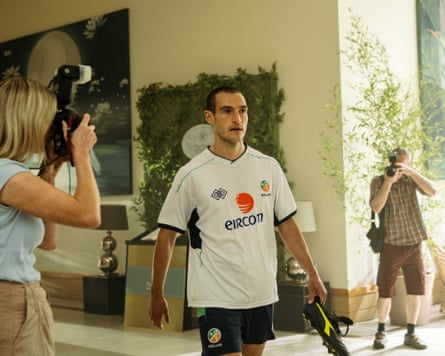
Shifting Keane’s rant about the fact that Ireland are refuelling not with pasta and salad but cheese sandwiches from the qualifier against the Netherlands to Saipan is justifiable. It’s a good story and it exemplifies his concerns. Other changes, though, are less justifiable. Keane’s explosive interview with the Irish Times is depicted as a betrayal, a journalist printing the story not after the tournament as agreed but the day before they left Saipan for Japan. That simply isn’t true, and lessens Keane’s culpability.
The most engaging moments of Saipan are the contemporary clips. In part it’s the texture that provides: the familiar voices of Bill O’Herlihy, Eamon Dunphy and Tony O’Donoghue, RTÉ’s evident excitement at speaking via a sat-phone despite the dreadful picture quality, and the sadness and bitterness in the phone-ins: this really was a subject that split the nation. The problem is that, other than one montage that briefly references the booming Irish economy, there is no real indication as to why the issue was so divisive, the way in which Keane was perceived by many as representing the new thrusting Ireland of the Celtic Tiger and McCarthy the lovable but shambolic past. This wasn’t just about an angry man shouting at an old bloke; it was about Ireland.
Perhaps achieving that in drama is difficult, particularly given it’s not an uncomplicated issue: Keane is not simply some avatar of “progress”. You don’t want Steven Reid and Jason McAteer – two of the handful of named other players in the film; neither come out of it well – discussing the state of the nation as they lounge by the pool. The faithfulness of the recreations are admirable but, by the end, those scenes feel almost an aesthetic experiment in the manner of Gus Van Sant’s scene-by-scene remake of Psycho.
And so you end up, like Browning’s imagined critic of Lippi, muttering about the futility of mimetic reproduction. This is not like seeing a doting mother and baby in the street, then marvelling at how accurately that has been reproduced in paint on canvas in a gallery. This is seeing something that happened on film, that for the vast majority of people was first experienced on a screen, reproduced in film on a screen.
This is not like Frost/Nixon, The Damned United or even Coogan’s turn as Brian Walden in Brian and Maggie, each of which features the reproduction of a key interview, because in each of those examples, the interview is part of a greater whole. Here, beyond stick-it-up-your-bollocks, there isn’t much else – and what there is takes some highly questionable liberties with what actually happened. And where there are conflicting views, better surely to present both than to offer the consolation of a simple dramatised narrative that is not merely not true, but is rather less interesting than the reality.