3 hours ago
9
3 hours ago
9
When James Herd moved near to Wisley Common 17 years ago, the heathland nature reserve was teeming with wildlife. “I’d take the dog around the common in spring and summer, and every few hundred metres I’d hear the rustle of a lizard in the undergrowth – and I’d see adders,” he says.
But over the past decade, the Surrey Wildlife Trust’s director of reserves management, who oversees the internationally important habitat, has seen that wildlife become depleted.
“There was a period, eight or nine years ago, when I’d get home and think: ‘God, I didn’t see or hear any evidence of reptiles.’”
To understand the decline, he says, you have to understand the route of the A3, a main arterial road into London that carries hundreds of thousands of vehicles a day.
The road cuts in half the protected Wisley and Ockham commons, rare lowland heath in Surrey that for centuries has been home to a rich pocket of biodiversity, including the sand lizard, Britain’s rarest lizard.
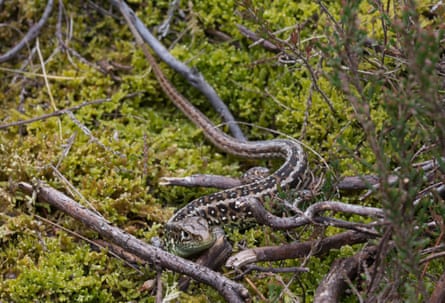
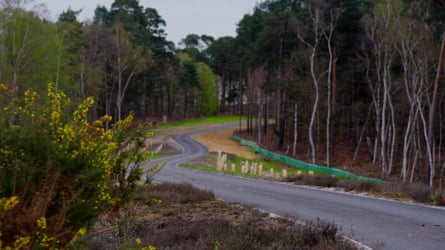
“It has fragmented the habitat, disconnected the ecological permeability of the site,” Herd says. “So species on this side of the common can’t get to that side of the common because there’s six lanes of tarmac and vehicles doing 70mph in the way.”
The habitat was dismantled further by the £317m M25 improvement scheme, which is widening the A3 at the Wisley interchange.
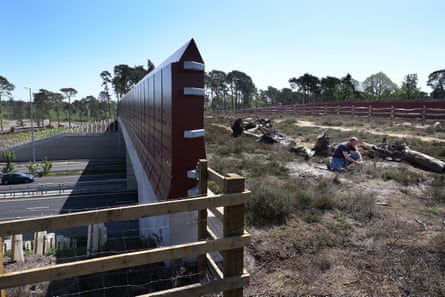
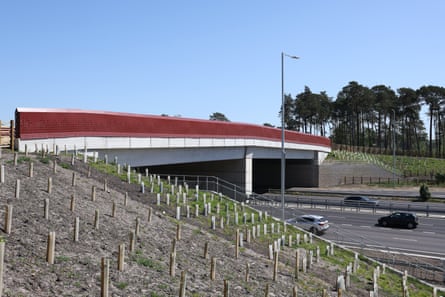
But from the rubble of that construction project, a green shoot has emerged. To mitigate the impact on the area’s wildlife, National Highways has built the Cockrow Bridge, a lowland heath wildlife crossing connecting the reserves and giving biodiversity a chance to recover.
The “green bridge” will allow a range of animals and insects to move between habitats and thrive despite the major infrastructure project.
According to the UK’s State of Nature report, average abundance of 753 terrestrial and freshwater species has fallen by about 19% since 1970. Of more than 10,000 species assessed in Great Britain, 16.1% – nearly 1,500 species – are threatened with extinction.
While there is no definitive data on the impact of roads, experts say the links between infrastructure and biodiversity loss are clear.
“It is based around genetic isolation,” Herd says, explaining how wildlife suffers when a habitat is spliced into smaller sections. “They will breed and breed and breed, but the gene pool becomes tighter and tighter and tighter, and that’s not a good thing.”
The result is fragmented populations, weakened gene pools and less space for species to adapt to climate crisis.
Herd, who advised National Highways on the project, says the Cockrow Bridge “changes how the ecosystem functionality can evolve and function better, in a landscape where species can interact more freely”. By building a link, “we’ve removed a barrier”.
The bridge itself is a floating patch of nature reserve; its contents were excavated and transplanted from the heathland on either side. Heather, the tough wiry shrub that defines heathland, is already springing up in purples and yellows above the A3’s roar, supporting the area’s insects and reptiles.
“They can feed here, get cover, they can bask, they can breed,” says Herd. Ground-nesting birds, such as nightjars, woodlarks and Dartford warblers, will also benefit from the newly connected landscape.
Piles of sand have been added to provide the breeding habitat for the highly threatened sand lizard, while logs line the back of the bridge. “If you’re a lizard or a snake and you get too hot, those stumps provide cooler habitat so you can cool down. They also provide cover from predators,” says Herd.
While the bridge is not yet officially open, that has not stopped wildlife using it already, say the team. Foxes, roe deer and adders have been spotted on the crossing.
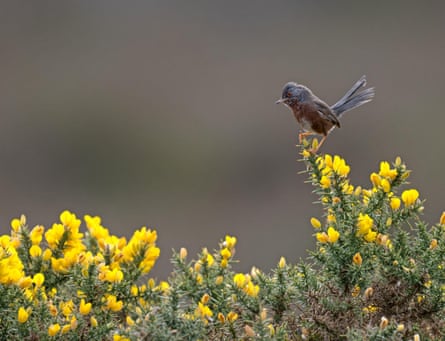
Insects have not been overlooked. “They’re doing most of the work here: pollination, decomposition, feeding everything further up the chain,” says Herd. “This isn’t just about big, charismatic species – it’s about reconnecting entire communities of insects that underpin the heathland.”
Cockrow is the biggest of the few green bridges that exist in the UK. “We’re way behind if you compare us to continental Europe and America and Canada,” says Ben Hewlett, a senior biodiversity adviser at National Highways who led the Cockrow project.
The US has more than 1,000 animal crossings, made up of overpasses, underpasses, tunnels and bridges. “There, it’s a major road safety problem,” says Hewlett. “They have elk, moose, bears – and if they run into the road and you hit them with a car, people are going to get hurt.”
Mainland Europe also has more roaming animals than the UK. In the Netherlands, building green bridges “is almost routine business when planning new roads”, says Edgar van der Grift, an ecologist at Wageningen University.
Alongside hundreds of underpasses and tunnels, the Dutch have built about 80 green bridges since 1988, including Natuurbrug Zanderij Crailoo in Hilversum. At 800 metres long and 50 metres wide, the crossing is the longest in the world. Thirteen mammal and six amphibian species have been recorded using the bridge, including pine martens and badgers, which had previously not been seen in the area for about 15 years.
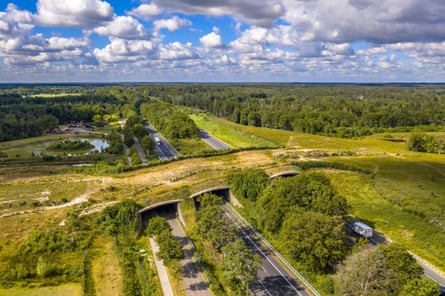
“If you design an overpass well, you have no problems with animals finding them, using them and colonising them,” says Van der Grift.
Dr Silviu Petrovan, a research professor at Cambridge University’s zoology department, says the UK has just as much reason to implement animal crossings. “Britain is one of the most fragmented countries in the world,” he says, owing to the density of its road network.
Providing this animal crossing infrastructure is a key part of helping biodiversity remain intact. “Green bridges increase the resilience of habitats and improve the chances that, if something goes wrong, populations can recover through recolonisation,” Petrovan says
Hewlett is pushing National Highways to speed up the introduction of green bridges. “Fragmentation is a key issue in nature loss and biodiversity loss on a national scale, on a regional scale [and] local scale,” he says.
“Our [road] network is probably one of the major causes in the country. You can’t get away from that. But there are things you can do, as we’ve shown.
“It’s about being able to build that case for more in the future, in a landscape where the benefits aren’t standardised or defined. There’s no Treasury methodology to value habitat connectivity. But if we want to be serious about nature restoration in the country, we have to think about it.”
Cockrow Bridge cost National Highways £3.7m to build. “Just over 1% of the project cost,” Herd says. He believes the bridge could serve as a blueprint for further highway projects.
“For every road scheme that goes in, if we could dedicate 1% to 3% of the cost to a greening element that helps defragment landscapes, we’d be investing in green infrastructure and unlocking nature recovery. It’s the shrewdest investment you could make.
“Because we’re in a nature crisis, right? We’re in a biodiversity crisis. Nature is really, really struggling. And unless we act pretty damn swiftly, we’ll hit a tipping point where we might be facing ecosystem collapse.”