2 months ago
94
2 months ago
94
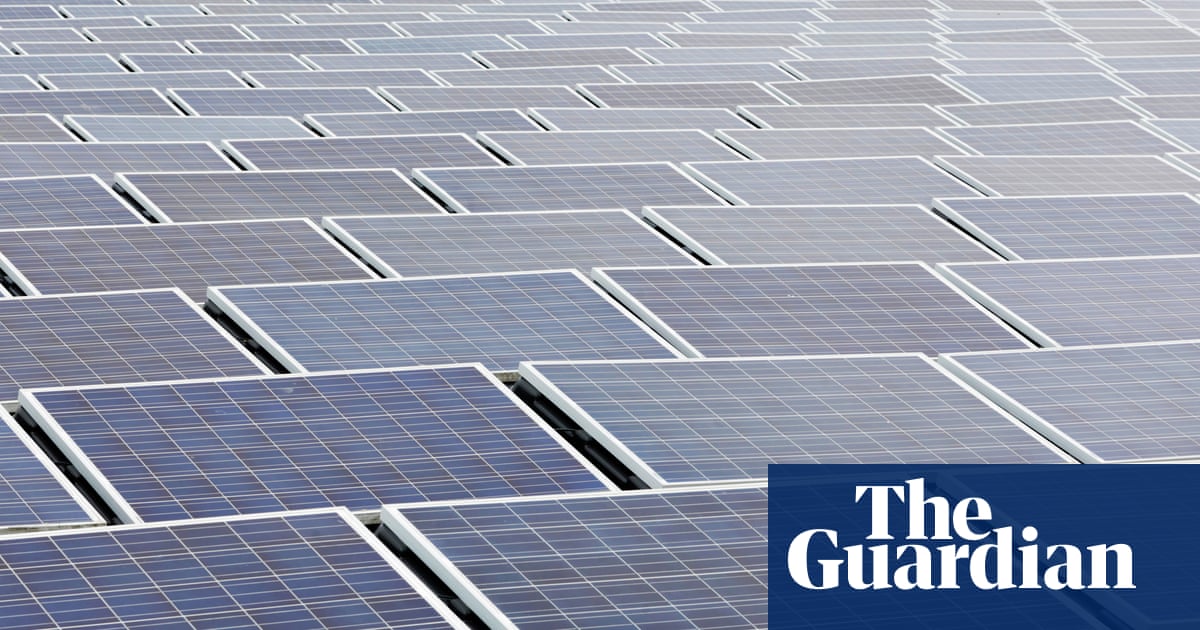
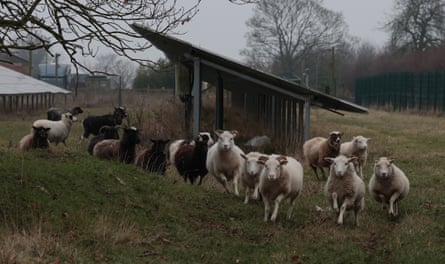
On a blustery Lincolnshire morning, Hannah Thorogood paused between two ranks of solar panels. Her sheep nosedived into the grass under their shelter and began to graze.
“When I first started out, 18 acres and 20 sheep was as much as I could afford,” said the first-generation farmer. “Now, because I can graze this land for free, I have 250 acres and over 200 sheep. Solar grazing has given me a massive leg-up.”
Across the UK, a growing number of farmers are discovering that the free grazing opportunities offered by some solar panel sites are a toe-hold in an industry where land is often unaffordable or unobtainable.
Dr Liz Genever, a farmer in south-east Lincolnshire, has been able to triple her sheep numbers thanks to free solar grazing.
“If I could increase my flock to the full potential offered by the local solar site, I could potentially increase my income from sheep from £20,000 to £60,000,” she said. “There’s been a massive acceleration in the last five years in solar grazing. “It’s a really important opportunity for sheep farmers.”
The opportunity could not have come at a better time. The UK has traditionally been largely self-sufficient in sheep meat. But high feed and farming costs, market uncertainty and low profitability have seen flocks fall to their lowest number ever recorded.
Nicola Noble, of the National Sheep Association, agreed the free solar grazing was a “valuable opportunity for new, younger or smaller farmers”.
Solar grazing is the practice of using sheep to manage vegetation on solar farms. Panels need grassland beneath them. On a typical site, that means tens of acres of grass that needs mowing or spraying, costing up to £50,000 annually.
By using sheep, however, those costs fall dramatically. Sheep do not require heavy mowing equipment to be hauled across the country on diesel lorries, or need tea breaks. They slip between panel legs and nibble where machines cannot reach. And they work in all weathers.
Grazing is so effective that in areas where there aren’t enough flocks, shepherds could start being paid for their services, said Murray Sellars, co-founder of the eco-friendly land management company, GroundGraze.
Not every site is suitable for solar grazing. But for those that are, it is a triple-win solution for the farming business, for renewables and for society, said Emilien Simonot, of Lightsource BP, which oversees one of the largest sheep-grazing programmes in the UK.
Prof Alona Armstrong, the director of energy and environmental science at Lancaster University, agreed. “This sort of multiple land use is vital,” she said.
A recent study showed that sheep grazing in the shade of solar panels may produce higher-quality wool than those on traditional agricultural properties.
But not everyone buys the “triple win” argument. Fraser Key, a fourth-generation farmer who built a 15-megawatt solar farm on his land in 2012, is both advocate and sceptic. Back in 2012, his site generated 25% more income than conventional farming.
“Today, that would be 100% because most farms are losing so much money,” he said, grimly. But Key has turned solar grazing into a profitable business – even supplementing what he is paid for leasing his land to the solar company by charging local shepherds to graze their flocks beneath the panels.
“Solar grazing is a very good thing,” he conceded. “But the drive to cover agricultural land with panels is dangerous. We can’t decimate the agricultural community in the process.”
Guy Parker, founder and co-director of Wychwood Biodiversity Limited, agreed that grazing can be beneficial to wildlife – but only at lower stocking densities. “Grazing is maximised on some solar farms, which minimises the biodiversity value,” he said.
Noble said there was also a risk of it becoming a PR exercise; a way to make communities more comfortable with planning applications. She said: “Sometimes solar companies promise to consider grazing at the planning stage. Then the grazing never happens.”
Solar grazing will not fix British farming. It won’t lower land prices, reverse climate change or make supermarkets pay more for lamb. But for farmers locked out of land, it offers something increasingly rare: a way in.
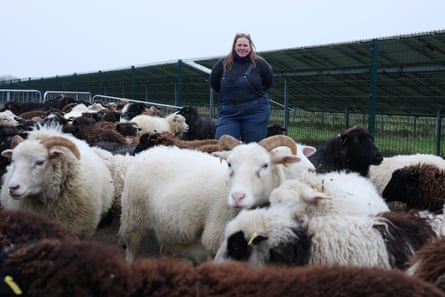
Back in Lincolnshire, Thorogood listed the benefits: “The sheep improve soil quality, increase pasture diversity and mean the land doesn’t need spraying,” she said.
“The land is secure, because there are cameras everywhere, and the tech teams keep an eye on the flock,” she said. “The panels give the sheep shelter in snow and extreme heat.”
For Thorogood, standing between the panels, the politics fall away: what’s left is grass and shelter for her flock – and a farmer who finally knows where she stands.