1 hour ago
11
1 hour ago
11
Generation Maybe is the most tactful possible title for Camilla Cavendish’s bracing new book – because the trend she’s describing is anything but a “maybe”. “The wave of childlessness that is sweeping the globe is extraordinary,” she writes. It’s in the UK, where the fertility rate hit 1.39 children per woman in 2025, the lowest on record. It’s across the Organisation for Economic Co-operation and Development, visible in so many measures – nearly half of Canadian women surveyed in their 40s said they’d had fewer children than they would have liked. But it’s also a global story. “The UAE, Chile and Tamil Nadu in India have even lower birthrates than Germany,” Cavendish writes. “China is growing old before it gets rich, and Russia has maintained its population size purely by annexing Crimea and parts of Ukraine.” In fact, when it comes to falling populations, “only the Black Death in the 14th century is comparable to what is happening now”.
When I meet her in central London, Cavendish is tailored, self-possessed, you might even say poised, but very open – she never gives an opinion without asking yours, she talks very freely about her family and she is upfront about what she sees as her faults. Now 58, she started her career at McKinsey, the mega-management consultancy, having done PPE at Oxford at the same time as David Cameron, for whom she worked as policy director when he was in government and to whom she remains intensely loyal (every time his name comes up, we have a fight).
She’s now a baroness, but you can’t imagine her relishing her correct address – she wouldn’t like the pomposity. She’s an FT columnist and a fellow of Harvard Kennedy school, which specialises in public policy. This duality shows: in her writing and in conversation, she slips quite seamlessly between the academic and the journalistic. “What drives me,” she says of this book, “is the feeling that so many people are missing out. It’s not the economics, it’s the heartache.”
I was always suspicious of the low-birthrate conversation, because in recent history it’s been a stalking-horse issue for the far right – an early adopter was Viktor Orbán, handing out lifelong tax exemptions to women as long as they stayed permanently pregnant. Elon Musk has praised Orbán’s pro-natalist policies to the hilt, while Peter Thiel has invested in an egg-freezing startup. In the hands of strongmen and billionaires, the conversation combines elements of old-fashioned misogyny – authoritarian men getting up in women’s business via reproduction – with a newer strain of wealth-supremacy, fighting for the right kind of babies to be born to the right kind of people, brought to you pre-screened by tech.

But, facts, in their unfortunate way, have forced this issue out of that silo and on to everyone’s agenda. The US commentator Anna Louie Sussman has just published Inconceivable: The Impossibility of Family in an Age of Uncertainty, which makes the punchy case that fertility is being driven down by political decisions. She contends (quoting historian Laura Briggs) that the US has “a precisely eugenic system in which insurers pay for the poor to get birth control and for the rich to get IVF”. If that sounds US-centric, geographer Danny Dorling’s book (out next year) takes it global: “The last year that people worldwide felt optimistic enough to have more children than the year before was 1989.”
Cavendish finds factors driving down birthrates everywhere. She draws on interviewees she found for myriad scenarios (the involuntarily childless guy; the unconventional, late-started family; young women looking for romance), as well as conversations, carefully chronicled, that she has had for previous books (most recently, one on an ageing society) and in her role at Harvard.
Low fertility is there before people even become couples, she argues – in the romance famine, the “rise of the situationship”, and the status gap that leaves low-income, poorly-educated men partnerless and involuntarily childless. It’s there in the “spermapocalypse”. The research on sperm counts, she’s careful to stress, is nowhere near complete, but she quotes one extraordinary study that hypothesised that if the 2017 curve on sperm count was to be projected forward, by 2045 the median western man would have essentially no sperm, and most couples would have to use assisted reproduction to have a child.
Low-fertility drivers are there in the “greedy jobs” that leave people too insecure to take career breaks and no time for relationships anyway. There’s the shortage of affordable housing, which is restricting family size as well as leading people to delay having their first child. Fear of giving birth, over-intensive parenting and a sense of being permanently judged and found wanting, the disappearance of the village that was supposed to help you raise your child … all play a part. And that’s before you factor in a pervasive anxiety about the future, and the climate crisis – the macro context that voluntarily childless people often cite.

Some of these elements are self-evident, while others feel more contestable. Through the ages, it’s been tricky to find someone you actually feel confident merging genes with. And how can the same anxieties about office culture and career breaks be driving down birthrates across the world, in cultures where workplace norms aren’t at all alike?
But the voices in Cavendish’s book ring out so clearly that you have to take notice. One 27-year-old woman from the UK tells her: “It feels like dating has become all about who wants the other less.” Another young woman describes going on a date with someone she met on an app, and even though she was having a great time, she couldn’t help scrolling through alternatives while he was in the loo. Two young security guards talk about trying to get a date with a girl from the office, concluding with the most offhand but devastating account of being at the bottom of the pile, economically: “‘You’re downstairs, they go upstairs, right? Know your place,’ he laughs, warming to his theme. ‘We. Are. Downstairs.’”
The genders aren’t shaking down neatly into powerful and powerless in Cavendish’s research – low-income men are struggling to find partners at all, but “even quite savvy women” are feeling the “commitment gap”, she says. “The fact that you can be dating someone, but you’re not in an official relationship, and are not really allowed to have any expectations of that.” It’s nothing like a war of the sexes, though she posits that political polarisation – young men moving to the right, young women moving to the left – might be a factor in the “romance famine”.
It’s worth noting, though, that the right/left split is much more pronounced in Europe than in the UK, and yet all our birthrates are tumbling. What you hear most plainly is that everyone feels really insufficient to this task of togetherness – whether they can’t find anyone good enough, or don’t feel good enough themselves, is almost moot.
Talking about “996” culture in China (working 9am to 9pm, six days a week), Cavendish quotes one guy: “Not only do I struggle to find time for reproductive behaviour, but I also can’t find a reason to have a baby who will eventually grow into another human labourer for capitalists to exploit.” And then another: “The entire situation is incredibly depressing. I feel like a cow surrounded by breeders who are discussing whether to play Mozart or Chopin to make my meat more tender.” Whatever you feel instinctively about the drive to have children being outside the rational, homo economicus self, it’s hard to really argue with those.
The clunky workings of the biological clock are still in play, Cavendish says. “I just couldn’t believe the number of women who essentially said to me: ‘I didn’t realise I’d left it too late.’ Men have no idea. And men will not admit that infertility affects both men and women.” A more novel element is “social contagion” – it’s not an uncontroversial idea, heavily criticised for its deployment in anti-trans discourse, but Cavendish keeps her focus pretty tight. She cites a study that found that if a member of your friendship circle was living with obesity, it increased the likelihood of your own weight gain by 57% (set against a 0% increase if a neighbour became obese). It’s just speculation that peers could be a significant factor in the decision as to when, and whether, to have children.
But if that isn’t right, how to explain the cohort effects? For instance, immigrants revert to the norm of their host country, with family size, incredibly fast – “within one generation”, she says. “In Norway, second-generation Somalis have an average of two children, compared with seven children for those still in Somalia. In the Netherlands, the fertility rate for Turkish immigrants is identical to the native one.” She warms to her theme; she loves the peculiarities of the data. “Even more fascinating is that it works both ways: Polish women have been shown to have had more babies after moving to England than their peers back home. These women are mirroring the household average of their new country, even though it often costs more to raise a child in London than in Warsaw.”
If insecure and burdensome work, as well as unaffordable housing, are observable pressures across very different countries, some economic conditions are easier to see through the prism of a specific one. In the UK, for instance, “we’ve now got to the point where the average pensioner household is better off than the average working household. That’s just unsustainable and it’s unfair. Unfortunately, with [the pensioner] voting bloc, they care about their grandchildren, but they really do want a lot of retirement benefits.” It was, obviously, Cameron who introduced the triple lock, which came from his feeling “really strongly that the generation that fought in the war should not be living in poverty. That was a visceral emotion for him.”
I find this indescribably annoying: one, because while Cameron was experiencing these visceral emotions, many far more desperate people were facing swingeing benefit cuts; and, two, because Gordon Brown was the prime minister who really drilled into pensioner poverty – which is to say, attempted to focus on the pensioners who were actually poor (and even he brought in the non-means-tested winter fuel payment). But, maybe I’m being too tribal. And anyway, that’s not the point at all: we are where we are, and “tweaking isn’t enough”, she says. “You need a radical transformation.”
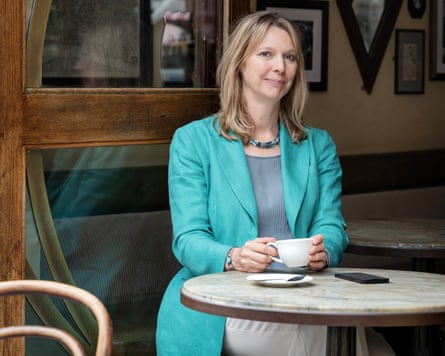
When Cavendish embarked on her book, she thought climate anxiety was going to figure largest as the reason people choose not to have children. In fact, there’s another one: insecurity, exemplified but not fully described by the astronomical numbers of young people still living with their parents (in the UK, more than one in three young men – but “young” now means “under 35”).
More than that, a pessimism has taken hold – some economists and demographers see the decision to have children as influenced by “narratives of the future” – whether we can imagine it being better than the present. And nobody can; not even those of us in our 50s, who have to imagine it, since the die is cast. (Cavendish has three sons, one still at school, the other two at or just emerging from university.) Of course, the climate crisis is playing a big part in that, but it still doesn’t wholly stack up – in the 80s, there was the wraparound threat of nuclear annihilation and it didn’t seem to dent anyone’s joie de vivre.
“I feel bleak,” she says. “Over the summer, I felt I was becoming overwhelmed in bleakness about the future, which is not my natural state at all.” And maybe that’s the daily diet of bad news, “but a lot of the younger generation that I talk to feel like that, and they’re not in the flow of the news”. Unless anyone wants to indulge my own theory of this as a techbro conspiracy – the deliberate spread of despondency to suck the life out of collective resistance (I’ve so far been unable to get to the bottom of it) – we’ll have to put a pin in this.
I still balk at the idea that any country can have a population crisis and an immigration crisis at the same time. “Ageing Europe feels fossilised,” she says (comparing it with Nigeria, one of the places whose population is growing fastest, and could outstrip the US as the world’s third-most populous country by 2050). There’s an easy fix for that, I suggest, which is to stop having a conniption and voting neo-Nazi every time young refugees arrive. “Individual people aren’t entirely substitutable for each other, are they?” she says.
I reply that, sure, I’m not so woke that I think someone arriving from Somalia is the same as having a grandchild. But I wonder whether bonds of fellowship and renewal might be rewarding, just in a different way? She stresses the importance of having control of your borders, but lands somewhere else: “Some academics think that we’re quite close to a moment where countries will start desperately competing for immigrants. It’s perfectly possible that we will flip, precisely because our welfare systems can’t sustain this population pyramid.”
This picture of worldwide depopulation is “a story about love”, Cavendish says. “It is a story about environments and contagion. It is a story about the climate. It’s a story about housing. It’s a story about inequality. It’s a story about old age. If we can’t adjust our expectations of old age, then we can’t adjust how the young are experiencing the economy. Fundamentally, it’s a story about pessimism, and that might be why it’s very depressing.”
The thing is, she says, having children is an amazing source of joy. “None of us, as parents, want to pontificate about that. We’re so aware of how indulgent it sounds and how other people may have struggled. But sometimes I wonder if we need to right the balance a bit.”
Generation Maybe: Why We’re Having Fewer Children, and What It Means for Us All by Camilla Cavendish is published on 1 October (Vintage, £25). To support the Guardian, order a copy at guardianbookshop.com. Delivery charges may apply