2 months ago
108
2 months ago
108
Supermarkets could help to support British consumers to move away from their reliance on mainly imported seafood – the “big 5” of cod, haddock, tuna, salmon and prawns – to more sustainable, nutritious and locally caught fish such as sardines and anchovies, researchers say.
A study by the University of East Anglia (UEA), which confirmed previous research showing consumers did not eat the recommended amount of fish in their diet, suggests the UK could be overlooking a major opportunity to improve national health as well as bolstering local economies by embracing its own rich populations of nutritious small fish.
Seafood consumption fell by 25% over the past decade, the new study shows. Younger people were least likely to eat fish, while pensioners were most likely to eat a variety of seafood. Sales in supermarkets, where most people buy their fish, were heavily concentrated around the “big five”.
Dr Silvia Ferrini, the lead researcher on the study from the UEA’s centre for social and economic research on the global environment, said much of the decline in seafood consumption in what was considered a “fish nation” last century was down to the “curse of modernity, in which we don’t eat simple food that is local”.
“We found out that the majority of British people don’t eat a portion of fish a week, so they are below a recommended good diet in terms of nutrients such as omega-3, which is good for brain development.”
The UK government, through the Eatwell Guide, recommends people have two portions a week of sustainably sourced fish, one of which is oily (such as salmon, mackerel or sardines).
Despite an abundance of fish in British waters, more than 80% of seafood eaten in the country is imported. And, although there are regional differences, much of the fish caught in local seas, including Cornish sardines and anchovies, is exported.
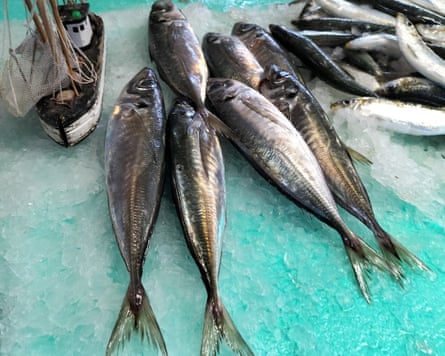
“This imbalance drives up carbon emissions, leaves the UK vulnerable to global supply chains, and pushes shoppers towards the same narrow selection of cod, haddock, salmon, tuna and prawns,” said Ferrini.
“The supermarkets might have a role in breaking this barrier,” she added, suggesting that strategies such as promotions or recipe cards could be used to change behaviour.
Her research, Socioeconomic evidence for sustainable fisheries, found a “strong trend” linking the availability and sales of seafood in supermarkets. Sales of salmon, which made up about 25% of all the fish sold, closely followed the percentage of that fish among the range on offer, at 20%. This was consistent for all species of fish.
The report concluded that while no direct relationship could be inferred from such data, it merited further investigation to see if an increase in market availability might increase sales.
Researchers at the university combined two focus groups, a national consumer survey, and analysis of data from supermarket sales and the Office for National Statistics’ living costs and food survey to understand buying behaviour and attitudes towards trying new fish.
It found that while many consumers were put off by the taste of fish and the presence of bones, a large percentage said they would be willing to try local fish such as sprats and flatfish (which includes species such as plaice, turbot, flounder and dab).
“Our research shows that curiosity is strong, with 40% of UK consumers saying they would be willing to try these lesser‑known species – especially if they are fresh, locally sourced and reasonably priced.”
The research was funded by UK Research and Innovation, a non-departmental public body sponsored by the Department for Science, Innovation and Technology.