1 month ago
33
1 month ago
33
A Syrian rights commission is preparing a case accusing Fadi Saqr, a militia leader within the Assad regime, of involvement in crimes against humanity and war crimes, a senior Syrian official has told the Guardian.
Saqr is a former commander of the National Defence Forces (NDF) militia and is widely accused of involvement in the mass killing and forcible disappearance of civilians in the Tadamon neighbourhood of Damascus, as well as other parts of the Syrian capital.
After Bashar al-Assad, the former Syrian president, was ousted in December 2024, Syria’s new government collaborated with Saqr on security files, causing anger among victims who had sought accountability for his alleged crimes.
Zahra al-Barazi, the deputy chair of the National Commission for Transitional Justice and an adviser in Syria’s foreign ministry, said the commission was working with victims to build a case against Saqr. Although the commission was appointed by the Syrian government, it is an independent body that will refer its findings to the Syrian judiciary, which in turn will decide whether or not to pursue the case.
Judicial proceedings against the former militia chief would be an important milestone for Syria, which has grappled with how to establish transitional justice after more than a decade of war left hundreds of thousands dead and pitted towns and neighbourhoods against each other. Experts have said a proper transitional justice process could help to stem intercommunal violence in the country, which has seen sectarian massacres and sporadic killings since the fall of Assad.
Al-Barazi said: “There is absolutely enough evidence against Saqr. We are also working with organisations who have documented a lot of these things. He was useful for certain reasons and he’s no longer useful. No one is above the law.”
Last week Syrian authorities arrested Amjad Youssef, a main perpetrator in the Tadamon massacres.
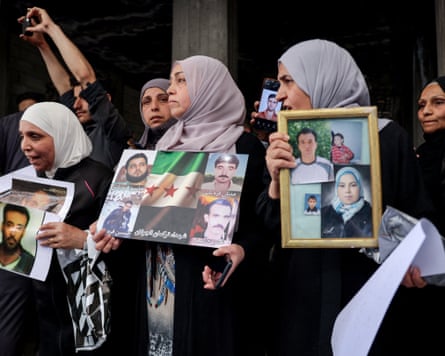
Videos found on the laptop of the former intelligence officer that were leaked out of the country documented the killing of nearly 300 civilians by regime forces in Tadamon in 2013. The Guardian in 2022 published a selection of the footage, which showed Youssef ordering blindfolded civilians to run forward while he shot at them, pushing them into a pit, executing them and burning their corpses.
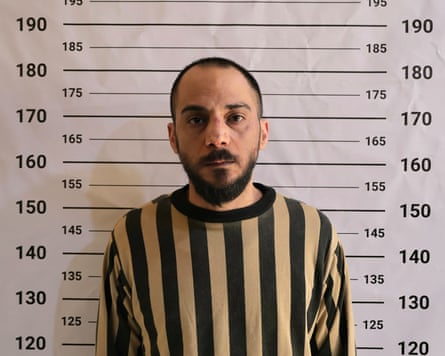
While Youssef has become notorious because of the videos, Tadamon residents have long insisted there were many more perpetrators, including members of the NDF led by Saqr. During the celebrations of Youssef’s arrest on Friday, they called for Saqr to be detained.
Ahmed al-Homsi, 33, an activist with the Tadamon Coordination Committee, a network that documented the massacres, said: “Amjad was just a foot soldier compared to Fadi Saqr. In Tadamon, nothing happened without orders from Fadi Saqr, whether it was the robberies, the arrests, the disappearances or the killings. He was in control, he knew about it all.”
Saqr has denied responsibility for the massacres. He told the Guardian he “only learned of the massacre through the media” and said he “trusted the judicial process”.
“Anyone proven to have committed crimes against humanity must be punished,” he said. “My silence regarding the campaigns against me stems from my desire not to influence the course of the investigations.”
Saqr said he became the NDF commander in Damascus in June 2013 – two months after the public footage of Youssef’s executions of civilians by the pit was recorded. However, the Guardian has reviewed unpublished videos of additional killings carried out by Youssef and NDF personnel that includes footage shot in October 2013, four months into Saqr’s tenure.
Prof Uğur Ümit Üngör, one of the Amsterdam-based academics who obtained the videos and leaked excerpts to the Guardian, said: “What is now often described as the Tadamon massacre was not a single event, but a process of mass killing carried out throughout 2013 and in the years that followed. The NDF participated in these atrocities and Saqr, whatever his personal involvement, was part of the chain of command.”
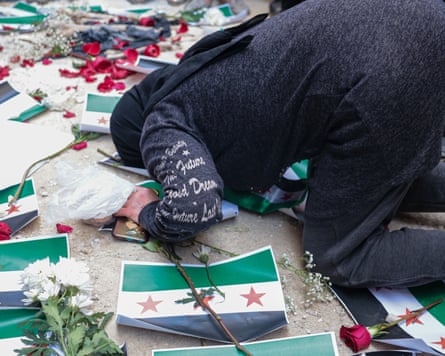
Tadamon residents and other Syrians have long expressed their outrage at the new government’s collaboration with Saqr. Maher Rahima, a 31-year-old man who lived through the atrocities, said: “If the officials of the new government had seen what I saw in Tadamon and heard the sounds of torture and smelled the burning of bodies, they would be ashamed to look at themselves in the mirror after protecting Fadi Saqr and other criminals.”
The government has justified working with figures like Saqr by saying it is attempting to balance the need for justice with pragmatic considerations of ensuring Syria’s stability in its transitional period. Saqr has helped the government to liaise with remnants of the Assad regime who have mounted a low-level insurgency since the fall of the former Syrian president.
Al-Barazi said plans to build a case against Saqr had been in place for a few months, during which time the political cost of keeping the former militia leader onboard increased.
“I think there’s a real acknowledgment that whatever gains from him, balanced against the tension it was creating with the public, is not worth it,” she said, adding that Youssef’s arrest had “helped to push this to the forefront”.
Al-Barazi visited residents of Tadamon on Tuesday, inviting them to join forces in building a case against Saqr and explaining how the commission would ensure witness protection. “We said that we would help them come together with a case to put forward to the prosecution against Fadi Saqr,” she said. “That would mean there would be a request to arrest him.”
It is ultimately up to the Syrian judiciary, not the commission, to issue such an arrest warrant, but al-Barazi said she had “heard of no resistance” to the plans to mount a case.
In Tadamon, the prospect of Saqr facing justice has given new hope to people who saw their neighbourhood turned into a killing field and feel little has been achieved in terms of accountability. Al-Homsi said: “Fadi Saqr’s arrest would be way bigger than that of Amjad Youssef. It would be like a second liberation day.”