5 hours ago
5
5 hours ago
5
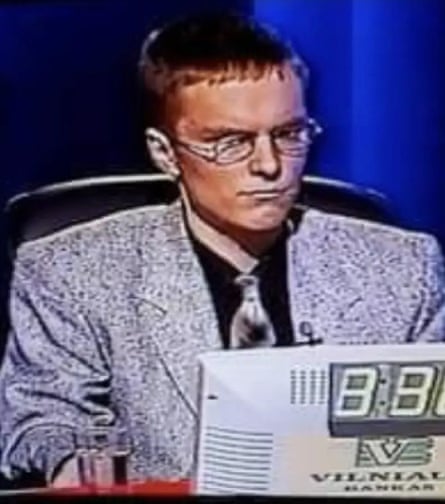
Valdas Dambrauskas can reel off the questions and answers without a moment’s pause. Who won the first Academy Award for best actor in 1929? It was Emil Jannings, even if someone else might have been tempted to go with Charlie Chaplin. Which country publishes the highest number of daily newspapers? India was the clear winner. Can you name the nation that produces the most electricity per capita in the world? His family, watching back home, clasped heads in hands but he was right: back then, in 2002, the answer was his native Lithuania.
It was enough to win Dambrauskas about £725 in his appearance on Six Zeros – A Million, the Lithuanian version of Who Wants to Be a Millionaire? “At that time it was quite big money,” he says. “I could have bought a flat in my home town; it was a very difficult period there and they were almost free. But my plan was to go to England and follow my dream to become a coach, and that’s how it started.”
More than two and a half decades later the story continues at Old Trafford where Dambrauskas will manage the Azerbaijani champions, Sabah, in their Champions League debut on Thursday night. The club’s journey is some tale in itself given Sabah, who came through a dramatic playoff with Hapoel Be’er Sheva, did not exist until 2017. But the path taken by their head coach, a 25-year-old office worker with only a modest football background when his general knowledge skills were put on display, is virtually unparalleled in the modern game.
The money he won helped Dambrauskas and his girlfriend, now wife, to move to north London and establish themselves in an alien environment. “I would have done it anyway – the show came in the middle of our planning,” he says of the move, which became an ambition after a work visit to Norway in 2000.
In Scandinavia he had grasped the extent of the Premier League’s incipient popularity. “I realised this was where real football is. There was no pathway to coaching in Lithuania if you hadn’t been a player; it was impossible. But if I could take a course in England, maybe I could get a chance to step on the ladder at home.”
Dambrauskas spent eight years in London. “The start was very, very difficult. I wasn’t speaking decent English, had no contacts, we didn’t know anyone, we lived in different places, did all kinds of jobs.” He worked in a Muswell Hill pub, delivered newspapers in the area, held down jobs in a nursery school, as a gardener, in sales, and as a self-employed handyman, often simultaneously. The hours were relentless but so was the young man’s focus.
It was a life of an immigrant couple straining every sinew to make their way. Their first child was born in 2004; by then Dambrauskas, who had studied philosophy and social sciences in Lithuania, had enrolled on a sports science and coaching course at London Metropolitan University. From his classroom on the 10th floor he could see the Emirates Stadium sprouting up during that spell of Arsenal invincibility.
The Access to Sports Project, based in Finsbury Park, is a stone’s throw from Arsenal but galaxies away in another sense. It is where Dambrauskas landed his first coaching role, giving sessions to children on Saturday mornings and during school holidays. His next step is all the more remarkable for what has passed since. A round of interviews with Manchester United Soccer Schools brought the chance to work with youngsters around the country, and sometimes on residential trips abroad, under the banner of the then serial title winners. Despite the name it was a far cry from even academy football, but the injection of confidence was transformative.
“It was John Shiels, CEO of the Manchester United Foundation, who gave me the chance. I don’t know what he saw in me – I came in with very broken English and couldn’t express myself as I can now – but he really supported me. At the end of the year he wrote me an appraisal of what I’d done. He said that I was good and could do much more. It was a massive, massive boost for me.”
Through a friend at university, Dambrauskas became involved with the community sports organisation London Tigers. “He told me they always needed coaches.” Eventually he took charge of their semi-professional team, which played in the Spartan South Midlands League. “That was where it really started, coaching at some kind of level.” It meant managing in the FA Vase and the early rounds of the FA Cup.
Dambrauskas also undertook part-time roles at Fulham and Brentford before working as a sports activator for Central YMCA on Tottenham Court Road. He would later take a broader role as sports development manager at London Tigers and took his coaching badges at the London Football Association. “It was a time with no holidays, no days off. I’m a big reader, I read all the time and studied constantly. Sometimes I would finish my university work on the bus. I took every kind of education I could and went to every possible course for every meeting.
“Over the years I had countless interviews for coaching roles, for jobs at centres of excellency in London and outside, so many CVs and applications, but I understood early on that it’s very difficult in England to get on the ladder and that to coach at professional level there was probably impossible. If there is a story where someone is starting in the community scheme and going all the way to become a head coach, I am still to find it.”
By late 2010 he felt ready to pursue what had originally been the end goal: a role in Lithuania. He had started working with their under-17s and agreed to join Ekranas, national champions at the time, as assistant manager. “I had the London Tigers job, 15 hours a week at Brentford and some other things here and there. We had a good life and people thought I was crazy going back home and earning about a fifth of what I was getting in England. But the biggest risk in life is not to take risks.
“I’m forever grateful to my wife for being behind me. We always faced questions: twenty- or thirtysomething guy always studying, trying to work in football, spending all his money on books and courses rather than buying an apartment or something for the family. But I’m very happy with how it turned out and nobody questions those decisions now.”
after newsletter promotion
A kaleidoscopic career bloomed. By December 2014 he had become head coach at Zalgiris Vilnius, the biggest club in Lithuania, winning two more league titles and various cups in a move that felt unthinkable during a humble upbringing in the tiny northern town Pakruojis. “My childhood was not a gift. My dad died when I was 11, and if he knew that I had the job at Zalgiris and that we won so many trophies he would be the happiest person in the world.”
Dambrauskas was not content to stop there. “You are basically nobody and suddenly you get this job. Then you have to prove yourself to everybody again and again and again. So you reached this step on the ladder but what’s next? How do you go to the next level?”
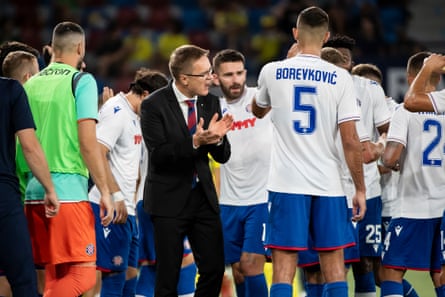
After three years he joined the upwardly mobile Latvian club RFS but harboured concerns about the prospects of leaving the small Baltic football bubble. In the event he need not have worried. Since 2020 he has managed in Croatia with Gorica and Hajduk Split – the latter are “like a tattoo you can’t ever take out, it leaves a mark on you” – in Bulgaria with Ludogorets, in Greece with OFI Crete, in Cyprus with Omonia and with the Hungarian club Diosgyor, who he describes as having “one of the biggest hidden football potentials in Europe”.
Itinerant career paths such as that are, especially in eastern and southern Europe, nothing new. But Sabah had been courting Dambrauskas for two years before he took over in 2025. Once the stars had aligned, he worked a miracle. In 2024-25, Sabah had finished 41 points behind the biggest club in Azerbaijan, Qarabag. Last season Sabah beat them to the title by nine points, earning their crack at the Champions League qualifiers. “I’m really grateful to Qarabag. Every game against them is like taking a master’s degree.”
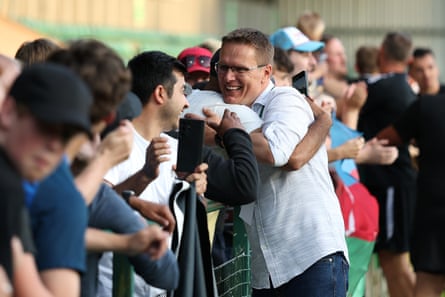
He waxes lyrical about the stability and facilities available at well-backed Sabah, who were cheered on with fervour befitting a national team when they thrillingly overcame an injury-time deficit against Be’er Sheva. Their success has come with a multinational squad that plays bold, front-foot football in the style he preaches. “But if you don’t understand the human being in front of you, it’s very difficult to pass him your ideas and build trust,” he says.
“What is important in east Africa can be completely different from what someone needs in west Africa or anywhere across Europe. You need to be able to understand different cultures, different traditions, different ways of speaking or behaving. Without that it’s impossible to do anything, and I believe this is where my strength lies.”
It is a glorious piece of circularity that Dambrauskas and Sabah will be watched from the stands on Thursday by a number of his old colleagues from Manchester United Soccer Schools. He beams at the thought; none of this could have seemed remotely attainable during their time on the grass together. “But I had this belief. I had this confidence all the time that I could do it.”
He is equally delighted that the draw has also brought a January visit to Arsenal, that huge presence in his eyeline during those years studying on Holloway Road. He is 49 and would surely lever himself among Europe’s most sought-after coaching properties if he can take Sabah further. “We’re going to respect everyone but not be afraid of anyone. There’s a very nice song by the Lithuanian band Colours of Bubbles called Truth or Dare. Very soon we’re going to find out the truth about ourselves and what we can do. It will be very beneficial for us because I don’t want this club to be a one-day wonder.” As final answers go, it may be his most significant yet.