2 months ago
135
2 months ago
135
“Viktor Orbán is a true friend, fighter, and WINNER, and has my Complete and Total Endorsement for Re-Election as Prime Minister of Hungary,” Donald Trump wrote on Truth Social last month. The US president followed up with a video message to far-right leaders meeting in Budapest, describing Orbán as a “fantastic guy”.
Orbán, a long-term friend and ally of Trump, may need all the support he can gather ahead of the Hungarian parliamentary elections on 12 April. The prime minister and his Fidesz party are trailing in most opinion polls. His main challenger, Péter Magyar, and his Tisza party are leading by nearly 10 percentage points. The public debate in Hungary has shifted dramatically: the question is no longer whether the opposition can win, but whether Orbán will accept defeat.
The significance of the Hungarian elections extends far beyond the country’s borders. Orbán has become a central figure among international authoritarian, nationalist rightwing leaders. He articulated the concept of the “illiberal state”, laying out as early as 2014 an autocratic system grounded in aggressively nationalist and socially conservative principles within a coherent ideological framework. More importantly for his followers, he has sought to demonstrate that such a model can, in fact, be put into practice. During his 16 years in power, Orbán has systematically dismantled the central pillars of liberal democracy, from an independent judiciary to a free press. In 2022, the European Parliament declared that Hungary could no longer be considered a full democracy, describing the country instead as an “electoral autocracy”.
Orbán has long claimed to have won his self-declared culture war, which has made him something of a superstar within the international rightwing movement.
And it is now rallying behind its main crusader. In mid-January, a dozen of the most prominent figures of the populist nationalist right appeared in a joint video message. They were all there: from Israel’s prime minister, Benjamin Netanyahu, and Argentina’s president, Javier Milei, to the Italian prime minister, Giorgia Meloni, and the Czech prime minister, Andrej Babiš.
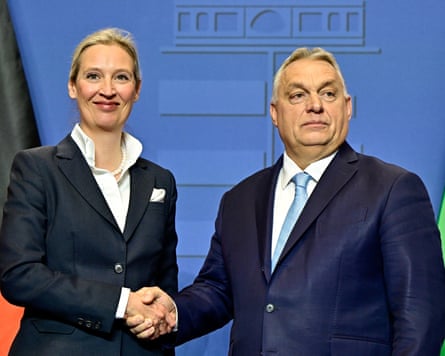
“Thanks to leaders such as Viktor Orbán, the camp of patriots, defenders of nations and sovereign peoples is enjoying increasing success in Europe,” declared Marine Le Pen, the former leader of France’s far-right National Rally. Meanwhile Alice Weidel, co-leader of the far-right Alternative für Deutschland (AfD), praised Orbán’s controversial pro-Putin stance, concluding: “Europe needs Viktor Orbán!”
The nearly-two-minute video could perhaps best be summed up by paraphrasing the closing line of Karl Marx and Friedrich Engels’s Communist Manifesto: rightwing nationalists of all countries, unite!
Yet while the international labour movement of the late-19th century was united by common ground – the struggle for decent working conditions and a living wage – the new nationalist international is divided by an inherent contradiction that cannot be reconciled. Political leaders who place their nation’s interests above all else will, sooner or later, clash with others guided by the same principle. That tension was laid bare during the Greenland crisis. Even some of Trump’s most ardent allies, such as Nigel Farage, described his moves regarding Greenland as “a very hostile act”.
It is one of history’s bitter ironies that this very attempt to construct an international nationalism – a global collaboration among authoritarian rightwing forces – may ultimately contribute to Orbán’s downfall. The roots of this paradox run deep into Hungary’s past. After the first world war, the treaty of Trianon stripped Hungary of about three-fifths of its territory and two-thirds of its Hungarian-speaking population – a trauma that has left deep scars on the nation’s self-image.
One of the first measures taken by Orbán’s newly elected government in 2010 was to grant Hungarian-speaking minorities in neighbouring countries the right to vote in Hungarian parliamentary elections. The result was politically significant: overwhelming majorities within these communities have supported Orbán ever since.
But this political love story now appears to be coming to a bitter end – precisely because of Orbán’s close collaboration with his nationalist allies.
In last year’s Romanian presidential election, Orbán backed the far-right, pro-Putin candidate George Simion, despite his openly anti-Hungarian rhetoric. In response, an overwhelming majority of Romania’s Hungarian minority defiantly cast their ballots for the liberal, pro-EU candidate Nicușor Dan, playing a decisive role in securing his narrow victory.
That Orbán may have gambled away what was once his most loyal voter base is less surprising than it might first appear. Rather, it reflects a deeply ingrained ideological reflex. It is the same slightly twisted logic that has led the Sweden Democrats – founded by neo-Nazis in the 1980s and now the country’s second-largest party – to support their rightwing radical counterparts, the Finns Party, despite their repeated attacks on Finland’s Swedish-speaking minority. For the very same reason, Orbán has also supported his far-right, Hungary-bashing counterpart in Slovakia, Robert Fico.
Orbán, Trump or Swedish nationalists – it hardly makes a difference. Global rightwing nationalist parties all share the same worldview, which the Sweden Democrats’ ideologue, Mattias Karlsson, has aptly described as a life-and-death struggle between “value-conservative patriots and cosmopolitan cultural radicals”.
Despite the new nationalist international’s endless rhetoric about the primacy of the “nation” and devotion to their “own people”, the struggle against the liberal state remains its overriding priority.
Its determination to preserve and strengthen its own authoritarian rule will always trump any professed concern for the rights of a particular national community. It is this authoritarian reflex that may ultimately cost Orbán the upcoming Hungarian elections – and, with them, his position as a leading figure of the global authoritarian, nationalist rightwing populist movement.
-
Gellert Tamas is a Swedish-Hungarian author and journalist. His next book, 56 Days, will be published in 2027