2 months ago
105
2 months ago
105
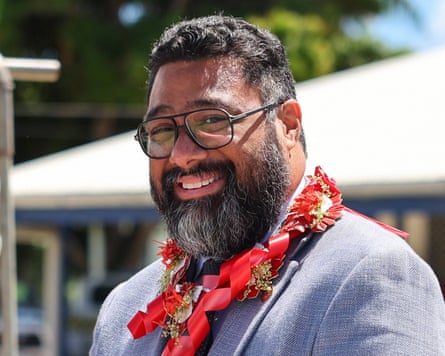
The recently elected leader of Tonga has described a deal to partner with the US on deep-sea mineral exploration as an “exciting development” amid concern in the small Pacific nation over the practice of seabed mining and the potential environmental impact.
Tonga is located in the South Pacific Ocean, a region attracting growing interest over whether critical minerals buried in the seabed could be extracted to help power industries and green technologies.
In some of his first comments on deep-sea mineral exploration, Lord Fatafehi Fakafānua told the Guardian that Tonga had a tradition and historical knowledge of the cultural practice, and the nation would be “cautious” in ocean exploration.
The US and Tonga struck a deal in February to cooperate to “advance marine scientific research for the responsible exploration of seabed mineral resources”. The statement, released on 26 February, said the two countries were “uniquely positioned” to work together in this field.
“Together, we commit to responsible exploration of seabed minerals and enhancing global scientific understanding of the deep ocean,” the statement said.
Fakafānua, who was elected prime minister in November 2025, said the partnership was “an exciting development for us”.
He added: “With regards to deep-sea minerals, as a nascent industry, Tonga remains fully committed to scientific exploration of our oceans under the multilateral systems we are legally bound to and continues to strictly maintain a cautious approach of firstly do no harm.”
Tonga has a long-running partnership with The Metals Company for exploration work, though no mining has taken place.
Environmental groups are concerned that exploration and deep-sea mining could damage fragile ocean ecosystems. Concern has also been raised in Tonga that the public have not been adequately consulted on the US deal.
Dr ‘Ungatea Fonua Kata, a respected public figure and academic, is among the strongest critics against deep-sea mining in Tonga. Kata described the Pacific Ocean as the country’s “home” and said communities rely on the sea for much of their livelihood.
“The Pacific Ocean is the largest ocean on Earth yet it’s our home, we are opposed to any activity that could damage that environment,” said Kata, who is also education director of the largest church denomination in Tonga, the Free Wesleyan Church.
“We have very little land mass,” she said. “Our livelihood is based in the ocean, so we do not want anything done that would be detrimental to our place of residence.”
Kata said plans for cooperation with the US on marine research lacked public consultation, particularly on an issue so vital to Tonga.
Drew Havea, the chair of the Civil Society Forum of Tonga, is a strong opponent to deep-sea mining and has called for a moratorium on the practice.
“Most Tongans disagreed with their country’s involvement in deep-sea mining,” Havea said. He called for a referendum on the issue at last year’s November election but the then government did not comply with the request.
Tonga’s Civil Society Forum has found strong support regionally from the Pacific Network on Globalisation, a leading environmental and advocacy group. Its regional coordinator, Joey Tau, has urged caution and warned that deep-sea mining was a huge unknown.
He said: “There is more need for deep-sea science and research, but one that is done independently, that benefits the common good of all humankind, and not one that is driven by industry.
“Mining has really a bad history in this part of the world. You can [also] look at other continents – it has displaced people, it has brought about social differences,” he said.