3 months ago
172
3 months ago
172
“How many?”
On the end of the phone is a nice press officer for the Greens, head full from a long day in Gorton, Manchester, showing off their would-be MP. And now, as Friday’s sky turns indigo, I’m calling about reports from Lewisham, south London, that tomorrow they’re expecting a flood of 500 Green activists. This comes as a surprise to the party’s own news machine.
“Are you sure?”
My figures turn out to be wrong. It’s nearer 600.
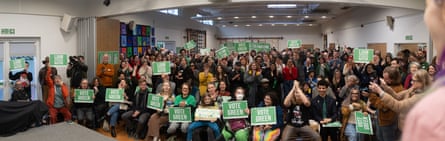
On a dreary Saturday morning, they stream in from all over London, hare along Kent’s A-roads, pour off Suffolk and Surrey trains, to converge on this primary school. It’s the largest venue the volunteers could hire and the corridors, the loos, even the little library with its impressive range of Julia Donaldsons, are all heaving with grownups.
We cram into the assembly hall, where the crowd is declared as the biggest turnout in Green history. The sole exception, I find later, is polling day of the last general election; yet today’s draw is not some short, sharp fight for Westminster, but a campaign for the council, where ballots are months away. In normal times, this stuff is about as pedestrian as politics gets, drawing a handful or two of diehards to trudge door to door, begging old customers to put their X in the usual spot.
Yet the size of today’s crowd tells you these aren’t normal times. This winter is a hinge moment in British politics, the point at which the default choice of leftwing voters is no longer Labour. In Wales, it will be Plaid Cymru; in Scotland, the SNP. And in this corner of inner London, as in many English cities, it will be the Greens.
For this position, the party owes much to its opponents, among them Jeremy Corbyn, Zarah Sultana and their genius advisers for so swiftly turning Your Party into a sparsely attended wake. But its biggest bouquet must go to Keir Starmer’s Labour.
Look up “one-party state” in a political dictionary and alongside Pyongyang there will feature Lewisham. At the last council elections in 2022, Labour scooped every single seat, plus the mayoralty. The local Green party, on the other hand, shrank so drastically it came close to shutting down.
Then: lift-off. Lewisham began 2025 with about 500 Green party members; by autumn, almost as many were signing up in just one week. At the start of 2026, the local party stands at about 2,500, putting it just behind the Green “fortress” of Hackney. At the school’s entrance I meet Ed, whose job it is to call up local newbies and welcome them to the party. Last January, the task was his alone. Today, he heads a team of nearly 25.
“Six months ago, I wouldn’t have believed we could fight Lewisham,” says the Green party CEO, Harriet Lamb, sipping tea in the hall and looking around with undisguised astonishment. “Now I look across Manchester, Birmingham, Newcastle and I think: this is a social movement.”
From the stage booms another announcement: later in the day, Zack Polanski will address volunteers. Ah, Zack. In Westminster, they are wowed by the Greens’ new leader, who is energetic, likable and fluent enough in the media to trouble Nigel Farage. Yet what’s striking today is how little activists or potential voters talk about Polanski.
Drop his name and praise flows, but ask why they’ve gone Green and you hear condemnation of the Labour party. Lamb was a Labour member; Lewisham’s two Green councillors defected from Labour, claiming they were “bullied out” for opposing the brutal destruction of Gaza. And every single non-white voter names Palestine as the reason they can no longer back Labour.
While SW1 theorises that the Green surge is down to Polanski, SE4 reality says it’s 99% Starmer.
One resident comes to the door having just read about Shabana Mahmood giving the police facial recognition technology. “As a black man, I don’t feel safe.” A dad pushing a pram talks of how the Labour council has approved a giant block of flats to go up at Lewisham market, of which only a fraction will be for social rent. “They ought to be doing more for the common man.”
I am recounting conversations from just before the latest Epstein file releases,which can only sharpen that sense of disconnect. Because what they show is how at the height of the banking crisis, with Wall Street and the City on public-sector life support, the class of financiers who brought about this disaster were eyeing up billion-dollar deals and fresh assets, whether superyachts or young women. While the rest of us headed into years of immiseration, the filthy rich carried on regardless – and they did so with the willing aid of the centre-left elite, whether Peter Mandelson or the French Socialists or the US Democrats.
In these semi-detached houses, with freshly painted doors and big burglar alarms and new shutter blinds, voters don’t kvetch about rising prices. Instead, they spurn Labour’s values. For all that our prime minister claims Harold Wilson as an inspiration, he has roundly ignored his hero’s maxim that Labour is “a moral crusade or it is nothing”.
All this is a gift for Polanski, and a potential headache. He heads a party that was fringe, yet can now claim to be mainstream. At the same time, many if not most of his members are embarking on their second political marriage after Corbyn. Every second marriage is a triumph of hope over experience, of trusting the new guy won’t let you down, while on alert for all the warning signs. The optimism of these activists is duly tempered.
One prospective councillor warns of the dangers of “building a project around just one guy”. A campaigner estimates that he has sunk a week of unpaid work into simply pulling off today’s meeting. Yet another notes: “We have an infrastructure for a party of 50,000 members when we’ll soon be at 200,000. It’s not sustainable.”
An hour after getting off the Pendolino from Manchester, Polanski pitches up. When I voice his members’ criticisms, he accepts them all. “It’s like being a startup that’s been around a long time, but suddenly we’re really getting going,” he says. “We’re having to run and catch the ball at the same time.”
While he spent the first few months of his leadership making a noise, getting the attention of journalists and voters and donors, he will now focus more on policy. Last night, he spoke with Joseph Stiglitz, the Nobel laureate in economics and campaigner against inequality. Next month, he’ll set out his platform on tax and spend. The big question is how he will find the time and space to do all this, when there are so many audiences for whom he needs to perform. In Gorton, he says, he had five lapel mics pinned to him at all times. He could not even go to the loo in peace.
But now he has to gee up the troops and make a speech, while running on empty. He heads towards the assembly hall, where a great mass of expectation awaits.
A video shows what happens next: he bounds on to the little stage, looks out over the wall of bodies. As he takes in the crowd, his eyes grow wide.
-
Aditya Chakrabortty is a Guardian columnist