2 months ago
97
2 months ago
97
It is only two months since Jakub Hrůša’s rightly acclaimed and idiomatic conducting of Leoš Janáček’s penultimate opera at Covent Garden. Now, like the proverbial London buses, here comes the same piece again (though this time calling itself The Makropulos Affair rather than the Royal Opera’s The Makropulos Case), with Simon Rattle leading two concert performances at the Barbican Hall.
Rattle’s first-night account was simply sensational. He plunged at almost manic speed into Makropulos’s compellingly exciting prelude, and barely let up for the best part of two hours, as the opera played without an interval. The fierce tension may occasionally have come at the expense of some of the lighter touches that beguiled in Hrůša’s approach. Yet Janáček’s extraordinarily deft ear for orchestral detail and harmony – like the bassoon solo announcing the central character’s first appearance – was never sacrificed. The LSO played thrillingly.
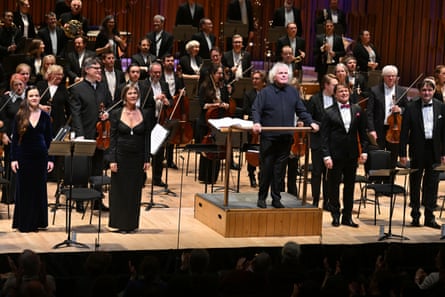
To succeed, this opera requires a commanding performance of the central role of the alchemically young diva Emilia Marty, originally born as Elina Makropulos in 1585. It got that from the German soprano Marlis Petersen. Marty is not an instantly sympathetic character, but Petersen found the emotional intelligence and vocal grandeur to make her final act transformation truly uplifting. Janáček’s writing for Marty is often cruelly exposed, but Petersen rose to every challenge. It was a performance fit to be bracketed with the most memorable Martys.
It also helped that all the many minor characters were so sharply drawn. Having several of these roles taken by native Czechs brought instant authenticity and nice contrasts. If Aleš Briscein’s Albert Gregor and Vit Nosek’s Janek stood out, Jan Martiník’s Kolenaty, Svatopluk Sem’s Baron Prus and Doubravka Novotná’s Krista were in no way eclipsed. Peter Hoare was a lively Vitek, while Alan Oke effortlessly stole his scenes as the elderly Count Hauk-Šendorf.
Tellingly, this concert version of Makropulos was able to pack more emotional impact and dramatic coherence than Katie Mitchell’s scattergun stage production in November. The story of a woman who has lived for 337 years, and finally embraces death rather than eternal life, emerged under Rattle as what Janáček surely thought it was: an intense and humane renunciation of the unattainable and tragic. A century on from the premiere in Brno, a work that was written in the shadow of first world war slaughter now felt frighteningly relevant to an era in which crazed autocrats such as Putin and megalomaniacs like Musk are seriously craving a version of the Makropulos alchemy to achieve their own immortality.