3 months ago
135
3 months ago
135
Blistering heat is continuing across most of Australia as the worst heatwave since black summer brings temperatures nudging 50C in parts of the country.
Adelaide residents woke up to 31C on Thursday morning, after the city reached a scorching 43C on Wednesday, according to the Bureau of Meteorology.
Severe to extreme heatwave warnings remained in place on Thursday for every state and territory except Queensland, the senior meteorologist Sarah Scully said.
“The heat is intensifying right across southern Australia,” she said.
Extreme temperatures across Victoria, South Australia and Western Australia were expected to extend towards Canberra and New South Wales from Friday.
On Thursday, maximum temperatures were expected to be 8-14C above average for January through northern Victoria, South Australia and the east and south coast of NSW.
Firefighters were preparing for extreme fire danger across South Australia’s mid-north and northern Victoria, building to catastrophic conditions in the Wimmera and northern Victoria on Friday.
Sign up: AU Breaking News email
That would be “the most dangerous day with regards to fires”, Scully said, due to hot, dry and windy conditions, including damaging winds with gusts up to 90km/h.
Fires were already burning in several states, with residents affected by a bushfire at Longwood in Victoria warned to “leave immediately”. The warning applied to people in Avenel, Caveat, Dropmore, Highlands, Ruffy, Tarcombe, Terip Terip, Locksley, Longwood, Longwood East, Ruffy, Tarcombe and Upton Hill.
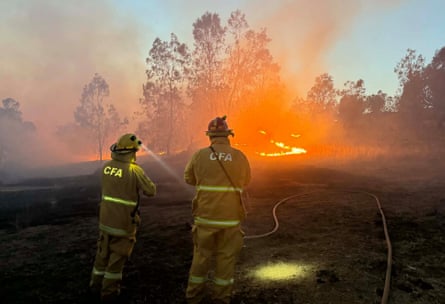
The Hume Freeway was closed in both directions between Seymour and Violet Town on Thursday – a stretch of about 74km.
Total fire bans were in place in mid-northern South Australia and across the Mallee, northern, north central and north-easterm Victoria and NSW’s southern Riverina. The total fire ban will extend to the whole of Victoria on Friday.
The potential for thunderstorms and dry lightning across much of Victoria and southern NSW was adding to concerns. Storms could bring large hail to the north-eastern ranges of Victoria, Scully said.
What happens to the body during a heatwave?
ShowHeatwaves put intense stress on the body - particularly the cardiovascular system and kidneys. The heart has to work hard to deliver oxygen and nutrients to organs while also increasing blood flow to extremities. Cardiovascular collapse – the heart suddenly failing – is a main cause of heat-related death in Australia.
Symptoms to watch out for:
- Hot skin
- Confusion
- Weakness
- Cramps
- Dizziness
- Vomiting
- Fainting
On Wednesday, some coastal towns in Western Australia nudged towards 50C, she said, with 49C recorded in Onslow on the Pilbara coast.
Many places across Victoria recorded their hottest day since 2020, including Melbourne where temperatures climbed to 40.9C. Avalon airport, near Geelong, hit 43.6C, also its hottest day in six years.
Walpeup in Victoria’s Mallee region hit 45C, with Mildura, Hopetoun and Warracknabeal not far behind at 44C.
In Adelaide, suburbs north of the city reached the mid-40s, including Edinburgh at 44.6C. Temperatures were as high as 46C at Ceduna, Port Augusta, Wudinna and Tarcoola.
It was hotter than normal in Tasmania, particularly in the north and east, reaching 33.9C at Ouse, about an hour’s drive north-west of Hobart, and in St Helens on the north-east coast.