3 months ago
149
3 months ago
149
‘The problem the art world has with class is a systemic issue and the need for support is everywhere,” says Meg Molloy, the founder of Working Arts Club, which aims to help people from working-class backgrounds secure jobs in the arts.
Founded in 2024 as an independent initiative in London, it has collaborated with the likes of the V&A, Royal Academy, Christie’s, Sotheby’s and Frieze London.
Now the club, which hosts events such as career meetings, panel discussions and private exhibition tours, is planning to expand throughout the UK, launching in Manchester on 24 March and then branching out to other cities.
“It’s vital that the club expands to the north of England,” says Molloy. “The north has an extraordinary art scene but the UK arts industry is undoubtedly London-centric, which creates huge financial and logistical barriers for working-class people outside the capital.
“When access depends on travel, unpaid or badly paid internships, and being physically present in the city, working-class people are being structurally excluded.”
Working Arts Club is free to join and has more than 1,000 members in London.
Molloy said: “Anyone from a working-class background working in the visual arts should feel that Working Arts Club exists for them, wherever they are – from a senior leader in a London gallery to someone looking for their first job in the industry in Sheffield.”

Evidence shows a stark class disparity within the creative sector, with those from lower socio-economic backgrounds significantly underrepresented. Not only is this present among artists themselves, but among people working in galleries, museums and other cultural institutions.
According to the latest UK government statistics, the creative industries employ 2.42 million people, of which 78% identify as being from a “more advantaged socio-economic background”.
Last year, Guardian analysis found that almost 30% of artistic directors and other creative leaders were privately educated, compared with a national average of just 7%. More than a third (36%) of the organisations’ chief executives or other executive directors went to private schools.
Molloy works as a consultant for artists and galleries, and her career in the arts spans more than a decade. She describes the experience as being “surrounded by people who’d gone to private school and studied art history – a subject barely even available in state education”.
“There’s no diversity of voice or thought in that, and it’s creating a bubble. It’s exclusionary, unfair and ultimately makes the art world less vibrant and harder for working-class people to infiltrate,” says Molloy.
Working Arts Club has created a network of creative job-seekers and professionals through its newsletter and Whatsapp group, where job vacancies and events are shared.
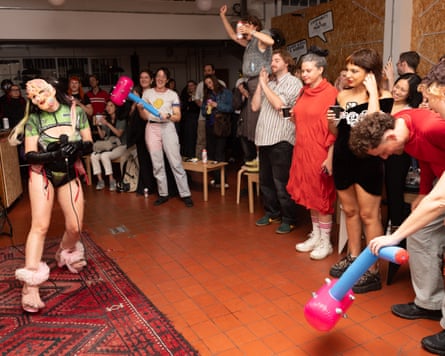
“Those who are just starting out in the sector can immediately be chatting with experienced people from large organisations,” says Kirsty Jukes, a communications officer at the Manchester Art Gallery, who will lead the northern wing of the club. “Having seen the benefits of the London iteration myself, I know it would be a great network to have up here as well.”
Amy Gilles, 31, a club member and operations manager at the Quentin Blake Centre for Illustration, said it had made networking “much more accessible”.
“I received a free ticket to attend Frieze Art Fair, which is incredibly expensive and a huge financial barrier. Being able to go and see how the industry works was hugely impactful,” said Gilles.
Other members highlight the need for class-based initiatives within the sector. “Networks, clubs and collectives focused on working-class people are so important because they create spaces where shared realities don’t need explanation,” says Jennifer Jones, 26, a club member who also founded a working-class artist group called Grafters Collective.
“I’d been feeling like no one around me understood how much harder it is to be in these spaces and to balance everything when you don’t have financial support, don’t have industry connections and don’t understand the social codes or how the industry works because you come from outside of these circles,” she says.
As well as the launch party in Manchester, there will be a social event in Liverpool in April. As part of the club’s expansion, Molloy and Jukes hope to partner with galleries, museums and art fairs in the north of England to set up panel talks and tours for its members.
Molloy says the club is looking for funding “to make the network sustainable and allow it to grow”.