2 months ago
128
2 months ago
128
In Albany, Western Australia, Finnish artist Kari Kola has thrown beams across the night sky with a spectacle that may even be visible from space
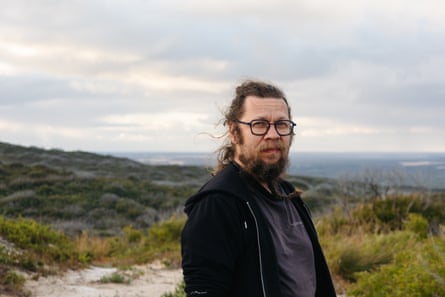
The coastal scrub above Whalers Cove crackles underfoot as Menang man Larry Blight kneels and pushes his hands into the sandy soil. After a moment he lifts a tangled bulb from the earth.
“This is bloodroot. Our people were named after it,” he says proudly.
The plant is known by the Menang people as meearn, and Menang means “those who eat the bloodroot”.
“It’s a cross between a chilli and an onion,” he adds, slicing it open to reveal its crimson flesh. “Quite spicy. It was part of the everyday diet.”
Blight is guiding a small tour group across Western Australia’s Vancouver Peninsula overlooking King George Sound. Many in the group have travelled to Albany for the city’s bicentenary celebrations, including Lighting the Sound, a monumental light installation by the Finnish artist Kari Kola, running over three weekends until 29 March.
Presented by the cultural organisation Form, the work spans more than 10m sq metres across King George Sound, making it the largest light installation ever staged on Earth.
But the inspiration was far smaller: a single bulb of bloodroot pulled from the earth here at Whalers Cove during an earlier visit with Blight.
“I was thinking what to create, what is the storyline, what is the connection?” says Kola, who has illuminated landscapes from the Connemara mountains of Ireland to Stonehenge in the UK. “I wanted to go back in time more than 200 years.
“Then Larry showed me the bloodroot. Everything started from there.”
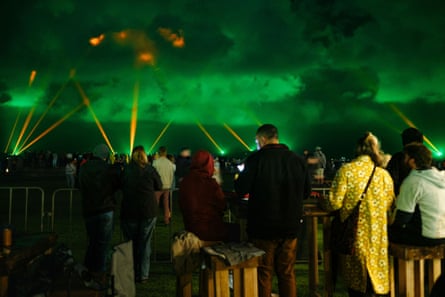
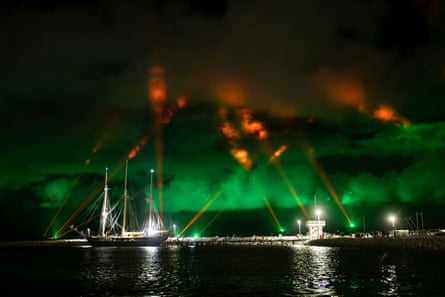
As the sun slips below the ocean on the opening night of Lighting the Sound, the first shafts of green light rise into the sky above King George Sound, piercing the darkening clouds. Soon, the green light gathers into an enormous aurora-like wash. Red shards follow, like bloodroot leaping into the sky.
“We are creating the red roots which connect the land and the cosmos,” Kola says.
It is particularly poignant to stage this spectacle at King George Sound, where so much history has unfolded. Known to the Menang people as Mamang Koort, meaning “heart of the whale”, these waters have been a gathering place for more than 45,000 years.
In 1826 the British brig Amity arrived, establishing the first European settlement in Western Australia. The harbour later became the centre of a whaling industry that operated for more than 140 years, ending when Australia’s last working whaling station closed in Albany in 1978. It also saw the departure of thousands of Anzac troops, who sailed off from Albany to the first world war. The tradition of the Anzac dawn service is believed to have begun here in 1923, on the hills overlooking the sound.
But the story of this place is not only one of conflict. Early Albany was often described as the “friendly frontier”, where Menang people and newcomers forged relationships that were unusual in the early years of colonisation. In the decades that followed, the harbour became Western Australia’s gateway to the world, welcoming ships, migrants and travellers arriving from distant shores.
For Menang elder Carol Pettersen, Lighting the Sound is a chance to reflect on the many histories that converge here. “We’re choosing to use the word commemorate,” she says. “It’s about recognising the past and celebrating the future.”
Realising that vision required two years of consultation with Menang elders and the Albany community, and a lighting system capable of reaching far beyond the land itself. Kola initially planned to illuminate the surrounding hills, but early tests showed the landscape looked too small from 8km away. Instead, he turned the sky into the canvas, sending beams high into the atmosphere where clouds and shifting weather become part of the work.
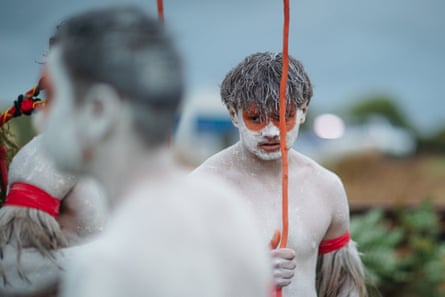
About 750 LED floodlights and 15 red “pencil beam” lights now stretch across the landscape, mounted on steel towers rising up to 20 metres above the scrub. “At this scale there’s nobody you can ask how to realise it,” Kola says. “You have to push the boundaries and learn in the process.”
The scale of the installation reaches well beyond Albany. Kola believes the glowing harbour may even be visible from orbit, and he has begun discussions with astronauts aboard the International Space Station about photographing the work from space.
Earlier that day, Pettersen said she was hoping for clouds. In Menang culture, she explains, people have long used firelight and clouds to tell stories, seeing images take shape in the sky.
“I hope there’s cloud tonight,” she says. “Then you’ll really see it.”
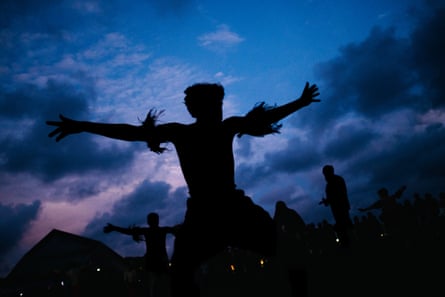
On the opening night she gets her wish. A thick canopy of grey cloud gathers above the sound, catching the beams of light and scattering them into shifting, luminous patterns, as though the harbour’s many chapters of history are being painted across the sky.
For Kola, that is precisely the point. His work, he says, does not impose something new on a landscape but reveals what is already there.
“It’s like a mirror reflecting the culture and the world.”