3 hours ago
8
3 hours ago
8
Despite being just 23, Dominic Sessa is perhaps as intimately acquainted with the 1970s as those who grew up then. Although the New Jersey-born actor has only starred in five films, two of them are marinated in the fashions, sounds and mores of the decade. In his new movie, Tony, he plays the 19-year-old Anthony Bourdain, future bad-boy celebrity chef, bestselling author of Kitchen Confidential and host of its hit TV spin-off. Tony restricts itself to one summer in 1975, when Bourdain bummed around the coastal resort of Provincetown, Massachusetts, falling in love, scrubbing pans in a seafood joint and catching the cooking bug. “For a rootless young man with sensualist inclinations,” he wrote, “it was the perfect getaway.”
A 70s retro vibe also hung over Sessa’s debut film. In Alexander Payne’s Oscar-winning 2023 comedy-drama The Holdovers, he played Angus Tully, a surly student forced to board at school over Christmas with only his classics teacher and the cook for company. That picture wasn’t merely set in 1970; it seemed, with its faded palette and fake crackles on the print, to have been made then.
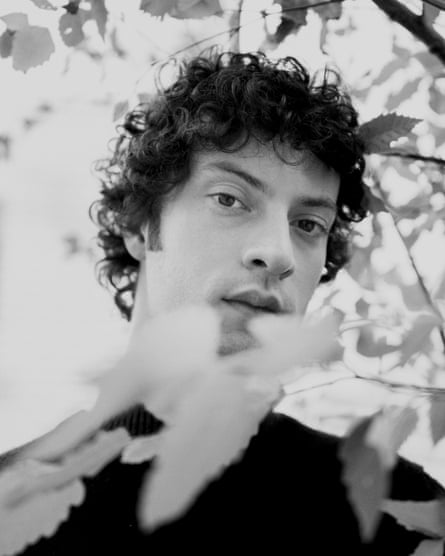
The most convincing period touch in each film, however, is Sessa himself. He has been described as having a “1970s face”, a euphemism for “unconventional”. His crown of dark, jumbled curls looks as if it was scribbled in crayon by a hyperactive child, while his wide, narrowed eyes are set high and far apart in his upside down triangular face. He projects inner conflict: when Tony and Angus behave arrogantly and disagreeably, even aggressively, Sessa’s features suggest a wounded quality that hints at future self-disgust for any misdeeds.
Sessa was barely aware of Bourdain before making Tony. “I knew of him but he didn’t have any significant meaning for me,” he shrugs, speaking over video call from a Manhattan hotel room. A gangly six-footer, Sessa is all elbows, collar-bones and sharp edges as he stares down the webcam in a brown-and-white checked shirt. “I think the only way to do the film honestly and without hesitation was to not have a strong opinion about him.”
Now that he has been immersed in Bourdain’s history, he has clearer ideas about the pioneering chef’s appeal. “I think he made people feel an overwhelming sense of potential in themselves,” he says. “He inspired this movement where there’s hundreds, probably thousands, of YouTube channels by people who dedicate their lives to showcasing what’s being eaten in different parts of the world. He was a rebellious person, someone who acted with integrity.”
Tony’s director Matt Johnson, who brought such vitality to the tech origin story Blackberry and the recent time-travel comedy Nirvanna the Band the Show the Movie, pointed Sessa towards two chapters from Kitchen Confidential, the memoir written in gunslinger prose and billed as a story of “sex, drugs, bad behaviour and haute cuisine”. There, the actor found the characters who inspired the film’s triumvirate of Provincetown kitchen mentors, the men Bourdain likens to “gods” and “pirates”: the wise head chef (Antonio Banderas), the coke-snorting Jack-the-lad (Leo Woodall) and the taunting, vulgar mischief-maker (Stavros Halkias).
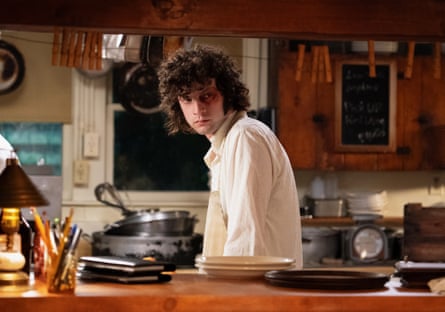
“The restaurant we were filming in had only closed a couple of days earlier, so we were in a fully operating kitchen,” he explains. “Stavros learned how to make lobster rolls, Leo learned to shuck oysters. Matt was, like: ‘Dom, you go in and wash the dishes, and Stavros and Leo are gonna make fun of you.’ They made it all real for me. I felt genuinely intimidated by them. They’re so nice but I think they enjoyed the chance to bully me.”
Dramatising Bourdain’s youthful exploits put Sessa in mind of his own misspent summers growing up on the Jersey Shore. He was raised in Ocean City, which was tranquil throughout the year then bustling with tourists during the holidays. His mother is a teacher; his father, who he has described as “a payroll guy”, died when Sessa was 14. He tells me he got his “opinionated” side from his mum, his sense of humour from his dad. “Jackass was one of the first movies he showed me,” he says fondly.
After his father’s death, Sessa won a sports scholarship to attend Deerfield Academy, a boarding school in Massachusetts. “The only time I’d be home was in the summer breaks when it would basically be like a party. I worked in a bakery where I had early starts, and I’d be getting drunk on the beach before going to work; I was a mess. At that age, you felt you were invincible, you couldn’t get in trouble. We felt like we owned the place. We’d throw beach parties, then cops would chase us off the beach. You’d go to whoever’s house and their parents were gone so you’d destroy the place. We were menaces. Reading about the way Tony described his time in Provincetown, I was like: ‘Yeah, I get that. I understand.’”
Partying wasn’t the only element in the film that chimed with him. “Playing Tony, I felt as if I was playing an unlikable side of myself,” he says, his tone no longer flippant. “He’s insecure and defensive at the start of the movie. I think a lot of young men have a very defensive way. You want people to respect you and treat you like an adult. But you feel as if you’re pretending. Deep down, there’s something underdeveloped that is hard for us to admit to. We’re always trying to hide that. I’m constantly going through that in my life.”
He sits back in his seat as if surveying the scene before him. “Like, doing this interview, I’m pretending to be an adult, you know? Sometimes when you’re young, it’s to your detriment that you don’t allow yourself to fail in a productive way because you’re constantly trying to protect your ego.”
What would his remedy be for young men like him? “Wilful hardships,” he says. “Deciding to go through hard things. Comfort is attractive. And we’ve built a culture around the comforts of the world. Where you really develop and learn the most about yourself is in doing something genuinely difficult. That’s what Tony does in this film.”
The picture opens with a quote from Kitchen Confidential in which Bourdain describes his younger self as being “badly in need of a good ass-kicking”. Sessa sings from the same hymn sheet. “These cooks verbally abused each other, ripped each other apart. It’s an initiation process in a way, a rite of passage. There’s love on the other side of it.”
If the actor’s view of kitchen life is impossibly romantic, very far from the widespread toxic culture that only this year led to the resignation from Noma of René Redzepi after accusations of workplace abuse, then that is fully in keeping with the tone of Tony. This is a movie so reluctant to spoil the audience’s buzz that it doesn’t even reveal in the end titles that Bourdain is dead, let alone that he took his own life in 2018.
Any toughness or complexity in the film comes from Sessa, whose performance ratifies his standing as both a 21st-century star-to-be and a 1970s pin-up manqué. How does he explain the period fixation? “Maybe it says something about me. Like I want to escape the modern era.” Does he? “Yeah, I think so. I love being in the bars, the smell of cigarettes. It’s like stepping into a time machine.” No mobile phones, no social media. “Everybody’s looking up, talking to one another.”
Eye contact isn’t the only behavioural difference he has noticed. “The impression I get is that young people back then were more confident in speaking, and perhaps more mature in interactions with adults. Nowadays it takes longer. I have friends in college who still can’t handle a social environment because of the way we’ve grown up. Especially after Covid. My generation got screwed.”
Sessa was at Deerfield when the pandemic struck. “They designed a way to keep us on campus and in a bubble. The kids who got sick were sent to the old abandoned health centre.” His low rumble of a voice is interrupted by his sudden, honking laugh, as if acknowledging that this all sounds suspiciously like an episode of Scooby-Doo.
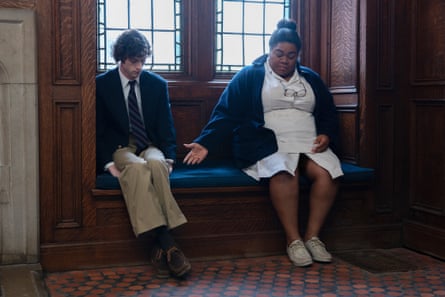
That cabin-fever scenario was almost a rehearsal for playing Angus. “This was right before The Holdovers, so I guess I got used to feeling trapped,” he says. In 2022, the film-makers were visiting local schools to scout potential locations, no more expecting to find their Angus than Sessa was anticipating being cast as one of the leads in a Hollywood movie.
As a financial aid student, he had felt out of place initially at Deerfield, where he had gone to pursue his dream of becoming a hockey player. When a broken femur in his freshman year put him out of action before the season had even started, theatre became his backup option.
“I wasn’t being myself when I first got to school,” he says. “I was acting in a way that wasn’t genuine to who I was. I saw these kids, the way they dressed and carried themselves, and I didn’t feel I belonged in that environment so I had to role-play how these people were. I didn’t think they would accept me otherwise. But once I started doing theatre, I made so many more friends. People wanted to get to know me because I was putting myself out there.”
Hockey lost its appeal. “I saw it ending and it not being a part of my life much longer. I was never gonna be the best player in school. I would probably be one of the worst.” There is no need to remark on his chances of being one of the best actors instead. The acclaim he received for The Holdovers – 21 nominations from awards bodies and critics’ circles in the US and UK, including eight wins and a Bafta nod – tells its own story.
In between The Holdovers and Tony, he turned down lead roles and studied drama for a year and a half at Carnegie Mellon University, taking supporting parts to keep his hand in. He played Michelle Pfeiffer’s sullen son, recently dumped and strumming an emo version of The 12 Days of Christmas, in the comedy Oh. What. Fun. In Tow, he was a non-profit lawyer whose client (Rose Byrne) tells him: “My car is older than you.” Multiplex-goers saw him as an upstart magician with Robin Hood ethics, stealing from crypto bros and diamond magnates, in the threequel Now You See Me: Now You Don’t.
It is Tony, though, that he credits for the second turning point in his brief career. If The Holdovers set him on his current path, Tony has helped him decide on the kind of actor – and person – he wants to be. Since making the film, he has been heeding the advice of Bourdain, who wrote: “Good food and good eating are all about risk.”
“I’ve been open to eating in a lot more B- and C-health-rated places,” Sessa says. But it’s not only about what’s on his plate. “In life generally, I feel more motivated now to follow my gut and take risks and live in the moment.” He mentions Shades of Paradise, a “crazy Euro-crime film” that he recently made in Barcelona, as an example: it gives him his first bona fide baddie to play after a string of messed-up but essentially decent guys. “I thought: ‘This is something really fun that I want to do.’” That’s his motto for today. “I’m doing what feels right.”