1 month ago
112
1 month ago
112
When 19-year-old Dejanae set her online job search criteria for the local area, she was shocked at how few options came back. She studied animal science in college but is struggling to find work in the West Midlands.
“It’s hard. You put Dudley, but it’s mainly jobs outside Dudley that come up because there just isn’t much here,” she said. “Even jobs in Birmingham (10 miles away) are difficult because I’m two hours away on a bus, so they don’t even want to consider me.”
In a report on the soaring number of young people who are not in education, employment or training (Neet) released in May, Dudley was singled out for its extremely high level of youth unemployment. The number of Neets and “not knowns” in the area was 21.5%, much higher than the national average of 5.6%. The majority of London boroughs, even those with similar rates of deprivation, have rates at about 2-4%.
Of the 10 English local authorities with the highest proportion of Neets, eight were in the north or Midlands.
The Neet crisis is one of the biggest problems facing Andy Burnham in his first few months as prime minister, and many are eagerly waiting to see how he responds to the report by Alan Milburn.

His recent reinstatement of a £2 cap on bus fares in England has been welcomed as a boost for young people who are more likely to rely on this mode of transport. But the Green party said the policy should be more targeted, calling for permanent free travel for all people under 22.
Bus travel is a big problem in Dudley, where poor transport links remain a huge barrier to accessing jobs in Birmingham. A long-awaited tram extension has been delayed for the eighth time.
In the heart of the Black Country, Dudley was one of the birthplaces of the Industrial Revolution and became a significant manufacturing hub in the postwar period. But as this heavy industry declined, so did the number of local jobs, diverting many to Birmingham, which now has a rapidly expanding professional and financial services sector.
Callum, a 20-year-old from Dudley, says he has applied for well over 1,000 jobs in the past four years. “I’m trying to get something within a 10-mile radius but there’s so little out there, and so many roles require experience young people just don’t have,” he said.
The shock of being such an outlier led Dudley council staff to take unprecedented action. Over eight weeks, they knocked on more than 600 doors across the borough to find out exactly what was happening to their young people.
With a much clearer picture, the number of Neets increased but the “not known” figure reduced drastically, giving them a new overall figure of 7.6% – still one of the highest rates in the country for an urban area.
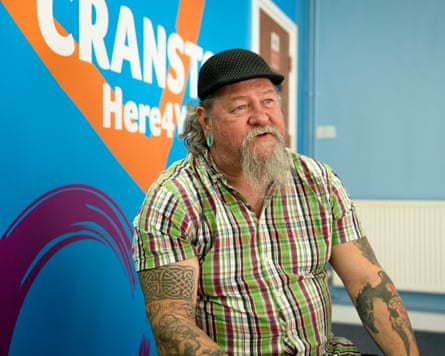
Staff found a “nervous cohort” and lots of neurodiversity and other vulnerabilities among children and their parents that was holding people back from work or further education.
Viv Webb, an employment and skills manager at Dudley careers service, said: “Lots of our young people are anxious about absolutely everything. If you try to start a conversation, it’s lots of shuffling in seats – that lack of social skill seems to be worse than I’ve ever seen it.”
Cranstoun, a social harm reduction charity, provides one of the last remaining youth clubs in the town, a drop-in service in Merry Hill shopping centre. Dudley has a higher than national average rate of permanent school exclusions, which Cranstoun staff said, combined with high levels of poverty, was pushing children down the wrong path.
Roy Stokes, a children and young people’s substance use worker, said: “We’re seeing drug and alcohol use increasing again, especially with young girls. “If your parents aren’t affluent enough to take you to after-school clubs, which are so expensive now, you go out on the streets. These things push anxiety levels up, then kids are leaving school with a feeling that there’s no future for them.”
The West Midlands has had some of deepest funding cuts for young people in England, with youth service expenditure falling by roughly 88% in real terms between 2011 and 2022. It has the lowest per capita spend for five-to-17-year-olds in the country at £25.74. In outer London, the spend is £50 a head.
But experts say the capital is a complex picture. Compared with Dudley, Lewisham in south London has a lower Neet and “not known” rate at 6.5% but this is the highest of all London boroughs and it has pockets of high unemployment for all age groups.
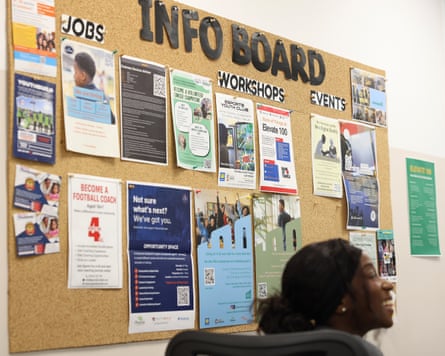
One of those pockets is Downham in the southernmost area of the borough, where a dozen young people gather around a table at Elevate 100, a service that offers careers advice and CV writing tips for 16-to-25-year-olds.
There are more jobs in the capital: Dudley has a job density of 0.60, meaning there are significantly fewer local jobs than there are working-age residents, whereas the London figure is 1.06. The extensive London public transport system also gives young people access to jobs over a wider geographical area, with free bus and tram access for 16- and 17-year-olds, as well as discounts on the tube.
But young people say competition is tough in the London job market with so many people flocking there for work. Many worried that without contacts, it was difficult to get a foot in the door.
“The landscape has changed so much,” said Kiara Kataike, a 25-year-old microbiology graduate who has been looking for work since 2024. She has found most companies she was keen to work for were cutting jobs, not hiring.
Whitney, a 30-year-old business studies graduate who wants to work in marketing or social media, said she had found a growing number of companies expected you to work for free. “But I need to live,” she said. “I need buy food. I have to pay my bills.”
Angela Brown, who manages youth leadership at Elevate 100, said the London job market was the toughest she had ever seen, but added: “I don’t dispute that the picture looks even dire the more you go outside London.”