2 hours ago
6
2 hours ago
6
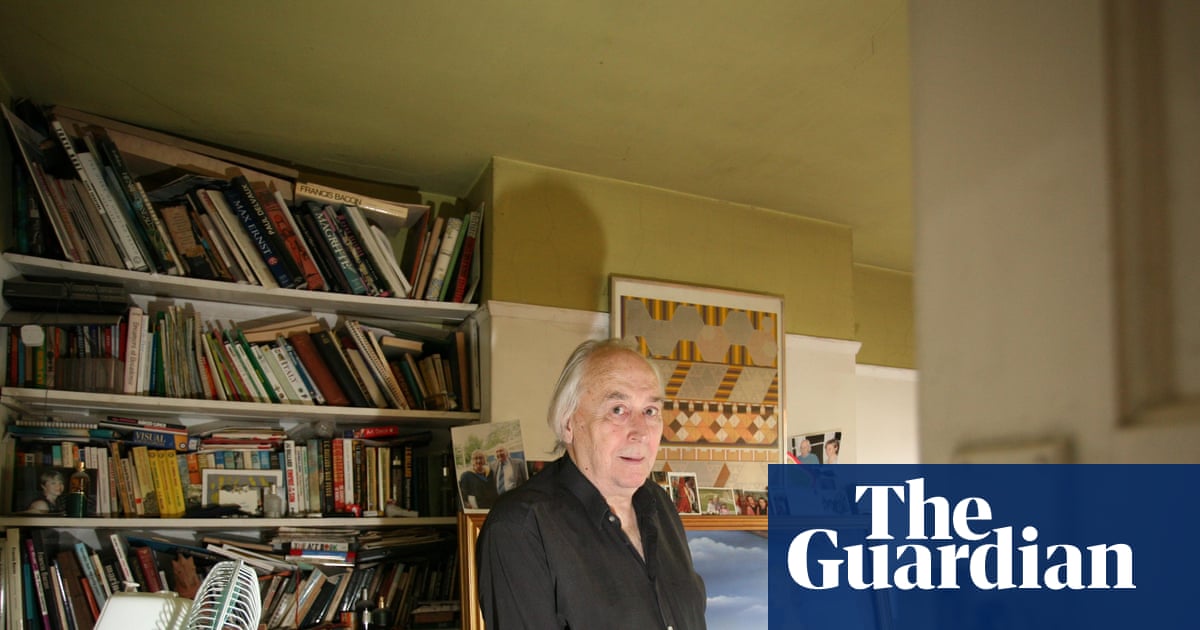
‘I consider an exclusive a failure,” Amy Goodman says. It is not a typical observation for a journalist to make, but it is the approach at the heart of a documentary about her career, Steal This Story, Please! If an article, item, narrative or interview is significant enough “it should be shared around the world,” she insists.
This time, however, her goal is not to share a particular news story, but rather an entire professional philosophy. To do so, Goodman had to let “two Oscar-nominated stalkers into my life” in an effort to “spread the word about this critical form of independent journalism” that she has practised over four decades.
In an era of the behemothisation of American news, endless mergers and mega-mergers, Goodman, 69, has successfully operated off-road, working first in community radio, then creating New York based Democracy Now!, an hour-long daily news broadcast aired online and on public stations in the US, Canada and around the world.
A core idea, she explains ahead of a series of screenings and appearances in the UK, is that “when we cover war, we’re not brought to you by the weapons manufacturers; or when we cover the climate catastrophe, we’re not brought to you by the oil, gas or coal companies”. Paid for by viewer donations, Democracy Now! does not accept advertising, sponsorship or government grants.
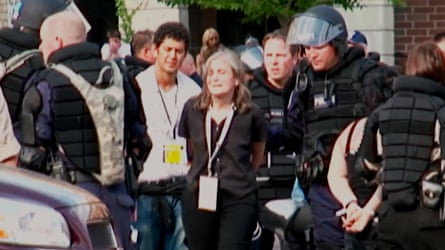
The documentary wastes no time in underscoring Goodman’s tenacity. Directed and produced by Tia Lessin and Carl Deal, it begins by following Goodman as she follows P Wells Griffith III, then Donald Trump’s climate adviser, at the Cop climate summit in Katowice, Poland. Griffith, who had no meaningful prior experience in the energy industry, went to the 2018 summit to praise the virtue of mining coal.
“Can you tell us what you think about President Trump saying climate change is a Chinese hoax?” Goodman begins, microphone ahead, camera behind, the pursuit beginning. Griffith, it turns out, does not want to talk. Instead he complains lamely of harassment, and climbs several floors just so he can hide from Goodman in the US delegation suite.
Outside, the door having been closed in her face, the failure to engage telling the story, a breathless Goodman tries to summarise. Except that, too, is a little much. Goodman pauses, smiles, turns her head to one side and says: “Actually, I have to take my breath.” It is an ideal counterpoint, the gentlest reminder that chasing any story requires effort; to the top of conference centres and beyond.
Democracy Now! has just celebrated 30 years with an event at the liberal Riverside Church, in Morningside Heights, New York, where political activist Angela Davis talked about “the importance of dissent” while Michael Stipe, Patti Smith, and Bruce Springsteen all sang. But the church was also where, Goodman emphasised, Martin Luther King spoke out against the Vietnam war, in April 1967.
“He said that the US is the greatest purveyor of violence on earth, and he was excoriated for the speech by the corporate media. I think it was Life magazine that said he had done a disservice to his cause, his country and his people, but he just doubled down and he said, ‘You have to connect these three pillars: militarism, materialism and racism’,” Goodman says.
The documentary, part fly-on-the-wall, part interview, part archive, takes viewers through the full arc of Goodman’s career from the 1980s with contributions from key collaborators, including Democracy Now!’s co-host Juan González. It is a remarkably consistent body of work, underpinned by the idea that events can only be properly understood if you “talk to people at the target end” – whose voices are easily forgotten or discarded by the vast US news networks.
“I remember when the US invaded Iraq [in 2003], the mass protests that rocked the planet, millions of people saying no,” Goodman says. “But I remember the network reporters and the hosts, the anchors, would go into a military jet and show people what it was like to be hitting the buttons. Or they would go into a tank and show what it was like to be steering it. Our job is to be at the target end: how does it feel when that button is hit? That’s our job as journalists.”
The approach was not without risk. Thirty-five years ago, Goodman travelled to East Timor in southeast Asia, then in the midst of a brutal occupation by Indonesia that had seen more than 100,000 people already killed. Despite the level of human suffering, it was not a well-covered story then, but Goodman and another American journalist, Allan Nairn, had arrived, hoping to follow a visit from a UN delegation.
It was 12 November 1991. Goodman and Nairn had gone to witness a commemoration mass for Sebastiao Rangel, killed a fortnight earlier by the Indonesian military. Several hundred swarmed into a church in the capital, Dili, then walked to a nearby cemetery, hemmed in by high walls. It had become a public act of defiance by the Timorese, but Goodman thought that while the Indonesian military had committed massacres before, they would not dare do so in front of western journalists.
“I held my microphone up like a flag, Allan put the camera above his head. I slung my tape-recorder, which I’d always hidden, over my shoulder and we walked to the front of the crowd,” Goodman recalls. Shortly after, Indonesian soldiers marched up “10 to 12 abreast” armed with US M16 assault rifles and fired on the crowd “without warning, without hesitation, without provocation”.
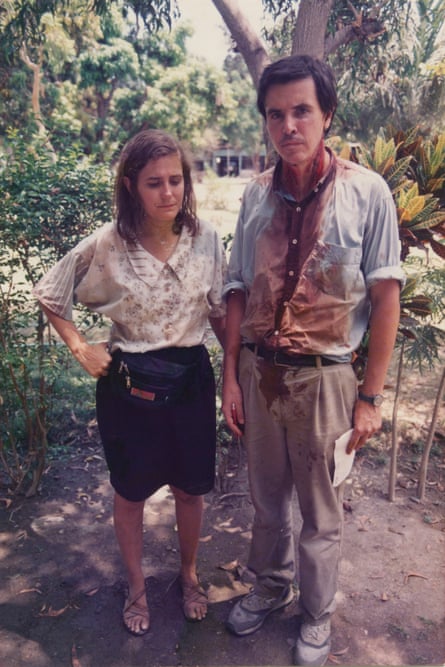
She cannot forget what happened next. “The first to go down was this little boy behind us who had his hands up in the V sign. ‘Viva East Timor,’ they shouted. ‘Viva independence! Viva Sebastiao!’” Goodman and Nairn were not shot but they were attacked and beaten with boots and rifle butts. Nairn threw himself on top of Goodman to protect her, and the soldiers “took their US M16s like baseball bats and slammed them against his skull until they fractured it” before finally relenting.
It was a defining moment, perhaps the ultimate justification for reporters bearing witness. Indonesian soldiers killed 271 protesters that day at the Santa Cruz cemetery. Goodman and Nairn survived because they were from the US, managing to get a flight out of the country. Though their equipment was seized, they were able to recount what happened in interviews and in a press conference in the following days, and their story was stolen by the world’s media.
“I mean, even just telling you right now, I can picture all of it. I can feel all of it,” she says. After the massacre, she and Nairn and dozens of Timorese piled into a Red Cross van and “drove like that as a human mass” to a hospital. There “the doctors and nurses started to cry when they saw us,” not because they were more badly hurt than the Timorese, but because, Goodman thinks, of what they represented, as westerners – both “the sword and the shield” – suppliers of arms to the Indonesians and people able to spread the truth.
The story of the Dili massacre is at the heart of the documentary and Goodman’s career. Film footage of the massacre, shot secretly by another journalist, Max Stahl, emerged subsequently, and gradually the Indonesian occupation became untenable. A referendum was held in 1999, and 78.5% of people voted for independence. Three years later, Timor-Leste became a country in its own right, and it was the first time that Goodman was able to return.
So was this, the day that Goodman witnessed a massacre, the most consequential story she ever worked on? The reporter demurs. She says that what is important is “covering movements” because “you never know when the magic moment comes” when a seemingly intractable problem, like the occupation of East Timor, is resolved or disappears.
It is a plea, she says, to keep reporting and to keep listening, regardless of the outcome: “I just think whether we’re covering an issue outside our country or in our country, it’s the respect for what people do every day and making sure that they can be heard, that they can describe their own stories. That is what gives dignity, whether they win or lose.”