3 months ago
165
3 months ago
165
Selling out a venue such as London’s O2 Arena used to be considered a high point of an artist’s career. Now, selling out just one night there might seem a bit underwhelming. Raye and Olivia Dean will play six nights apiece at the 20,000-capacity hall this year; Dave is playing four, Ariana Grande is playing a whopping 10. Harry Styles, never one to be outdone, last month announced a staggering 30 dates at New York’s Madison Square Garden, with more than 11 million people applying for presale access, as well as a record-breaking 12 nights at Wembley stadium: the most on a single leg of a tour. Taylor Swift managed a mere eight.
Swift’s Eras tour, which made more than $2bn (£1.6bn), doesn’t seem a complete outlier any more: Coldplay’s Music of the Spheres tour has lasted four years and made $1.5bn, and the Weeknd’s After Hours Til Dawn tour is also four years deep and has crossed the $1bn mark. It’s even de rigueur for world leaders to get involved in the fight for tickets, with the Mexican president, Claudia Sheinbaum, asking the South Korean president, Lee Jae Myung, to help book more BTS shows in her country, just as the then Canadian prime minister, Justin Trudeau, publicly asked Swift to come to Canada. Meanwhile, the Singaporean government paid for Swift’s six shows in the country to be a south-east Asia exclusive.
Styles and Swift now have generations of ultra-devoted fans who will come and see them each time they tour. But that doesn’t fully account for the scale of the demand. Why is it that the big stars feel bigger than ever, and are they in danger of overshadowing the rest of the live music industry?
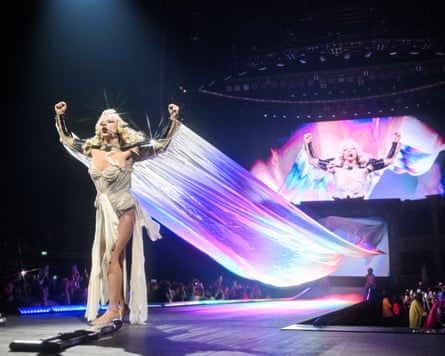
Emma Bownes, senior vice-president of venue programming at AEG – the world’s second largest events company after Live Nation – says that “post-Covid, there was so much pent-up demand that when arenas and stadiums could open, there was this surge of people who wanted to experience that again”. Last year was the busiest ever for the AEG-operated O2 Arena, which hosted 239 shows, and Bownes doesn’t anticipate any slowdown. “We’re looking at a really busy 2026, and we’re booking 2027 right now.” Because of demand, she says “agents and promoters are booking their tours a lot further in advance than they used to, and they’re utilising parts of the calendar that they didn’t previously. Artists used to play festivals in August, but in August this year we have 10 shows with Ariana; we have Summer Walker, A$AP Rocky.”
Archie Marks, a 20-year-old university student from Birmingham, is one of those driving the demand: he says he goes to “most of the big arena pop concerts that a lot of gays attend”, and estimates that he went to about one arena show a month in 2025, as well as a few stadium shows over the course of the year. Going to concerts is expensive, of course, and Marks says he “doesn’t really spend much money on clothes or anything and I keep my food shop to bare essentials”, with nearly the entirety of his disposable income from hospitality and teaching work goes towards tickets. He suggests that the increase in these events’ popularity “has a lot to do with TikTok”, particularly because clips of artists bringing out special guests, or debuting new songs, tend to go viral on the platform, “creating fomo”, which leads to more demand for tickets.
Marks uses his younger sister as an example. “I love her to death, but she has like, no music taste – she’ll listen to musical theatre albums, and that’s it,” he says. But when Sabrina Carpenter toured the UK in 2025, his sister wanted to go to the show, despite being “really tuned out” from Carpenter’s actual music. Same goes, he says, for Styles’s forthcoming tour. “It’s that social media thing of having access to something that no one else has, or wanting to be the first person to have access to it,” he says.
One artist manager I speak to on condition of anonymity – whose background is in live events and works with an arena-selling artist – says a sought-after ticket has become “a status symbol: to say you were at the Eras tour or Beyoncé, that’s huge.” While she feels that the demand for tickets “is good for the music industry”, she worries about smaller artists on her roster, who are still playing theatres and clubs, and whose gigs fans might forgo in order to attend higher-priced arena shows. “Some of those tickets are like $600. It just takes money out of people’s pockets, and in the US, there’s only so much money to go around.”
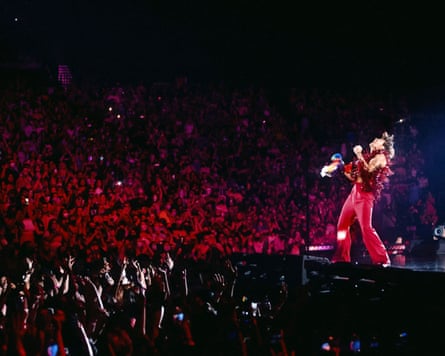
More artists such as Styles are opting for residency tours, in which they might settle at one arena or stadium for a few nights at a time, just as Adele did with 10 consecutive dates in Munich in 2024. Residency shows require slightly less muscle, as a show’s elaborate staging and production only has to be set up and packed down once. Such shows move the cost of travel on to the consumer, rather than the artist’s own touring production, meaning further financial outlay for fans.
Because of those costs, Marks says that when artists are playing arenas and stadiums, and charging “triple figure” prices, “I would expect a budget” – meaning high production values, with dancers, costuming, stage sets and more. Last year, he was impressed by Lady Gaga’s eye-popping, ornate Mayhem Ball, but felt somewhat shortchanged by a Lana Del Rey stadium concert in Cardiff. “I paid a bit more for Lana, and you couldn’t see where the budget had gone necessarily – the staging wasn’t very impressive, the setlist was a lot shorter,” he says. “I felt like my money wasn’t going towards something, whereas with Gaga, I felt that.”
The artist manager says that the arena-sized band she works with feels this pressure from fans. “People are so easily distracted these days – you actually have to put money into production. There’s an expectation of more than just a band putting on a tight show.” This isn’t always easy, she adds, especially because costs of touring have remained high post-Covid, and require a team that can sometimes balloon into the hundreds, with specialist lighting techs, managers, stagehands and more required to navigate bespoke production. “Even at a huge scale, if your tour is grossing millions of dollars, these production costs are insane. It’s not like these [artists] are getting super rich off it.” She says the high-level, social-media-friendly spectacle of these shows is putting pressure on indie artists to up their production, too: “People aren’t coming in expecting to see just a band any more.”
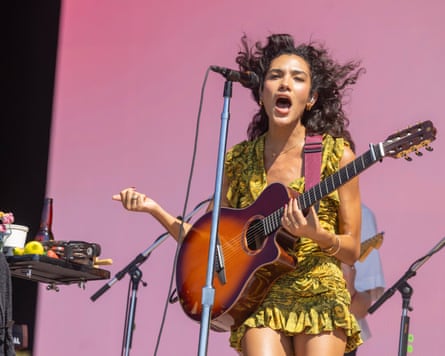
Ariel King, a reporter for the live music trade publication Pollstar, says that in the US, the industry-wide demand for concerts has actually “tapered off” of late, and suggests there are more stadium and arena shows because big artists “are the people that can afford to tour consistently”. It’s tough for mid-level artists touring theatre venues, who are “not getting quite as much of a gross, have limited production, but the costs are still high” – whereas economies of scale kick in at the arena and stadium level.
Even if bands do pull out all the stops, there’s no guarantee fans are going to be happy. There was a marked backlash to Styles’s tour announcement, with some fans complaining that there was an unreasonable jump in prices compared with previous tours: for Wembley Stadium, standing tickets were at least £144, and while some seats were as low as £44, others cost more than 10 times that. Olivia Dean took Ticketmaster, Live Nation and AEG to task late last year after tickets to her US tour, which sold out in minutes, appeared on resale outlets at massively inflated prices (a practice the UK government announced in November it planned to make illegal). The artist manager says that it’s “damn near impossible” to mount large-scale shows without using a large ticketing service such as Ticketmaster, because of the contracts venues have with certain providers. “I was so happy to see Olivia Dean standing up to ticketing services,” she says. “I think it’s going to take more and more artists speaking out and coming together and boycotting these services, because they have a monopoly.”
Nevertheless, fans are still trying their hardest to secure tickets to certain shows; Marks says his mother was “somewhere around 300,000th” in the queue for tickets to see Styles in London. But just because a show boasts a global superstar, it doesn’t mean it’s necessarily better. “I went to see Perfume Genius for like, £15 in Manchester,” Marks says, “and it was one of the best gigs I’ve ever been to,” he says. “It was just him, and his band, and a chair. And it was immense.”