2 hours ago
10
2 hours ago
10
-
Russia has banned voting against the war in September’s elections. The supreme court upheld a suit brought by a small pro-Kremlin nationalist party, Roblina, and stripped voters opposed to the war of their last option on the ballot: Yabloko, the country’s only remaining anti-war party. The court banned Yabloko’s entire list of federal election candidates from standing for the State Duma of Russia’s parliament.
-
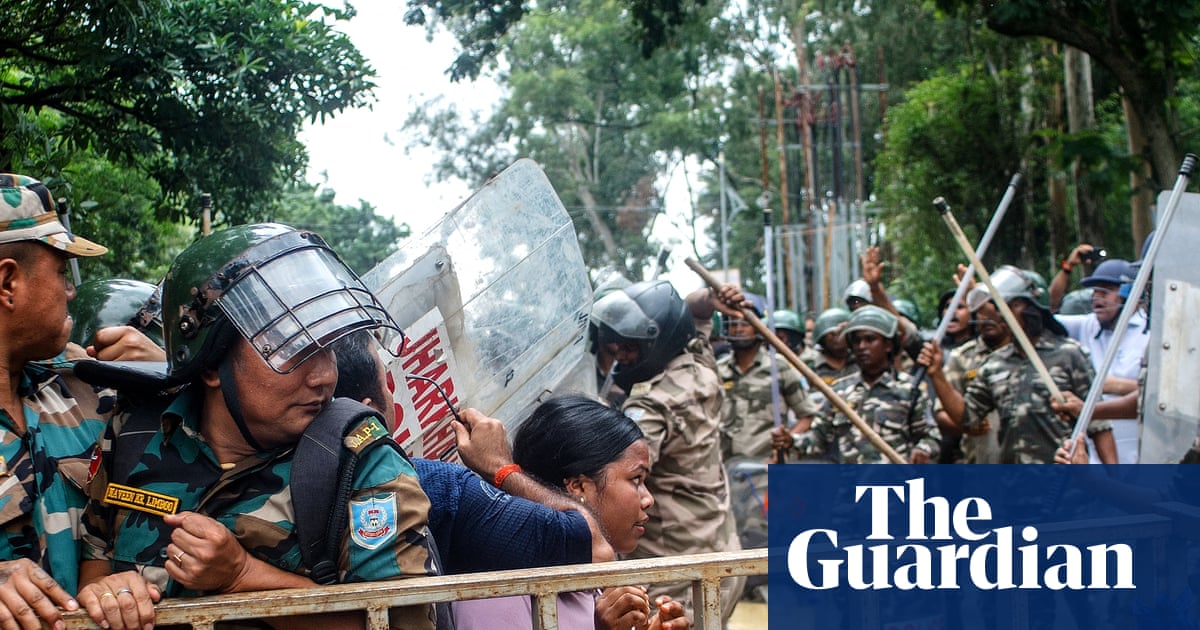
With most of Vladimir Putin’s opponents jailed, exiled or dead, Yabloko is the only liberal party still operating in Russia. Voting options other than Putin’s de facto party, the ruling United Russia, are only tolerated if they are too weak to win; give their backing to the Kremlin; or serve as “spoilers” that draw votes away from anyone who might pose a threat to the regime. About a hundred supporters, mostly young people, gathered outside the courthouse chanting “Shame! Shame!” after the ruling was delivered. Like the Duma, the supreme court routinely rubber-stamps the Kremlin’s wishes.
-
Addressing protesters, Yabloko leader Nikolay Rybakov said the party would appeal against the decision. In an interview with Agence France-Presse on the weekend, Rybakov said about 40 party activists were facing prosecution for opposing the war. The party’s deputy leader, Maxim Kruglov, was jailed for seven years in June over social media posts, while Rybakov was fined and barred from elections for posting a photo of Alexei Navalny. Independent polls show most Russians favour peace negotiations with Kyiv.
-
Russian missiles and aerial bombs killed five people and injured about 20 others in the south-eastern Ukrainian city of Zaporizhzhia early on Tuesday, said the regional governor, Ivan Fedorov. At the same time, the military administration in Kyiv said warehouses in a central district of the capital were ablaze after missile strikes. One person was reported injured.
-
A Ukrainian MiG-29 fighter jet caught fire and crashed during a combat mission when a missile misfired, with the pilot ejecting safely. Ukraine’s air force said the pilot – who had been targeting Russian positions in the southern region of Odesa – was taken to hospital.
-
Russia’s rollout of a Starlink alternative to counteract its banning from the US-based system is taking place faster than predicted, with 16 satellites in orbit so far, top Ukrainian intelligence official Maj Gen Vadym Skibitskyi has warned. Russia’s Rassvet system remains a far cry from Starlink, which had more than 10,000 satellites as of June and has given Kyiv a major advantage in drone operations and battlefield communications.
-
Speaking to RBC-Ukraine, Skibitskyi, head of the Ukrainian GUR, said Rassvet has “begun launching it much faster than originally planned”. Russia planned to have 292 satellites by 2027 and 924 by 2035. “Once Russia deploys a full satellite constellation, the system will operate like Starlink. Discussions are already under way on how to counter it.” Analysts have noted that while Russia has been slow to produce innovations in the war, it is quick to adapt to and copy Ukraine’s actions, introducing corresponding systems that it produces and adopts rapidly.
-
As Russia pounds Ukraine with supersonic missiles that Ukrainians have no interceptors for, Skibitskyi said Moscow had already met its annual production targets for Zircon and Oniks missiles in the first seven months of 2026 and was exceeding its 2026 missile production goals by 10% to 20%. At the same time, Ukraine’s emerging ballistic missile industry, and drone production facilities, had become a priority target for Russia’s missile campaign. Russia’s stockpile of Iskander-M ballistic missiles, the mainstay of its supersonic strikes, was estimated at about 130, with 65 new ones made in July alone. On Tuesday, there were unconfirmed reports that Russian ballistic missile launcher systems were destroyed inside Russia, not far from the border.
-
A Ukrainian drone strike set fire to the Taneco refinery in the Russian city of Nizhnekamsk, about 750 miles (1,200km) from the Ukrainian border, Luke Harding writes. Ukraine’s general staff said it was part of a campaign to reduce the “military potential of the Russian aggressor”. Russian authorities said at least 13 people were killed. Taneco is one of Russia’s biggest and most technologically advanced oil refineries, and part of it produces rubber and petrochemical products.
-
Overnight into Monday, Ukraine’s armed forces hit equipment depots and a repair unit in the occupied Donetsk and Luhansk parts of eastern Ukraine, while Russian-installed local authorities said the Zaporizhzhia region in south-east Ukraine was largely without electricity on Monday after Ukrainian attacks destroyed key power facilities.
-
Reuters reports that Ukraine is considering shipping grain by rail through Moldova as a more secure export option than by sea as its ports are battered by Russian attacks. Sources in Ukraine and Moldova said Kyiv wants a 50% discount on freight through Moldova to the Romanian port of Constanța. A source at Moldovan Railways said Moldova wants guarantees about the volume to be transported. The Ukrainians estimate a working corridor could provide for 10% of Ukraine’s exports. Moldovan and Ukrainian ministers met in Odesa on Monday for discussions.