7 hours ago
18
7 hours ago
18
The UK’s planned ban on trade with unlawful Israeli settlements is a welcome, if overdue, first step and must be judged according to its practical impact, a UN expert has told the Guardian.
The UK foreign secretary, Ed Miliband, has vowed to act more decisively against Israeli settlements, as well as continued restrictions of aid into Gaza, prompting the US ambassador to Israel, Mike Huckabee, to claim on Saturday that Downing Street was motivated by “Jew hatred”.
Miliband said what he had been told about restriction on aid into Gaza had reinforced the need for more decisive action. But Huckabee, writing on X in support of the Israeli foreign ministry’s own criticisms, said: “The Brits have lost it. The Jew hate of their government knows no boundaries and knows no facts.”
Huckabee did not mention in his statement that Miliband is himself Jewish. The Israeli foreign ministry had said: “Had the foreign secretary been interested in facts rather than stories, he would have known that there are no restrictions whatsoever on bringing medicines into the Gaza Strip, and that no medicine is being blocked.”
Palestinian groups in the UK are holding judgment until they see the fine detail of Miliband’s policy, due to be announced on Tuesday, but are expecting the most significant shift since a previous foreign secretary, David Lammy, withdrew most arms export licences in September 2024.
Speaking to the Guardian, Francesca Albanese, the UN’s special rapporteur on the occupied territories, said a “ban on settlement goods was a change in UK government stance and absolutely important”. She added she would “not join those dismissing it as theatre before the details had been announced”.
She said a settlement trade ban would have to be part of “a true paradigm shift to Israel-Palestine that ultimately seeks to implement the international court of justice advisory opinion in 2024”, which stated that Israel’s presence in the occupied territories was “unlawful in its entirety”. The opinion, she added, said that “all states carry an obligation – not a preference of an obligation – not to recognise the situation as legal, and not render aid and assistance in maintaining it”.
Albanese also said the trade ban could not be narrowly confined to goods – such as agricultural products and cosmetics – since “they are a fraction of what sustains the occupation, and a fraction that Israel can absorb without difficulty”.
The package should also aim to include trade in services, she said, progressively suspending British intelligence cooperation, all arms licensing and the unexamined flights out of RAF Akrotiri in Cyprus. Albanese warned that if the steps were not taken or were “completely off the table”, the changes would “over time come to be seen as not amounting to a reckoning, but a press release”.
She said that a state banning “dates from Ma’ale Adumim [a city in the West Bank]” while “continuing to licence the equipment used to enforce the checkpoints around it” had not “changed its relationship with the occupation … It has rearranged its communication strategy.”
Albanese added that, “because the 2024 ICJ advisory opinion declares the entire Israeli presence in the occupied territories as unlawful, third states’ obligations ‘not to render aid or assistance’ extends to everything that sustains that unlawful presence as a whole.”
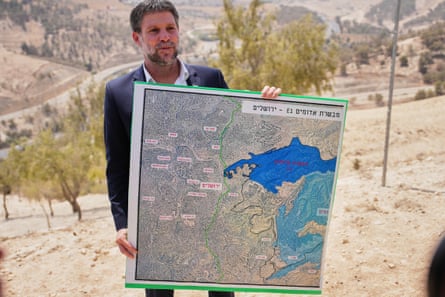
Albanese said the UK needed to end any ambiguity around the tender for the E1 settlement that will sever East Jerusalem from the rest of the West Bank and cut the territory in two, adding: “Since bids close a week before Israel’s elections on 27 October, there is nothing that London can realistically do in September that can change that calendar.”
But she warned the government could not let the tenders simply pass, pointing out that Israel’s finance minister, Bezalel Smotrich, had already said E1 was designed to “bury the idea of a Palestinian state”.
“There is a difference between the tenders closing and the settlement getting built and financed,” she added. “Construction on this scale needs finance, insurance and construction firms, and since E1 amounts to annexation and not just settlement expansion, sanctions or similar have to be threatened against those firms that seek to cooperate with the building of E1.”
Albanese also called on the UK government to join South Africa before the ICJ, and also support Nicaragua on Monday when the ICJ hears preliminary oral objections from Germany over claims filed by the Central American country that Berlin’s continued arms sales to Israel makes it complicit in genocide.
She said: “Britain is not a party to that case. It can still choose which side of the argument it stands on: whether it treats participation in international accountability mechanisms as a threat to an alliance, or recognises that an alliance built on anything other than principle and the rule of law is not an alliance at all. It is an arrangement of convenience, honoured only until convenience changes.”
Finally she urged the UK to issue guidance to UK-based firms not to overcomply with sanctions imposed by the US on the international criminal court prosecutor, the deputy prosecutors, eight judges and an increasing number of others, including herself and Palestinian human rights groups that have cooperated with the court. “This has frozen bank accounts, everywhere, for people doing nothing other than their judicial function or providing evidence lawfully requested by an international court,” she said.