2 months ago
146
2 months ago
146
When Les Claypool wrote his first song for Primus in 1984, he faced a crisis of self-confidence. “I was too embarrassed to sing in my apartment,” he says on a video call. “But my roommate at the time was dating the preacher’s daughter, and had keys to the church across the street.” In the dead of night, the madcap bassist and singer took his recording equipment to the empty church, set up on the podium, and first sang his anti-war song Too Many Puppies, which recast soldiers as little dogs: “Too many puppies are being shot in the dark!”
It was the first oddball creation of many: Primus’s rubbery fusions of prog, metal and funk have made Claypool one of rock’s most unlikely success stories. Albums such as 1991’s Sailing the Seas of Cheese are cartoon lands filled with colourful misfits, largely drawn from Claypool’s upbringing in blue-collar California, and given voices inspired by Mel Blanc’s work for Looney Tunes. Today, Claypool has two platinum records, a legacy of influencing giants such as Deftones, and a global cult fanbase including Rush and Tom Waits. But his wackiness, along with his having written the South Park theme and popularised the fan catchphrase “Primus sucks”, has made it hard to peel off the label of class-clown. “There’s an iron hand in that velvet glove,” he promises.
His forthcoming album The Great Parrot-Ox and the Golden Egg of Empathy, made with Sean Ono Lennon as the Claypool Lennon Delirium, is another eccentric invention. But beneath its story of a robot turning the world into paperclips, it asks real questions about humanity in the AI age. Coinciding with a career-spanning tour and Primus’s first UK shows in almost a decade, it prompts a re-evaluation of Claypool, who – since that night in the church – has always said serious things in unserious ways.
Brought up by a family of mechanics, when Claypool attended high school “everybody wanted to be Eddie Van Halen”. Classmates included future Metallica guitarist Kirk Hammett. But inspired by Rush’s Geddy Lee and funk heroes such as Larry Graham, Claypool reached for the four-string: “To me the bass was a more sultry instrument, whereas the guitar sounded kind of wimpy.” Cutting his teeth playing R&B in Hells Angels bars, he started Primus (initially Primate), playing over a drum machine. His strange style, filled with slap-bass, taps and chords, came from “holding down the root of the bass but also trying to play the rhythm guitar parts”.
Claypool began devising cartoonish characters, using voices including a signature nasally tone. He proudly recalls Public Enemy’s Chuck D telling him “You sound like Mr Magoo.” But his creations often had a darker side. “There was a lot of alcoholism and drug abuse in our family, but we kind of laughed our way through,” he says. This ability to find “humour through pain” gave him the characters for Jerry Was a Race Car Driver, My Name Is Mud and Harold of the Rocks: all zany yet troubled outsiders, who helped Claypool explore violence, addiction and other realities around him. “I know most of these characters.”
Primus started playing clubs, and in 1986 his astonishing bass-playing earned him an audition to replace Cliff Burton in Metallica. “I didn’t know how popular they were,” Claypool says, and he misread the room. “We played a song or two and I said, ‘Hey, you guys want to jam on some Isley Brothers?’ Nobody laughed.” If Claypool suggests his eccentricity blew it, Metallica’s James Hetfield gave a different reason in the documentary Behind the Music: “He was too good.”
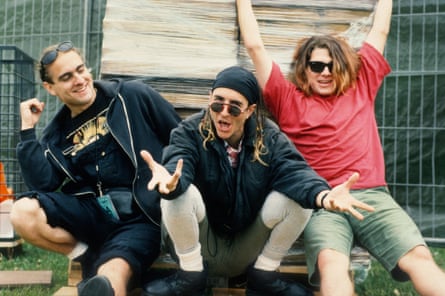
But Primus soon got their own shot at the big leagues, now in a classic lineup with guitarist Ler LaLonde and drummer Tim Alexander. The success of 1989’s Suck On This and 1990’s Frizzle Fry landed them a big-label deal with Interscope. “I said: ‘Well, we’re going to be sailing the seas of cheese,’” Claypool recalls, meaning: “We’re going to be thrust into the mainstream, and we’re going to sink or swim.” An alternative to 1991’s more self-serious rock albums such as Nirvana’s Nevermind and Pearl Jam’s Ten, Sailing the Seas of Cheese went platinum, as did 1993’s Pork Soda. Since then, he has had a mandate to be as weird as he likes.
The Claypool Lennon Delirium’s new album The Great Parrot-Ox and the Golden Egg of Empathy – a Technicolor psych-rock opera paired with a comic book – may be his strangest yet. Over the phone, Lennon describes meeting Claypool when his band the Ghost of a Saber Tooth Tiger supported Primus in 2015, bonding over “oddball stuff” such as King Crimson, and deciding to collaborate. This third album was inspired by philosopher Nick Bostrom’s writings on the dawn of uncontrollable AI. Asked to “do something very innocuous like make paperclips in an efficient way”, Lennon paraphrases, it may eventually “turn the whole world into paperclips”.
The album turns this into a story populated by Claypool’s wacky characters, depicting the land of Cliptopia being turned into paperclips by the AI Cliptron – foiled by an art-loving youth, a seaman, talking manatees and a half-parrot half-ox. Refreshingly, it doesn’t demonise technology so much as argue for human compassion as its necessary partner. Claypool’s “funny bones”, as Lennon credits them, make it sing, and helped to fuel Lennon’s own contributions. “I can be funny in life, but it can be hard to be funny intentionally in music. Being in a band with Les brings out that side of me,” Lennon says, also noting “There’s these deep layers of irony to everything he’s doing. He’s one of the best lyricists I’ve ever met.”
The album presents the power of empathy through a golden egg, shown in the comic book to soften Cliptron’s chrome heart after it hatches – revealing a baby parrot-ox. “One of the biggest perspective-changing elements a person can go through is having a child,” says Claypool, a father of two. Fatherhood also reinforced his imagination, basing Primus’s latest album The Desaturating Seven on a bedtime story he and his wife read to their children. However, “There was always this element of embracing our childhood to Primus,” he says, including their side-adventures on tours. “Anytime we were near a Disneyland, me and Ler had to go.” He leans forward, adopting his Magoo voice. “Usually on some mind-altering substances!”
That whimsical streak has often meant he has been sold short. He traces Primus’s “joke band” label to 1995’s Wynona’s Big Brown Beaver – a silly, throwaway track thrust into the spotlight after it was chosen as a single by Interscope, earned a Grammy nomination, and garnered incorrect speculation that it was about Winona Ryder. “It was kind of a bummer.” Today, the preconception that Claypool is a wacky humorist bothers Claypool less: he likens his more socially conscious music to Dr Strangelove, which “can tell a story and make a statement, but it’s humorous and entertaining.”
While Primus’s UK shows will be their first in nine years, Claypool is fond of Britain. He visited London’s Tower Records in the 90s to buy tapes of British comedies including Blackadder and “anything with Rik Mayall and Adrian Edmondson”, sampling The Young Ones on Primus’s Los Bastardos. He also bought Cannibal! The Musical here, by the future creators of South Park. Consequently, he knew their work, and accepted when he was asked to write the show’s theme.
He has been reflecting on his past as he prepares his Claypool Gold US tour, featuring a stacked lineup of his acts: the Claypool Lennon Delirium, Primus and Les Claypool’s Fearless Flying Frog Brigade. But for all the imaginary characters in his career, he looks back most fondly on the real people that have filled it, from Lennon to idols-turned-fans such as Tom Waits and Geddy Lee. Above anything, “If I was my 16-year-old self looking at me now, I’d be way more impressed by the roster of heroes I’ve gotten to meet, befriend and work with. That’s what it’s all about.”