7 hours ago
7
7 hours ago
7
One of the curiosities of debates about cycling in the UK is that almost all of them centre on the place with the greatest concentration of not only bikes but also politicians and journalists: inner London. Inevitably this is just a small part of the story.
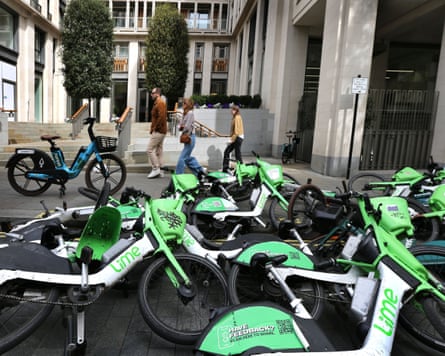
Much of the current focus is on so-called share bikes operated by companies such as Lime and Forest – nippy electric-assist machines that can be picked up and left on pavements. On Saturday, a Guardian investigation revealed that councils in the capital have so far this year seized 3,393 dangerously parked or abandoned ebikes, a number 23% higher than the total for the whole of last year.
Depending on your view, ebikes are either a gamechanging boon to short-distance urban transport or, if we heed the testimonies of those who have been menaced or injured, a dangerous and lawless scourge.
But even this misses the point. Outside the handful of urban areas where Lime and their competitors operate, the ebikes that exist are privately owned. And many of these are not, at least under the law, ebikes at all.
This can sound complex, but bear with me. To be classed as an ebike, a machine must have a powered speed limit of 15.5mph and a motor that only kicks in when you pedal, not via a throttle.
Wander around pretty much any UK town or city for long enough and you will see contraptions that very much do not meet these criteria. They might look broadly like a bike, with pedals and a chain. But they are often throttle-powered and can travel much, much faster than 15mph.
These are not ebikes. They are illegal electric motorbikes. This is a vital distinction to make before you start discussing ebikes, and whether they are, indeed, a brand new peril on our streets.
Now that we know where we are, how much, if at all, of the media scare stories about ebikes or their illegal cousins have a basis in fact? Again, it’s slightly more complex than it might seem.
If you hang around central London, it won’t take too long to see someone on a Lime bike sail serenely through a red light, sometimes weaving awkwardly through gaggles of pedestrians.
This is, of course, illegal, and for all that some cyclists try to justify such behaviour on self-preservation grounds, I’d also argue that it is selfish and intimidating. People should be able to cross the road at a green pedestrian signal without having to first scan the horizon for a beefy twentysomething called Josh on a Lime bike who is running late for his post-work five-a-side game.
But is there any need to panic? Not really. Cyclists are no different from drivers in that quite a few break the law if they think they can get away with it. One issue for cycling PR is that two-wheeled offences are often just more visible.
Government statistics show that when the traffic is flowing freely, fully three-quarters of drivers speed in 20mph zones. This is harder to spot, but the difference is that this sort of behaviour has a realistic chance of killing someone.
Very serious or fatal pedestrian casualties with legal bikes and ebikes do happen, but they are vanishingly rare, unlike incidents with motor vehicles. This is not a matter of morals, just physics – more specifically the way kinetic energy increases so rapidly as the inputs of mass and velocity change.
Some argue that riders of Lime-type bikes are disproportionately likely to flout the rules, in part because they are paying for the transport by the minute. I’m not sure that’s the case.
after newsletter promotion
Either way, it’s undeniable that, overall, share ebikes – in fact all legal ebikes – are a good thing. They make cycling available to demographics that would not normally consider using a bike, especially people without anywhere safe to store their own machine. Despite the occasional annoyance of the Josh contingent, I welcome them to the bike lanes.
It is a very different case for the illegal variants. These are often heavier – some are designed to look like motorbikes – and can go at significant speed. It’s not uncommon for me to be overtaken by a silent, moped-weight gizmo doing 30mph or more. I am, it is fair to say, not a fan of this.
This is, however, not a cycling problem. It’s a law-enforcement problem. It’s therefore also a political problem, not least whether or not any ministers are willing to crack down on a food-delivery industry heavily reliant on riders using illegal bikes.
But the repeated conflation of these two issues has ramifications for cycling. In part it is a call for restrictions on cycling because of offences by those speeding on illegal machines. And because illegal bikes often have vast, poorly made batteries with a tendency to catch fire, some rail companies are pondering bans on all ebikes.
The cycling world is changing quickly. And it is perfectly OK to be annoyed with the Lime bike buffoons. But do remember – they’re not the problem here.
-
Peter Walker is the Guardian’s senior political correspondent