2 months ago
108
2 months ago
108
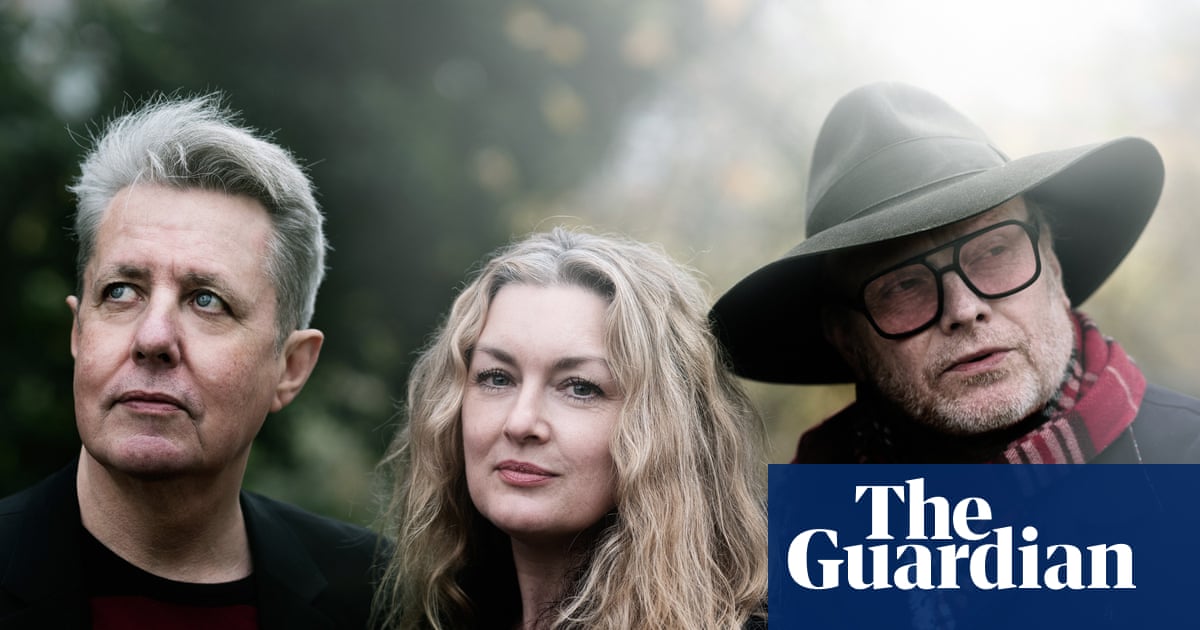
The beating heart of Sugar was always the sound of Bob Mould’s guitar: a colossal, metallic, thunderous thing, like a sonic boom you could whistle. “It was incredible, being engulfed by that wall of sound,” remembers bassist David Barbe from his office at the University of Georgia, weeks before the group are due to play their first shows in more than three decades. “Bob was so loud, there were times on stage when I could see Malcolm drumming, but I couldn’t actually hear him.”
“I didn’t wear earplugs when I started playing with Bob,” adds Malcolm Travis, the aforementioned drummer, from his home in Cape Cod, Massachusetts. “But soon afterwards, I did. It was just deafening.” And while everyone involved is 30 years older than the last time they played together, age has not withered them; anyone who’s caught Mould playing solo in recent years will attest that his guitar is still fearsomely loud.
Sugar didn’t merely deal in volume, however. Their 1992 debut, Copper Blue, put that noise in service of sculpted, melody-etched pop songs, securing critical plaudits and commercial success that had been hitherto unimaginable for an underground artist like Mould. But when Sugar dissolved three years later, he was left wrung-out by the intensity of this life-changing rollercoaster. As he says now, from his home in San Francisco, “There hadn’t been much time for reflection during the Sugar years.”
Mould had written Copper Blue’s songs in 1991, the same year Nirvana’s paradigm-shifting breakthrough pulled many of their alternative rock contemporaries and inspirations into the mainstream. But while Mould’s previous band Hüsker Dü had been a key influence on Nirvana, the crossover success enjoyed by fellow “godparents of grunge” such as Sonic Youth, Soundgarden and Dinosaur Jr seemed far from his grasp; he’d followed Hüsker Dü’s 1988 implosion with two modest-selling solo albums that had left him without a band, label or management. “I could feel this cultural groundswell coming, this great energy happening,” he remembers, “but I was on the edge of everything, not at the centre.”
Adrift, he nevertheless retained his faith in his songwriting, touring incessantly across Europe and the US accompanied only by his guitar, testing out new tunes before audiences. From Creation Records’ London offices, Mould collected a record deal from Alan McGee and a pre-release cassette of My Bloody Valentine’s Loveless. “I was mesmerised, just taking it in,” he remembers, of the album’s uncannily blissful noise-rock, which would profoundly influence his own forthcoming opus. “I hadn’t heard anyone get this sound so right in a long time.”
To accompany him on what he envisioned as his next solo album, Mould reached out to his friends, Travis and Barbe. “Bob and I listened to his demos, drinking coffee and chain-smoking cigarettes,” remembers Travis. “The songs were incredible.” Barbe agrees: “They crystalised the best aspects of everything he’d done: the melodicism of late-Hüsker Dü, the power of punk rock, the maturity of his solo albums … They sounded like a greatest hits.”
Mould soon realised these weren’t accompanists but bandmates, christening their new group while gazing at a sachet of the sweet stuff in a Waffle House in Athens, Georgia. Sugar then relocated to suburban Massachusetts to record the album, which ranged from lullabies to love songs, to darker and more ambitious tracks such as The Slim, a corrosive waltz Mould wrote “in the voice of someone widowed by Aids”. This keen balance of sweetness and substance yielded an anthemic, multifaceted masterpiece that inspired critical rapture upon release in September 1992. “We hit the ground running,” Mould remembers. “I didn’t really get to take my shoes off until September 1993.”
Constant touring and glowing reviews ultimately brought Mould his first Top 10 chart success in the UK, and when Copper Blue won NME’s 1992 album of the year award – which Barbe says was “like winning an Oscar” – MTV and US radio stations like KROQ playlisted the group. While the success was sweet vindication for Mould, he would not rest on his laurels, delivering Beaster, a 32-minute EP of new material “with religious themes and heavy imagery” that he wanted released at Easter 1993.
“Beaster was an emotional fever dream, all kinds of insanity at once,” Mould says of the six-song cycle that smashed together rock star messiah complexes and the dark underbelly of organised religion, yet reached No 3 in the UK. The root was “what the ‘moral majority’ had turned America into in the 1980s, and how that affected me as a young, closeted gay man; how the government ignored HIV and Aids for so many years, at the behest of the church.”
Mould’s homosexuality had been an open secret within punk circles. However, once Sugar’s star was ascendant, Barbe says he “could sense journalists fishing for the scoop, so they could be the one to ‘out’ Bob”. In 1994, Spin magazine sent the novelist Dennis Cooper to interview Mould, on the understanding, Mould said in 2008, “if I didn’t come out, they were going to out me”. The experience had been traumatic, but today he just shrugs. “Why didn’t I do it much sooner? I could have been of much greater use to my community. The only backlash I experienced was some radio stations in the deep south took Sugar off their playlists.”
But the episode was a wake-up call for Mould, that this post-Nirvana reality meant even bands like his were playing an unfamiliar celebrity game – that, as he says, “the innocence of 1992 was gone”. In March 1994, Sugar decamped to Triclops Studio in Georgia for their second full-length, but the vibes were off. Two other alt-rock second albums, Smashing Pumpkins’ Siamese Dream and Hole’s Live Through This, had recently been recorded there – both were triumphs, but the product of notoriously torturous sessions. Perhaps the place was cursed? Then, on 8 April, the in-studio TV the band left tuned to MTV delivered the news that Kurt Cobain had killed himself. Mould was distraught. “It was a good time to walk away for a bit. I pulled the plug, erased the tapes completely. There was nothing worth saving.”
Months later, Sugar took a second swing at their second album, File Under: Easy Listening. While strong, it was no Copper Blue II; Mould had written the first album over a year, “testing the songs out before audiences. I wrote this second one in three months, from within a mason jar instead of out in the field, and I could feel the pressure.” They toured the LP, but when Barbe said in early 1995 that he wanted to spend more time with his young children, a burnt-out Mould took the opportunity to call time on Sugar.
For the next three decades, Mould pursued a varied and successful solo career, Barbe produced albums by groups such as Deerhunter and Drive-by Truckers and taught at the University of Georgia, and Travis became a drummer for hire. Bad timing scuppered a few mooted reunions, until – after receiving a birthday video message from Mould – Travis told the bandleader that turning 70 had made him realise “the window was rapidly closing on a reunion. If we want to do this, we better do it now”.
And so the reunited Sugar are touring Europe and the US from May until October, having recorded two new tracks to commemorate the event. Mould, however, won’t be drawn on whether further Sugar music will follow; his focus is elsewhere. “My only thought in the 90s was to just ensure this thing could keep going,” he says. “This time, I’m just trying to enjoy it all, in a way I wasn’t able to the first time around.”
What’s for sure is, it’s bound to be loud – punishingly, electrifyingly so. Be sure to bring earplugs.
Sugar tour the UK from 23 May to 4 June; tour starts London.