2 months ago
131
2 months ago
131
Even by the standards of a band noted for their unhurried approach, Massive Attack’s recorded output has dwindled to a trickle in recent years. They’ve seldom been out of the press, but less as a result of their music than their political campaigning: frontman Robert Del Naja was among the 500 people arrested at last Saturday’s Palestine Action protest. It is six years since they last released any new music – a trio of YouTube videos on which their music effectively acted as a soundbed for spoken-word pieces about global system change – and a decade since they released something you could actually buy, a single called The Spoils. Their most recent album, Heligoland, came out in 2010: Taylor Swift was still a country star, Harry Styles was still at school, Instagram and TikTok had yet to be launched.
It means that any new release automatically carries a sense of event, particularly if you’re old enough to remember how significantly Massive Attack altered the musical landscape of the 90s. You could formulate an argument that their debut album, Blue Lines, was the single most influential British album of its era: it spawned an entire subgenre, trip-hop, in its wake; 35 years on, you can still hear its echoes everywhere, from the mainstream pop of Billie Eilish and Lana Del Rey to the nu-soul of Joy Crookes and Greentea Peng to the endless swathes of anonymous “lo-fi beats” that get millions of streams on Spotify.
Of course, it’s a very long time indeed since Massive Attack’s own music sounded remotely like Blue Lines: from the late 90s on, their sound broadly grew darker, more abstract and disquieting, more obviously influenced by spiky post-punk experimentalism than hip-hop or soul – particularly if Del Naja, rather than bandmate Grant Marshall, was piloting the music.
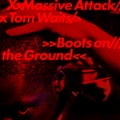
This is a state of affairs underlined by Boots on the Ground. Accompanied by a video featuring the work of a documentary photographer who posts on Instagram as thefinaleye – Black Lives Matter protests and the police response to them; ICE raids; homeless veterans – it lasts seven minutes. Almost three of them are consumed by a deeply disconcerting intro and coda consisting entirely of the sound of guest vocalist Tom Waits’s laboured breathing, as if he’s panting from exhaustion or gasping for air; there’s also an equally unsettling burst of complete silence five minutes in, which gives the impression the track is over.
Waits’s presence on Boots on the Ground underlines Massive Attack’s continued ability to attract blue-chip collaborators. Perhaps that’s something to do with the fact that, from early on in their career, they appeared to treat their guest vocalists less as stars making cameo appearances than genuine partners – Tracey Thorn’s presence on 1994’s Protection seemed to shape the sound of the whole song; something similar happened with Elizabeth Fraser on 1998’s Teardrop – and so it proves here.
Waits apparently submitted his vocal some years ago, but says in an accompanying quote, typically dark and droll: “Today, as in all of mankind’s yesterdays, guarantees this song will never go out of style.” His vocals are always unmistakeable, but his spirit seems to seep into the music: if the beat is a little more streamlined than you might find on his later work, it has an ungainly lurch and a hint of arhythmic clatter to it that wouldn’t be entirely out of place on one of his solo albums. A gently gloomy piano figure floats over it, and there’s a curious interlude where the rhythm is replaced by military snares and indistinct hymn-like vocals. But your attention is drawn by Waits’s voice – at its most Beefheartian here – and what he’s saying. Apparently sung from the viewpoint of a boorish, violent, unbound figure of authority – the type of aggressor and warmonger so emboldened of late – the lyrics veer between the surreal (“Big titties!”) and the distressing: “I killed a brown man … he choked on his spit and his face turned blue … he died right here, I got the pearl from his snout.”
Clearly, this isn’t a piece of music destined to elbow Massive Attack’s greatest hits – Teardrop, Safe from Harm, Unfinished Sympathy – from people’s affections: it is dark, disturbing, ominous, with a distinct streak of WTF? running through it. Which makes it music perfectly fitting for the times.