3 months ago
133
3 months ago
133
Around 2040, Australia will reach peak death. A silver tsunami of boomers are predicted to propel the annual death rate to double that of today, putting immense strain on the healthcare and deathcare systems.
Dr Hannah Gould – a death scholar and author of the book How to Die in the 21st Century – calls it “boomergeddon”, and says it brings with it a certain range of ideas about what a good death looks like.
“The overwhelming value of end-of-life decisions, particularly among the baby boomer population, is this value of right, autonomy and control,” she says.
Choreographing end of life – from bespoke aged care solutions and medical interventions to prolong quality of life to one-of-a-kind burials - is increasingly possible if you have the resources. The idea of trying to wield total control over our final act, however, gives Gould, who lectures in Buddhist Studies at the University of Melbourne, the heebie-jeebies.
“It’s very different to how previous generations have seen death and it might be quite different to how millennials will see death. I’m a millennial, and it doesn’t strike me that control is a value that I’ve ever had a part of.
“I don’t think millennials think they’ve got enough resources to be in control of anything.”
The welfare of death workers
As a small child, Gould held her breath when the family drove past cemeteries, but later became interested in comparative religion and religiosity and wound up specialising in religious materiality – in particular, altars to family ancestors and to Buddha – while doing her Masters at Oxford University.
She further became credentialed in death by becoming a member of the “dead dad club” when she was 23. That got her considering what people regard as a “good death” and a “bad death”.
“Classifying that whole complicated experience as ‘bad’ enrages me just about as much as when people said he ‘lost his battle with cancer’,” she writes.
Now she’s the go-to person for questions about death from journalists and dinner party guests alike. Gould say she doesn’t resent the questions, which are as varied as “Do I really get my person’s remains back from the crematorium” and “Will I ever stop crying over my dead pet?” (“No”).
As she says, “People never get the chance to ask about death, so once they get over the initial shock, they do love asking me. I’m happy to have conversations with taxi drivers and people in a bar and at the dog park – if I can be brave enough to tell them what I do.
“Sometimes, I’m just like, ‘I study something’.”
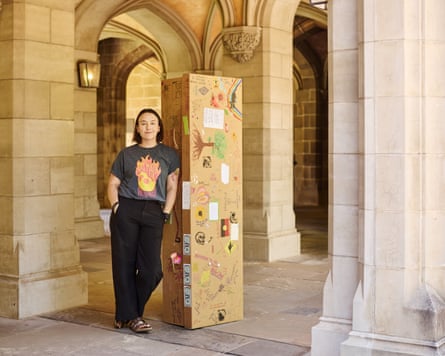
For those not immediately dealing with death, their questions might be along the lines of the more spectacular ways that a person can be sent off – increasingly it’s seeming as though the sky’s the limit, particularly if you have the means to be fired into space in a rocket. Personalisation of funerals is the No 1 trend Gould is seeing, with the most common desire being a return to nature.
“I always hear, ‘Can’t you just put me into a nice meadow and put a sapling on top of me?’” Gould says. “But you will kill that tree. And also, where is this meadow?
“The idea of what a green death [is] is often quite naïve. It’s not informed by good knowledge about what deathcare actually looks like, and it’s certainly often not informed by compassion about people who work in deathcare.”
While working on her PhD, Gould had stints working at a crematorium and at funeral homes, so she’s a strong advocate for the welfare of death workers – something to be considered when making your creative demands of being wrapped into a shroud, planted, or buried at sea. Research has suggested that increasingly elaborate funeral demands carry with them increased worker hazards, particularly psychosocial ones.
As people’s expectations of what they should be able to demand in death is expanding, independent providers are rushing to meet that trend. Body disposal options are broadening. Gould worries that the media excitedly reports on new technologies, without any factchecking of their environmental claims.
“There are a lot of promises made,” she says.
“The problem is that it’s an unequal knowledge relationship. People assume they’re regulated. People assume that there are health and safety checks. People assume that these processes are legalised.”
One tip for everyone
But while technology and options in death are expanding, Gould says we remain, as a society, averse to talking and thinking about dying. A case in point is AI grief companions and AI-assisted advance care planning.
“I think this further entrenches this idea of us being afraid of death, like we can’t even have this conversation with another human being,” she cautions.
“More fundamentally, it robs people of being carers. The experience of confronting mortality through caring for someone who’s dying and talking to a loved one about death is a very human experience, and you are giving that job to a robot.”
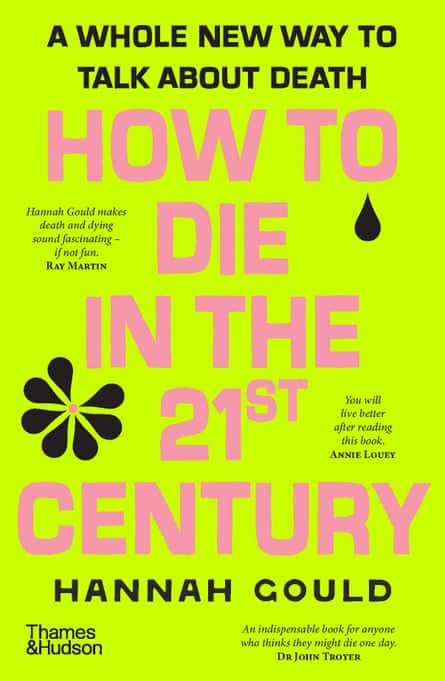
How to die in the 21st Century contains six lessons in mortality – on contemplating, dying, disposing, celebrating, grief and memorialisation. Yet even as the book’s author, as someone who works in the death sector, Gould admits she hasn’t done much death admin of her own (“No one does; it’s the funniest thing. I have a will.”).
She does recommend one action we should take immediately, even if we don’t plan on dying any time soon.
“Know who your legal next of kin is,” she says. “If you have a problem with that person making your decisions, change that person. It often happens with young queer people who maybe have a contentious relationship with their parents. And I say to them, ‘Well, if you were to die, it’s your mum and dad who will be organising the funeral.’ Or maybe it’s your ex-husband, because you’re still technically legally married.”
Gould thinks it’s important to advocate for our wishes – but also, of course, to communicate them. “It doesn’t have to be a big, scary conversation. It can be a Post-It note on the fridge.
“I’m ‘the death person’ now, but when my mum had to get quite minor heart surgery I made her email both my brother and I a paragraph: if it is the case that I can’t do X,Y and Z, I don’t want to be here. I want this kind of thing for my funeral. I want this to happen to my remains. Okay, love you, bye.”
How to Die in the 21st Century is published by Thames & Hudson Australia on March 3.