4 hours ago
7
4 hours ago
7
A couple of weeks ago, I was walking through the streets of Vilnius, on my way to give a talk on geopolitics to a group of visiting Austrian business and academic leaders. It was a pleasant spring day: people were out and about, cafe tables were set outside – all the familiar tranquillity of a European capital that has grown used to talking about war in theory, but not to expecting it overhead.
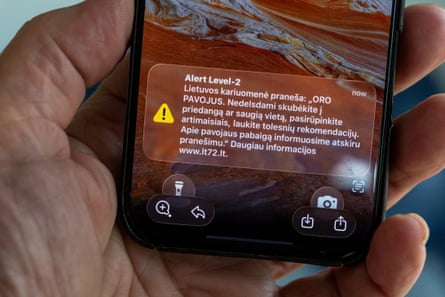
Then an alarm blasted from my phone. Not a polite notification. Lithuania’s emergency alert system is designed to be impossible to ignore. The first message warned of a possible drone threat. The next was sharper: air danger – seek shelter.
I kept walking, working my contacts in government, trying to understand how real the threat was, where the drone might be, and whether Vilnius was actually at risk. Around me, the mood shifted. People did not panic (Lithuanians rarely do), but faces tightened. Some walked faster while others carried on after a glance at their screens.
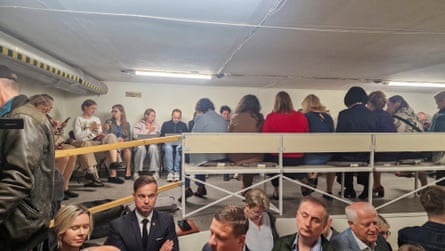
Still, for the first time in our modern history, we all suddenly needed to take shelter. When I reached my destination, the meeting had been moved from a conference room to the cellar of a local library. It was cramped with the Austrian guests I was supposed to brief, and with local Lithuanians who had found the same place as a shelter. So I began my lecture on geopolitics underground not as a metaphor, but as a fact.
The working assumption about what triggered the alert is that a Ukrainian drone, aimed at Russian military or energy infrastructure, was diverted and crossed into Lithuanian airspace. It did not hit anything, and it has not been found. But that ambiguity is precisely the problem. The drone was simultaneously an accident, a warning and a possible test. The next one could be another accident – or a deliberate Russian provocation.
Nothing suggests that Russia directly attacked Lithuania. Recent Ukrainian drones targeting Russian military and energy sites have crossed into or near Baltic and Finnish airspace, reportedly after Russian electronic warfare diverted them. But Moscow can still exploit the confusion: even a Ukrainian drone can serve Russia’s purpose if it spreads fear in a Nato city. Since March, drones have exploded in Latvia and been shot down over Estonia. Recently, a Russian-made Geran-2 drone, launched during an attack on Ukraine, hit an apartment block in Romania and injured two civilians, including a child.
That is the new reality on Nato’s eastern flank. The war is in Ukraine, but its sparks fly far beyond the border.
Russia is upping the pressure because it has reasons to be worried. Ukraine’s long-range drone campaign is becoming more effective. Its war machine runs on oil revenue and manpower, and both are under pressure. GCHQ director Anne Keast-Butler recently said new intelligence showed that almost half a million Russian soldiers had been killed since the start of the war. Western estimates also suggest Russia is losing about 30,000 killed and wounded a month, a rate that is already exceeding recruitment.
A wounded Kremlin is more likely to test us, and make democracies think that helping Ukraine brings the war home. This is precisely the trap Nato must avoid.
Drone threats are not limited to Nato’s eastern borders: they should worry London, Washington, Berlin and Paris as much as Vilnius, Riga or Tallinn. The area is not a distant frontier, and drone range is no longer limited to Russia’s immediate neighbours. But there is a larger lesson too. As long as Russia’s brutality in Ukraine continues, Europe cannot be 100% safe. We cannot insulate ourselves from this war by pretending it is happening somewhere else.
The Baltics understand this. We have lived for years under Russian intimidation: cyber-attacks, disinformation, GPS jamming, sabotage scares, undersea cable incidents. The Centre for Strategic and International Studies (CSIS) has found that Russian attacks in Europe nearly tripled from 2023 to 2024, after quadrupling the previous year. Lithuania’s own regulator says Russia has expanded GPS spoofing from Kaliningrad so dramatically that false signals can now reach up to 450km into Europe.
**And yet, we have learned to live under pressure without being paralysed by it. In 2026, Lithuania is spending 5.38% of GDP on defence – the highest level in Nato – even if this means difficult choices elsewhere in the budget. Citizens are also joining the Lithuanian riflemen’s union, a voluntary, state-supported civic defence organisation whose membership has grown by about a third since 2024. The economy, too, has adapted and grew by 2.7% in 2025, almost twice the EU average of 1.5%. That is the lesson for the rest of Nato: pressure can be turned into constructive action and results.
At the approaching Nato summit in Ankara, one practical additional step would be to turn Baltic air policing into a genuine air defence mission: not merely patrolling the skies but detecting, tracking and, where necessary, neutralising threats. Russia will watch closely whether Nato’s response is credible or hesitant. Any weakness will be read as an invitation to further provocations.
During the drone incident, my Austrian guests listened more closely than audiences usually do. In the library’s basement, it could have been that my points about Russian threats no longer needed much explanation – or perhaps they resonated because Austria, although an EU member state, remains non-aligned on defence, and has traditionally been more inclined to treat Russia as a partner to be managed, rather than a threat to be deterred. But this is not about us, the Baltics, lecturing the rest of Europe. It is about sharing our practical experience, which should be treated as a lesson in the west’s self-interest.
-
Linas Kojala is CEO of the Geopolitics and Security Studies Center, a Vilnius-based thinktank