3 months ago
167
3 months ago
167
Amanda Barry was rummaging for something in her mother’s loft when she came across her father’s trunk. Delving beneath the old blankets, she uncovered a trove of photographs, letters and journals that would set her on his trail, all the way to the Antarctic.
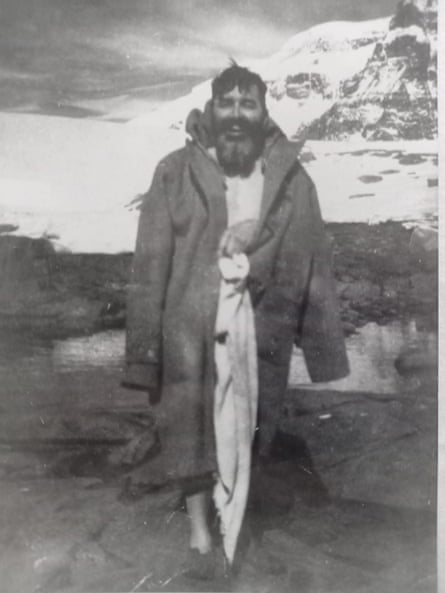
Barry’s father, George, had died suddenly after a heart attack when she was nine. Her mother had kept alive the sense of him; his pipes and cigarettes were still in a drawer of the sideboard. Like her four older siblings, Barry owned a photograph, taken at Port Lockroy in Antarctica, where in 1948 he was base leader. “He always wanted to go back,” she says. “I remember thinking, ‘Well, Dad, I’m going to go. For you and for me.’”
But the Antarctic is not the easiest place to get to.
Barry, 63, who grew up in Essex, had worked as a publicist for video games after her A-levels. Following a stint with Lynne Franks PR, she built her own public relations company, specialising in environmental issues.
“I never had children, and the people who worked for me were like my chicks … It was very fulfilling,” she says. And exhausting.
In her 30s, around the time she was exploring her mother’s loft, Barry was asked to write a business book, and found herself wrestling with an unexpected decision. “I thought: ‘I’m going to close my business … I’m going to get off this hamster wheel and take time out.’”
She wrote the book, freelanced as a publicist, fell in love and got married. She contacted the British Antarctic Survey and asked to visit its archive. “I would really like to go to Port Lockroy, where my father was,” Barry told the head of personnel. He informed her that to work for the Survey, she would need a science degree.
It had always niggled Barry that she had never been to university. In her 50s, she enrolled with the Open University, graduating in environmental science.
Barry volunteered to lead walking tours and to help out at the local museum in Ullapool, north-west Scotland, where she now lives – all with a view to strengthening a future application to work in the Antarctic. She trained as a coach, often working with women “who are going through life transitions”.
The Port Lockroy base is now overseen by UK Antarctic Heritage Trust, which each spring recruits a new Antarctic team; no science degree is necessary. Barry applied – and was offered a two-month stint as museum manager in Port Lockroy.
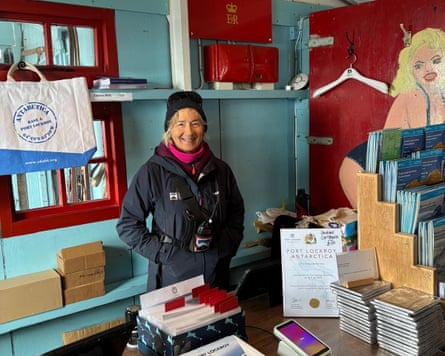
Last November, she flew to Ushuaia, Patagonia, and from there joined a cruise ship that was travelling to the Antarctic. A rib boat took her to Port Lockroy, on Goudier Island. “The island is tiny. The size of a football pitch. It was snowy. There were lots of gentoo penguins. No slipway. We sort of clambered ashore.”
“I’d imagined stepping on to the rocks, and I’d imagined my father stepping off,” she says, as if they were shadows passing. After unpacking in the Nissen hut, which she shared with five co-workers, Barry slipped away to Bransfield House – the original hut where her dad had lived, and now the museum.
“The first time I walked in, I saw his picture on the wall,” she says. “I cried, of course. It was such a magical thing.”
A long-treasured photo of her father showed him bearded and wrapped in a coat after a swim, a mountain behind him. During her stay, she searched for the beach. One day, she held up the picture of him, flipped it – and realised she was in the right place. “I stood on that spot where he had stood. And, oh, it was amazing,” she says.
Barry returned to Scotland in January and is still processing her trip. “It has given me more confidence, and the knowledge that I’m resilient … You’re living in a small space. There’s a mixed bunk room with people you don’t really know. There’s nowhere to go.” No running water, a camping toilet.
After a career of having to look and dress the right way, it was liberating to shower irregularly – by boarding a passing cruise ship – and give presentations in a woolly hat.
Did she feel her father was with her? “I did,” she says. “I really did.
“When you’ve lost a parent when you’re young, you’re always hankering, always searching for that connection. I think I’m always wanting to fill that gap. And I never can. But going there was the closest I’ll ever get to it.”