3 months ago
175
3 months ago
175
When news came that the US defence secretary, Pete Hegseth, would be travelling to Normandy to mark D-day, some in the seaside village of Langrune-sur-Mer – where the afternoon ceremony was slated to be held – felt they had to speak up.
“We found it unbelievable that they could send someone who held views and values contrary to democracy, human rights, peace and Europe,” said resident Chantal Richard. To her, the incongruence felt deeply personal. “We grew up going to D-day ceremonies, some of us had grandparents or parents whose lives were affected by this war.”
The view led Richard and the 40 or so other members of Langrune en Commun, a residents’ association, to sign a 179-word statement. Published days before the 82nd anniversary of the D-day landings, it called for Hegseth’s visit to be cancelled.
“The honour of Langrune, that of France and the memory of the young allied soldiers – American, British and Canadian – who died on our beaches in the name of democracy demand that this individual’s visit be cancelled,” it said.
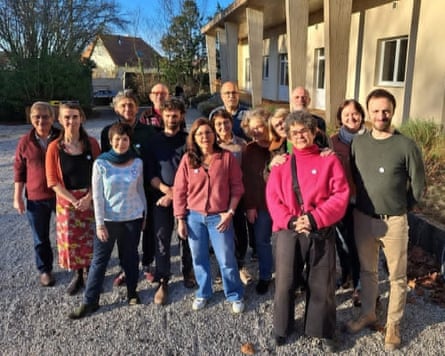
Few in the association, which seeks to foster solidarity among residents and promotes environmentalism, expected it to have much of an impact. Preparations had long been under way to transform the village of about 2,000 people into the international host of the ceremony; the flagpoles had been carefully erected, the podium was in place and more than 400 high-ranking officials from across the globe were set to arrive in the village.
For the association, however, the hope was to have people reflect on the deeper meaning of the D-day anniversary, said member Julia Breen. “We celebrate it as a historical moment, but what does war mean today? What does it mean that we are safe but there are people being bombed right now?”
The short statement took on new life after Hegseth sparked global condemnation for using his D-day speech to condemn immigration. The villagers’ protest soon went viral, with media around the world taking note of their singular effort to stand up to the US defence secretary.
“It snowballed into something that we honestly did not expect at all,” said Richard. In the days since, the association’s website has been inundated with hundreds of emails from across the world. “We’ve been getting messages, mostly from the US, from people saying: ‘Thank you for speaking out, we support you,’’’ said Richard.
Some of the dispatches have been particularly moving, such as the one they received from a US veteran of the second world war, said Breen. “He told us: ‘I’m going to get a bottle of French wine and I’m going to toast to your health because you’re defending the values we fought for.’”
It was a reversal from the mixed reaction they had received after publishing the statement. At the time, some in the village, including elected officials, accused them of exaggerating about Hegseth and seeking to turn the wartime liberation of Europe into a political affair, said Richard.
The concerns about the association were seemingly unfounded, Richard added. “The person who turned the commemoration into a major political issue wasn’t Langrune en Commun but Pete Hegseth,” she said. “He didn’t come to celebrate freedom, democracy and peace, he came to push his far-right, anti-immigrant and warmongering rhetoric.”
Hours before the ceremony in Langrune-sur-Mer was set to take place, Hegseth spoke at the US military cemetery in Colleville-sur-Mer. Against the stark backdrop of rows of white crosses, he told those gathered that Europe was facing a different “invasion” of its shores.
“Sadly, today, different European beaches are stormed by different, dangerous ideologies,” he said, in remarks that prompted a prominent historian to accuse him of “grotesque stupidity”.
It was Hegseth’s only public appearance of the day. He had earlier told organisers that he would not be attending the afternoon ceremony in Langrune-sur-Mer but did not provide a reason for his absence.
In Normandy, the Socialist party group in the regional council noted that it had only taken a few hours for the villagers to be proven right. It described the remarks as a “desecration” in a statement to newspaper Ouest France. “The men buried in Colleville did not die so that we could close off beaches; they died to liberate a continent from an ideology based on the hierarchy of human beings and racism. To distort their sacrifice into an argument for hatred is to betray their commitment.”
In the US, Republican House member Michael McCaul described Hegseth’s remarks as “inappropriate” in an interview with broadcaster ABC News. “There’s a time and a place for these issues of immigration. That was not the day, not the anniversary of D-day. I think out of respect to the veterans, and myself being the son of a D-day veteran, those remarks were out of place.”
The criticism extended to Langrune-sur-Mer, where Breen described the remarks as “absurd, contradictory, nonsensical, and racist”. For Richard, it was a sign that the association had been right to speak up, even if they had been the only ones to do so.
“I think our statement helped people to come out from the woodwork,” Richard said. “If it gave others the courage to speak up and say that they think the same, that they’re not OK with the ideology of the Trump government, that’s a good thing.”
The sentiment was echoed by Breen, who said she was proud to be part of an association that had emerged as a small “point of resistance” against those who had looked to protocol as a reason to remain silent in the face of someone who “promotes rhetoric that is bellicose, racist, supremacist and imperialist”.
She was swift to add, however, that what they had done in Langrune-sur-Mer was far from extreme. “It’s crazy that resistance today is just about reminding the world of its values,” she said. “And that doing so seems like a radical stance.”