3 months ago
179
3 months ago
179
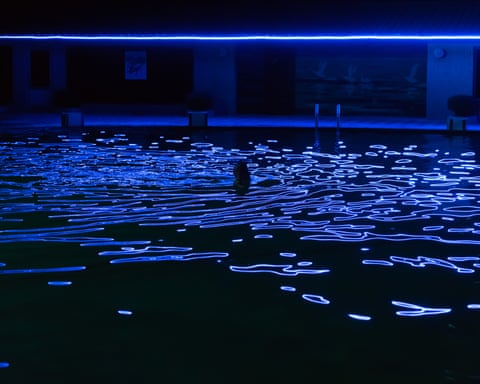
From Hong Kong to Cairo, New York to Kyiv, the world is caught up in confrontations with authoritarian power. Matthew Connors’ new photo book tells the story
‘Suddenly anything is possible’ … Night Swim, Pyongyang, 2016Wed 20 May 2026 08.00 CEST
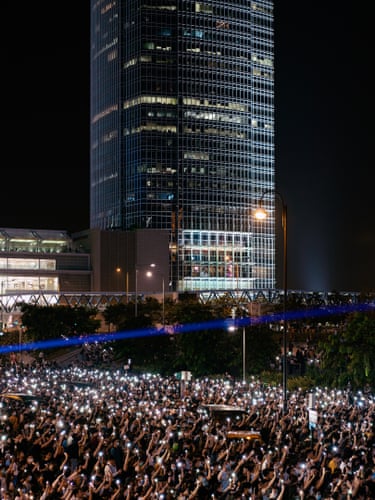
Edinburgh Place, Hong Kong, 2019
The Axe Will Survive the Master is a distillation of 12 years of work across multiple continents. Protests in America, the pro-democracy movement in Hong Kong and the war in Ukraine are the main anchor points, but the book also includes pictures from Egypt, North Korea, Cuba and other places around the world where social contracts have been under duress. It’s an oblique record of life on a faltering planet, tracing the contours of an era shaped by confrontations with authoritarian power. The Axe Will Survive the Master is published by MACK Books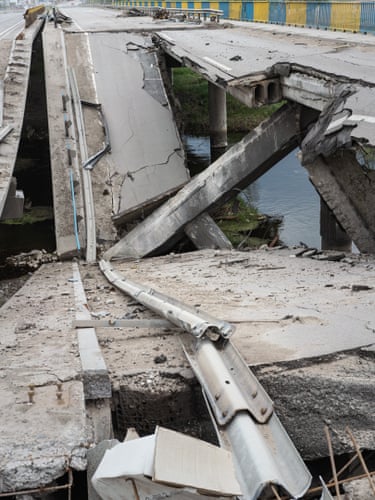
Bridge, Kyiv, 2022
Matthew Connors: ‘This book completes a trilogy that began with General Assembly (2013) and Fire in Cairo (2015). Where each of those earlier publications was rooted in a single context – the Occupy movement and the Egyptian revolution – this one weaves multiple situations together into a single sequence. It charts an escalatory pattern across these contexts: collective assembly, revolutionary upheaval, totalitarian control, surveillance repression and outright war. Each is a different register of the same fundamental struggle’
Night Swim, Pyongyang, 2016
‘Underlying all these contexts is a condition Mark Fisher described in Capitalist Realism – the sense that the existing order has foreclosed our capacity to imagine alternatives. He wrote that even glimmers of alternative political and economic possibilities can have a disproportionately great effect. From a situation in which nothing can happen, suddenly anything is possible again. I was searching for those glimmers; the places where the cancellation of the future was momentarily breached and another way of being came into view’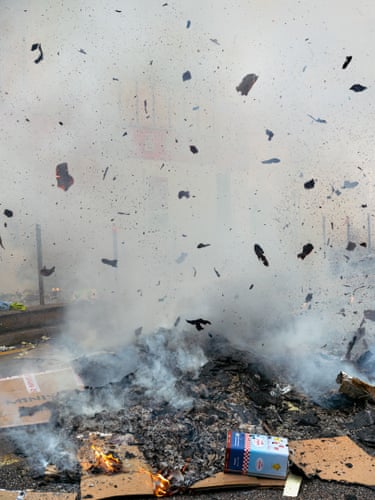
Vortex, Hong Kong, 2019
‘This book emerged from the ashes of several other book projects I was building up simultaneously, each rooted in a specific geography: Ukraine, America, Hong Kong, North Korea. I had enough material to make a book out of each, but the results felt flat and predictable. I began to sense there was something more interesting in thinking about my vantage point across all these contexts’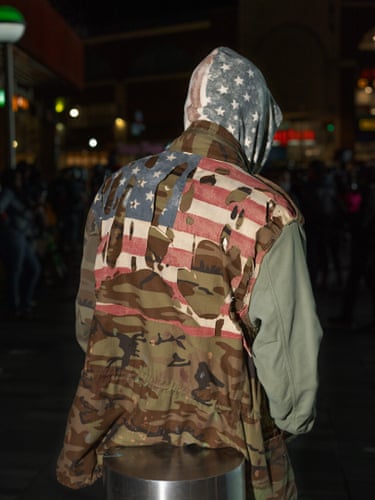
Flags, New York City, 2020
‘The challenge was to bring all of this material together – drawing from an archive of 200,000 images – into a single sequence that dissolves geographic boundaries. Images from across the world arrive without caption or marker, resisting organisation into separate categories. The political forces the book depicts aren’t geographically bounded. They’re systemic and interconnected’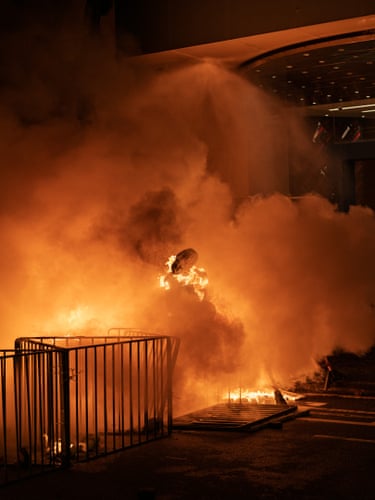
Barricade, Hong Kong, 2019
‘In each context, I set out to photograph political realities – what happens when governments and their citizens come into conflict. I was also attempting to reckon with the role American foreign policy had in these dynamics abroad. It usually began with an obsession I couldn’t shake, a sense that I needed to engage with unfolding events, fuelled by a mixture of anger, curiosity and hope. I had a palpable sense that there were limits to what I could understand without being present’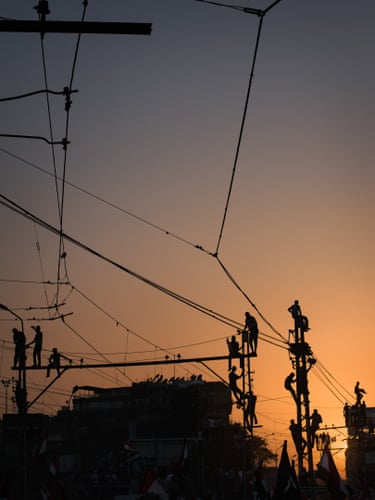
Al-Ahram Street, Cairo, 2013
‘The starting point for me has always been to just show up – with openness and humility. I’m not an expert in geopolitics or organised dissent, I try to find the ideas in my encounters. I don’t work with assistants, fixers or drivers. I don’t seek special access or embedded arrangements. Sometimes I work for volunteer groups which helps me get oriented, but I try to spend as much time as I can wandering alone to get a sense of the rhythm of a place. This affords me the time and space to make mistakes and calibrate myself to emerging ruptures in the status quo’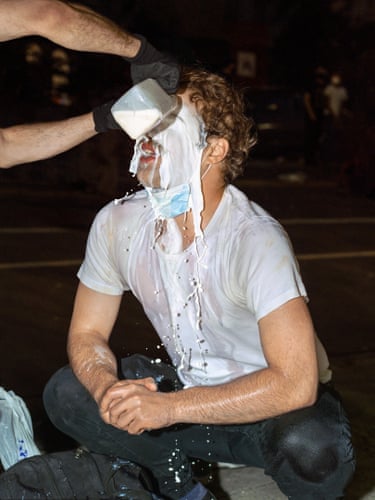
Milk, New York City, 2020
‘I photographed these events to better understand them, though I don’t expect the pictures to be a form of explanation to others. Devoid of documentary scaffolding – captions, essays – the book instead includes fiction I wrote. There is a short story in the first-person plural which speaks from inside the condition the photographs have been circling – a collective hallucination with the texture of lived experience but no stable geography, positioning the pictures without explanation. In other words: I was not speaking about, but speaking nearby’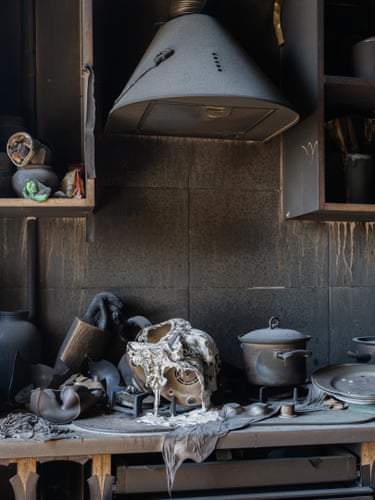
Kitchen, Borodyanka, 2022
‘The title of the book is from Svetlana Alexievich’s Secondhand Time. It is a phrase spoken by a former Soviet security officer who was involved in executing political prisoners. It alludes to how authoritarian oppression corrupts the fabric of society itself. I chose it because I wanted to resist framing our predicament as simply a fight against any single leader or regime. To escape the endless struggle between survival and mastery, we would be better served attending to that deeper degradation than indulging in our obsession with charismatic tyrants’
Projection 5, Hong Kong, 2019
The work encapsulates a lot of changes in the world and in myself. Since I started these images 13 years ago, I’ve ridden multiple waves of idealism and disillusionment. The book reflects a lot of competing feelings, but I consider it to end on a hopeful note. The coda is a run of images showing laser lights Hong Kong protesters were shining against a building in the Central Government Complex. I see this as a counterpoint to Albert Speer’s monumental Cathedral of Light in Nuremberg, suggesting a path forward through spontaneous acts of collective creativityExplore more on these topics