3 months ago
117
3 months ago
117
An Austrian mountaineer has said he is “endlessly sorry” his girlfriend froze to death on a joint climb to the country’s highest peak, but denied criminal wrongdoing as his trial began in Innsbruck.
The 37-year-old defendant, identified only as Thomas P, gave evidence on the first day of the high-profile proceedings over the tragedy on Großglockner, in a case that could shape international standards for liability in mountain sports.
During emotional testimony, Thomas P told the judge he was not guilty of the charge of gross negligent manslaughter for the death by hypothermia of his 33-year-old partner, Kerstin G, whom he is accused of wrongfully abandoning near the summit.
He said he wanted it to be known “that I am endlessly sorry about what happened, and how it happened” on the morning of 19 January 2025, local media reported from the courtroom.
“I loved Kerstin and didn’t want anything to happen to her.”
Großglockner is the tallest mountain in the Alps east of the Brenner Pass, at a height of nearly 3,800 metres above sea level.
Prosecutors say Kerstin G’s boyfriend left her “defenceless, exhausted, hypothermic and disoriented” about 50 metres from the summit while he scrambled to get help, after a series of errors that would prove catastrophic.
The prosecution argues that Thomas P, as the far more experienced alpinist, was in effect the guide on the two-person tour and therefore bore responsibility for the safety of them both.
They say his fateful mistakes included insufficient planning, clothing and equipment, a failure to turn back despite hostile weather conditions with icy winds of up to 74km/h, and a decision not to alert rescue teams to their plight as soon as it became apparent during the night.
If convicted, the defendant faces three years’ imprisonment.
Thomas P told the court his partner was also an enthusiastic mountain climber and physically very fit. “We always planned the tour together and took decisions jointly,” he said, reportedly contradicting previous statements to police in which he described himself as taking the lead in organising the trek. “I did not lead the tour so was not in the lead role.”
He added that the adverse conditions, in which the wind chill plunged to –20C, had taken them by surprise.
Thomas P said: “The wind down below was almost nonexistent, only picking up at higher altitudes. It was impossible to predict how the wind would be in the upper reaches of the Glockner.”
Asked why he did not call emergency services before he went to seek help at about 2am, he replied: “It was an absolutely exceptional situation. Kerstin had no strength left, so I secured her to the rock with a rope and then climbed down.”
When he returned to her, apparently having had second thoughts about leaving her alone, he said she shouted to him: “Go, go on your own and save your own life.”
Kerstin G’s body was recovered after daybreak.
The defence lawyer read out a letter from Kerstin G’s parents, which he said disputed a perception that she had been a victim.
“Our daughter takes responsibility for her own actions, we can’t blame her boyfriend,” they wrote. “She did mountain runs and summited mountains far more difficult than this one.”
However, the prosecution cited a message from Kerstin G to Thomas P 12 weeks before her death, saying the climb would be a challenge for her: “‘I completely lack experience when it comes to winter tours.”
The defence lawyer said problems began at about 8.15pm when a rope got caught, costing the couple a precious 90 minutes, after which Kerstin G injured her hand.
He said his client failed to send a distress call to a rescue helicopter because his girlfriend’s condition only dramatically worsened after it had flown away. He said a viral infection could have played a role in debilitating her.
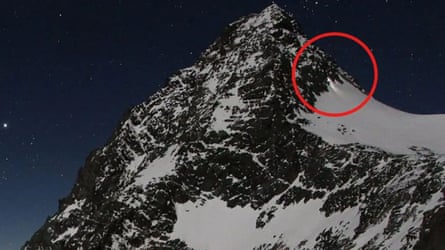
Kerstin G’s death made global headlines last year, also because webcam images captured the couple’s climb. Thomas P faced accusations on social media that associates described as a “witch-hunt”.
The judge hearing the case specialises in mountaineering. He is expected to take the testimony of two Alpine experts as well as more than a dozen witnesses, including mountain rescuers.
About 8,400 accidents occur in Austria’s mountains each year in which nearly 300 people die. But the cases rarely lead to criminal proceedings.
The court’s ruling is widely expected to set a legal precedent far beyond Austria’s borders.