3 months ago
110
3 months ago
110
When the NFL announced in September that Bad Bunny would perform at the Super Bowl half-time show, the immediate expectation was that Benito Antonio Martínez Ocasio would Make a Statement.
There was, of course, backlash from the people who think a performance in Spanish is un-American (all while Puerto Rico remains a US territory). But there was also criticism from those who argued that, post-Kaepernick, there is no performance on an NFL stage that could meaningfully challenge the power whose invitation into its center of capital and nationalism these artists accepted. And as we’ve reached peak Bad Bunny this week, Puerto Ricans have pointed out that many fans’ investment in the island ends with the artist.
Still, 2025’s Debí Tirar Más Fotos was the monumental latest entry in Bad Bunny’s documentation of Puerto Rican struggle. Its sober caution against the erosion of a Puerto Rico for Puerto Ricans amid foreign tax incentives and mass economic displacement; its honoring of Afro-Puerto Rican modes of musical storytelling and resistance in bomba and plena; its 31-show residency at el Coliseo de Puerto Rico in lieu of an international tour brought millions into the island’s economy. All of it was in solemn devotion to never compromising his land, identity or history.
The Super Bowl half-time show is inherently about compromise. But as he kicked off the Benito Bowl, somehow, Benito’s biggest compromise seemed to be the amount of words bleeped out of his verse.
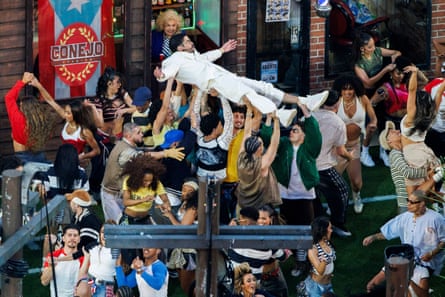
A young man carrying a Puerto Rican flag before a sea of sugarcane opened with a benediction for all of us: “Qué rico es ser Latino. Hoy se bebe,” (“How sweet it is to be Latino. Today we drink”) echoing Benito’s unquestionably most unbroadcastable song (more on this in a moment).
Dressed in white like everyone else – and in a gorgeous bespoke Ocasio jersey-suit-jacket emblazoned with his mother’s birth year, 1964 – Benito proved many Kalshi betters correct with Titi Me Preguntó, the blueprint of Benito’s many-girlfriended persona.
Around him, he’s built an entire ecosystem of community: los viejos playing dominos, street vendors selling coco frío, piraguas, and tacos (sold by Los Angeles’s actual Villa’s Tacos), boxers Xander Zayas and Emiliano Vargas in the fight, a man proposing to his girlfriend just as the femme-forward Yo Perreo Sola starts. “Las mujeres en el mundo entero,” he says, “perreando sin miedo”. (“The women in the whole world, perreando without fear.”) Behind him, at la casita he built in the image of a house on the island, is a yearbook of stars, including but certainly not limited to: Karol G, Pedro Pascal, Cardi B, Jessica Alba, Young Miko, and Alix Earle.
Those with little imagination might have thought Safaera, YHLQMDLG’s hardest, dirtiest perreo, would be impossible to execute. Instead, Benito highlighted the song’s many, many bleeps and a notoriously FCC-unfriendly line.
Just when this couldn’t get rowdier, Benito falls through the roof into la casita, disoriented as a mix of reggaetón’s all-time heaviest unfolds, among them Tego Calderón’s Pa’ Que Retozen, Don Omar’s Dale Don, and obviously, Daddy Yankee’s Gasolina, then joined by his own ultraheavy EoO. The show at large is a dizzying reminder of the many pantheons of Puerto Rican legends – in reggaetón, in salsa, in jíbaro music – that Benito is succeeding and never letting history forget.
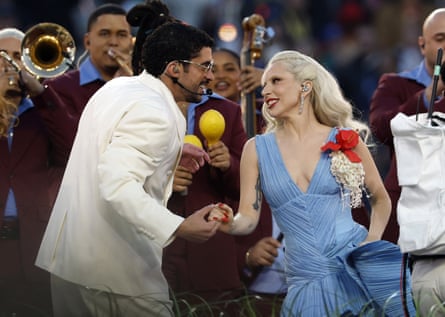
Lady Gaga was not among the most popular guesses for Bad Bunny half-time show guests, but even Die With a Smile is a good time when Gaga and Los Sobrinos salsafy it at a literal wedding onstage before Benito joins her for a beautiful Baile Inolvidable, Latine boda style, sleeping kid on a chair and all.
Later in the performance, Ricky Martin would sing the hell out of every le lo lai in Lo que le pasó a Hawaii. But my favorite celebrity sighting came on Nuevayol, amid a reconstruction of a beautiful block of barbershops and bodegas: la santa madre of Williamsburg herself, Toñita in all her rings, in a replica of her Caribbean Social Club, which has resisted developer displacement since 1974 and remains the spot for the community to grab full plates of food and $3 Medallas.
Benito delivered on his music’s promise of displaying the reality of Puerto Rican life: in a stunning performance of El Apagón, Benito runs the light-blue flag of Puerto Rican independence across the field, as performers on power lines evoke the frequent blackouts on the island as a result of its decaying energy infrastructure. This somber reminder shifts quickly to the jubilant call-and-response of Café Con Ron as Benito is joined by Los Pleneros de la Cresta.
“God bless America,” Benito proclaims as he progresses to the finish, promptly naming Chile, Argentina, and all of South and Central America and the Caribbean before finishing with the United States, Canada and Puerto Rico. “Seguimos aquí,” (“We’re still here”) he closes, spiking a football that says: “Together, we are America.”
Elsewhere in the performance, Benito handed a young boy watching his Grammys speech on television an award of his own (last week, Debí Tirar Más Fotos won album of the year, the first predominantly Spanish-language album to do so). But earlier in the broadcast, he opened his first acceptance speech with the simplest statement he could make right now amid the ongoing occupation of Minneapolis by Immigration and Customs Enforcement (ICE) agents. “Before I say thanks to God, I’m going to say … ICE out,” he said, the first in the broadcast, to a roar of applause. “We’re not savage, we’re not animals, we’re not aliens. We are humans, and we are Americans.” In September, he acknowledged that the potential of immigration enforcement at his concerts factored into his decision not to tour the mainland US.
Baked into the politics of Debí Tirar Más Fotos is the immutable condition that Puerto Rico cannot be subsumed into the United States or Americanness; across his discography, he has highlighted the dispossession of Caribbean identity, labor, and jerga (slang) that comes when the American imagination tries to absorb, or blur out of focus, its cultures.
This isn’t Benito’s first time performing at the half-time show. In 2020, he was a guest of Jennifer Lopez and Shakira at Super Bowl LIV in Miami; the performance was at best a defiant celebration of two Latina giants of the 21st century, and with its protest element attributed to the cages dotting the field around them, made a show of Latine oppression at worst. Where did that conversation lead us? And for whose benefit?
A lot of violent realities for our communities continue outside. The Super Bowl will never televise the revolution. But this year, Benito reminded so many of us of the love, the community and the absolute joy that we create together every day in spite of everything else.