9 hours ago
11
9 hours ago
11
Every year, as summer draws to a close and fall begins, California’s bears get hungry.
Black bears have long roamed the state, hunting for acorns, ants and pine nuts by the bucketload to pack on calories before hibernation. But increasingly, for every berry and root, there’s an even greater temptation: our trash and the detritus of human existence.
That dynamic is playing out in perhaps a surprising place: Los Angeles. As communities on the outskirts of the metropolis grow, bears are butting up against humanity, drawn to residents’ pools, their chicken coops, their fruit trees and trashcans.
“Black bears are incredibly adaptable, versatile omnivores,” said Wilson Sherman, a PhD student at the University of California, Los Angeles, who studies human-wildlife interaction. “They can eat everything we can eat.”
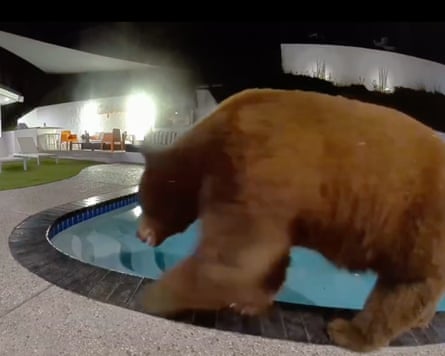
Human-bear interactions have increased since the 1990s, Sherman said, which makes sense as communities expand and the state is now home to some 50,000 to 70,000 black bears. A few hundred of those live in the Angeles national forest, just north of the city and its millions of hungry households.
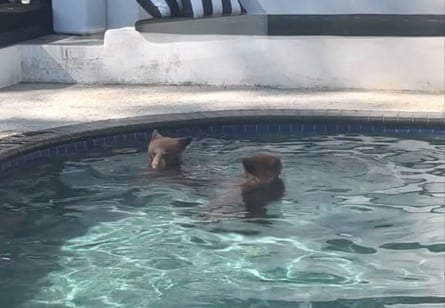
Brian Gordon and his partner moved to the state’s bear capital – Monrovia, California – four years ago. Their house is the last before the Angeles national forest begins, and as they were buying the home, a family of bears wandered through the back garden. It was the start of a new era of coexistence.
Now, the pair regularly share their pool with a family of bears and document their exploits on an Instagram account called PoolBearLife. Videos show bear cubs with their snouts bubbling in the water, climbing – and falling from – trees and causing adorable, young bear mayhem.
“I only had education up until I bought this house of bears from whatever I saw online. I actually thought people get eaten by bears a lot,” Gordon said. “But after we bought the house, we had bears walking through. That’s really all they’re doing. I realized, OK, I have an unnatural fear of these animals and we’ve kind of adapted to living around them.
“People will say ‘you guys are the bear experts,’” Gordon went on. “No, we’re city boys. We bought a house that happened to have bears.”
Gordon and his partner live amongst the bears, but they’re also vocal advocates for doing so safely. Trashcans are kept clean, temptations are removed and, despite the filming, they give the bears their space. Sometimes mistakes are made and a bear finds a case of beer in the garage.
But with consideration, bears don’t even stop to sniff the trash cans and will just pass through the backyard like it’s an extension of the forest nearby, the couple said.
In a perfect world, Sherman said, human dominated landscapes that buttress the natural world would take steps to minimize bear contact. That means making neighborhoods as unattractive to bears as possible.
“Pet food left outside, koi ponds, fruit trees with a lot of fruit on them, swimming pools, all these things can be attractive to bears,” he said.
It’s not that human food tastes better, it’s just much more calorie dense and therefore easier for bears to pack on the pounds. In fact, bears that live or forage near human environments tend to reproduce more often and at higher rates, likely due to the availability of our food.
“It takes a lot of work to get the calories from, say, a half eaten pizza in the trash in equivalent calories from acorns and ants,” he said. “It makes sense to get calories from human food.”
The other major factor is climate crisis. Warmer summers can alter the availability of natural food and force bears to expand their ranges. Major wildfires like the 2025 Eaton and Palisades fires were also linked to a lack in natural food sources, prompting the bears near Los Angeles to search in neighborhoods instead.
Alex Heeran, a research scientist at the California department of fish and wildlife who studies the human dimensions of wildlife encounters, said human and bear interactions generally peak every year in late summer and early fall. September is often a really active month as black bears finish up their pre-hibernation hungry period, known as hyperphagia. 2026 is on track to be a record-setting year when it comes to reported bear encounters, Heeran said.
It’s also a time when humans are out in force around Labor Day for the year’s final picnics and camping excursions. Fish and wildlife officials will often get reports of bears creating a nuisance and occasionally damaging fences, getting into sheds and making a mess as they look for calories.
“The bear’s just looking for food, doing natural behavior, but it’s creating a situation that’s not ideal,” Heeran said. “A lot of the conflict can be prevented.”
Sometimes, however, that conflict can escalate, which can result in a bear being euthanized or relocated. It’s rare and wildlife officials try and prevent situations from escalating to that point, but it happens.
Earlier this year, the city of Monrovia erupted in fury after a mother bear known as “Blondie” was euthanized. Officials had determined she had swiped at local residents twice, causing minor injuries. She had two cubs at the time. They are now being raised in captivity until they can hopefully be released back into the wild.
Residents rallied for an alternative plan, but that effort ultimately turned into a memorial walk through the city in Blondie’s honor.
“The city was not a part of that conversation or decision,” Becky Shevlin, the mayor of the city, which is peppered with monuments to black bears, told the Los Angeles Times in March. “We were absolutely devastated, especially when you think about her having the two little cubs.”
Sherman said the spread of bear footage on social media, many of it captured by doorbell cameras that have exploded in the last decade, is a double-edged sword. On the one hand, people get to see bears being bears, doing cute things.
“Bears are really cute, and a lot of the things they do are really cute … This is a real way to build meaningful empathy for wildlife, and building empathy for wildlife is a powerful motivator for conservation actions,” he said. “There is this risk of … kind of Disney-fying them. Black bears are by nature not particularly aggressive unless they are put in a dangerous or threatening situation, but they can cause damage. It’s best to give them their space.”
As September draws to a close, interactions between bears and Angelenos will thin out for the season. But residents of the city will have to contend with their neighbors again come spring, alongside the mountain lions, deer and coyotes that call the city’s outskirts home.
“When people move to these foothill neighborhoods, a lot of people are moving in because they think it’s a suburb of LA. But they’re not necessarily thinking they’re going to have bears in their back yard,” Sherman said. “At first it can be really scary, but the people I’ve spoken to generally become accustomed to them.”
“Bears are super likable and this population of bears wouldn’t be there if people didn’t like bears so much.”