2 months ago
90
2 months ago
90
The Bull by Paulus Potter is one of the star paintings at the Mauritshuis in The Hague, a bucolic image of animals and a farmer.
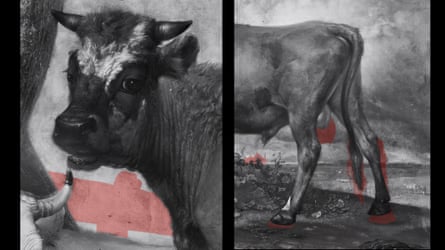
But new research suggests the painting has unexpected hidden depths: conservators restoring the artwork say the bull’s testicles were originally much larger, and appeared to have been halved in size by the artist to respect 17th-century sensibilities.
“We found that Potter made lots of changes as he worked,” said Abbie Vandivere, a paintings conservator at the museum. “[The bull’s] balls were bigger and lower, his whole back end was shifted – but, indeed, the balls are the biggest change.”
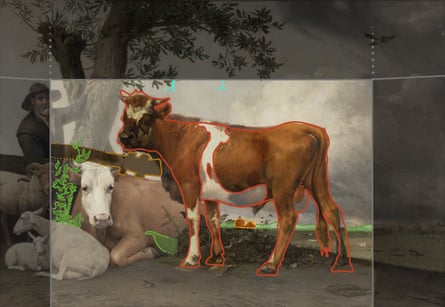
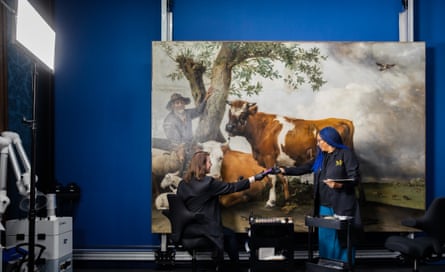
The surprise emerged when a team of conservators, who have been working for 18 months to restore the painting, made X-rays to understand how Potter created his composition of farming life. Looking at his preparatory sketches of cattle and consulting cattle experts, they found there were indeed contemporary breeds with “giant, pendulous testicles”.
While Potter may have made the changes to portray a younger bull, the working theory is that the naked truth was considered unfit for polite society in 1647. Another of his works, an etching now in the Rijksmuseum entitled Pissing Cow and commissioned for the mantelpiece of a Princess of Orange at around the same time, was rejected for being too smutty.
“He had an etching of a pissing cow that created a bit of a controversy,” said Jolijn Schilder, a paintings conservator. “It is assumed that he got the order from Amalia van Solms, Princess of Orange, and he was supposed to create a piece for one of the palaces. It was turned down by her because she thought it was too filthy a subject to show a pissing cow above her mantelpiece.”
The research on The Bull is part of a broader effort to find out more about Potter, who died in 1654 at just 28 from tuberculosis. When the Netherlands became a vassal state of France in the late 18th century and William V fled to England, 192 of his artworks were looted by Napoleonic troops, with The Bull considered one of the gems.
“It was taken to Paris and was immediately very popular, because it’s extraordinary that Potter, a 17th-century artist from the Netherlands, painted a cow on a lifesize scale, which was normally only for kings, emperors, biblical and historical scenes,” said Schilder. “The fact that the Dutch did a simple cow, without any further meaning to it, really struck the French. They loved it.”
According to research by a Mauritshuis senior curator, Quentin Buvelot, after Napoleon’s defeat at the Battle of Waterloo, the Dutch demanded the return of paintings including The Bull – but when troops turned up at the Louvre in 1815, “the French tried to prevent this by removing all the higher ladders”.
The 236cm x 339cm (93in x 133in) masterpiece was eventually returned in triumphal procession and Potter’s farmer character for years featured in Dutch phonics teaching material for schoolchildren.
The Mauritshuis has a display on the completed restoration process, which was conducted behind a glass box in a public gallery. But although the scans of the first bull are on display, his full glory is modestly hidden under Potter’s final layer of paint.